IgG Dog Reduced Jupiter C4 300
LC Conditions
Column
Jupiter 5 µm C4 300 Å, LC Column 150 x 2 mm, Ea
Brand
Jupiter
Part No
00F-4167-B0
Phase Name
C4
Elution Type
Gradient
Mobile Phase
A: 0.1% TFA in Water/Acetonitrile (95:5)
B: 0.085%TFA in Acetonitrile/IPA/Water (75:20:5)
Gradient Profile
Step No.
Time(min)
%A
%B
1
0
80
20
2
20
5
95
Flow Rate
0.25 mL/min
Temperature
22°C
Detection
UV-Vis Abs.-Diode Array (PDA) @ (22°C)
Detection Info
Sample Notes
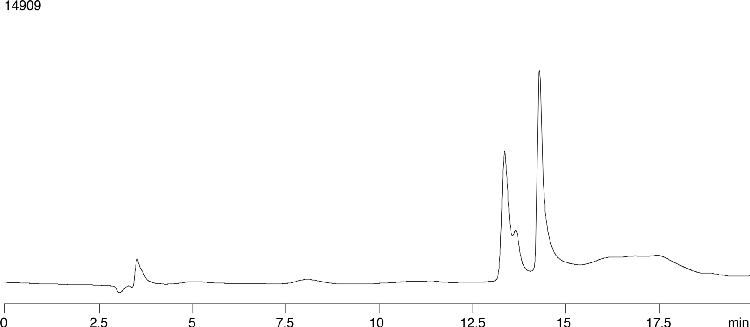
Application Focus: Reducing antibodies to separate heavy and light chains by Jupiter C4 While using IPA in the organic mobile phase can help improve the chromatography of Ig-G, often the best way to observed changes in immunoglobins is by reducing the proteins and separating the heavy and light chain of the protein and analyzing them by HPLC on a Jupiter C4 column. Key to get complete reduction of a protein is to perform the reduction in a chaotrope (either urea or guanidine) to unfold the protein thus breaking up any non-covalent interactions. Upon incubation with DTT, BME or some other reducing reagent, Ig-G heavy and light chains are released and can by separated by HPLC. In this example, dog Ig-G was reduced with 2 mM dithiothreitol in 8 M Urea at 45º C for 30 minutes. In this example dog Ig-G was reduced with dithiothreitol and injected on a Jupiter 300 C4 column. As shown in App ID# 14909, one can see the heavy and light chains are baseline resolved using the conditions discussed in length in App ID#14908 (20% IPA in the organic mobile phase and elevated temperature). These results demonstrate the ability of the Jupiter 300 C4 to resolve differences between large hydrophobic proteins for demanding applications such as the separation of immunoglobulin proteins.
Order Items Used in This Application
- 1. IgG
Similar Applications
No Similar applications found.