Zebron ZB-WAXplus GC Columns

100% Aqueous Stability for Polar Compounds
- 100% aqueous stable, excellent for aqueous samples; bonded and solvent rinseable
- Extremely inert for acidic compounds
- Enhanced selectivity for low boiling solvents; high retention of alcohols and chlorinated solvents
- Increased efficiency at 20 °C
Need a G43 phase for residual solvents testing? See ZB-624.
Testing free fatty acids? See ZB-FFAP.
Recommended Applications
Alcohols, Aldehydes, Aromatics, Essential Oils, Flavors & Fragrances, Free Fatty Acids, Glycols, OVIs, Pharmaceuticals, Solvents / Residual Solvents, Styrene, Xylene Isomers

Order
Overview
Upgrade to Zebron from any polyethylene glycol phase:
Zebron ZB WAXPLUS GC Column
WAX columns from different manufacturers are not always created equal!
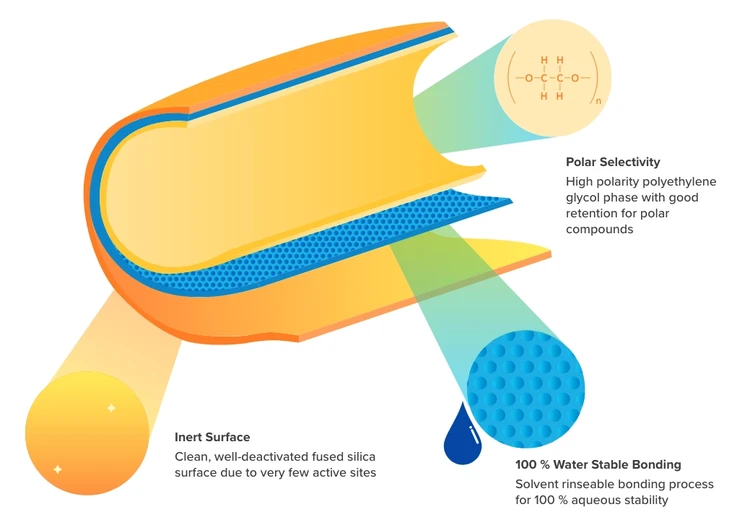
As part of the Zebron PLUS GC column family, ZB-WAXPLUS is manufactured using improved technologies that reflect our attention to detail every aspect of a ZB-WAXPLUS column’s anatomy is meticulously engineered and individually tested for unprecedented performance.
Water Reproducibility of ZB-WAXPLUS
Historically, polyethylene glycol (PEG) phases have been unstable with aqueous samples such as beverages or glycols, resulting in poor reproducibility and decreased lifetime. The ZB-WAXplus bonding procedure results in exceptional stability to repeated injections of aqueous matrices.
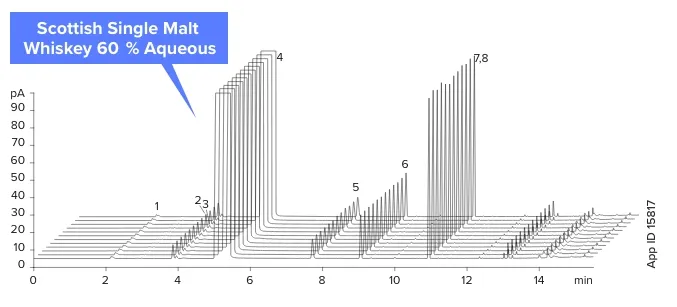
Reproducibility and Stability Test
Sample:
- Acetaldehyde
- Ethyl Acetate
- Methanol
- Ethanol
- Propanol
- Isobutanol
- 2-Methylbutanol
- 3-Methylbutanol
ZB-WAXPLUS provides optimal selectivity for many aqueous soluble compounds such as those found in alcoholic beverages or glycol samples. The ZB WAXPLUS bonding process results in exceptional stability to repeated injections of aqueous matrices like whiskey. Multiple or routine water injections will not alter the efficiency or polarity of the phase over time.
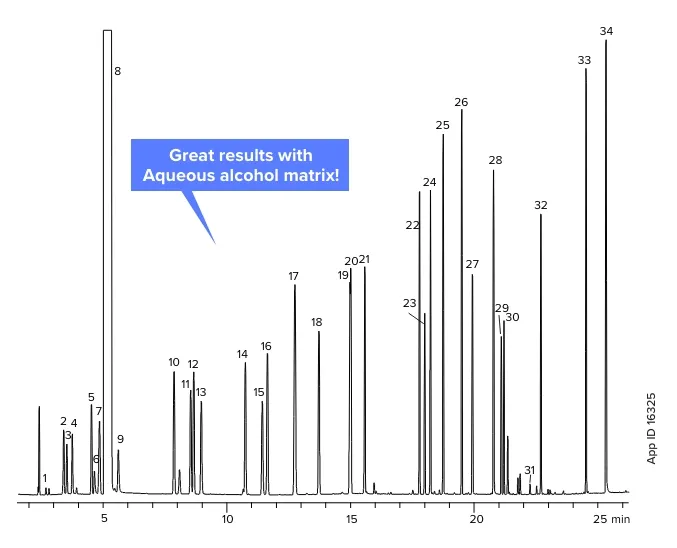
Distilled Alcohol Standard by Neat Injection on GC-FID
chloride
Sample:
1. Acetaldehyde
2. Isobutanal
3. Ethyl formate
4. Acrolein
5. Ethyl acetate
6. Acetal
7. Methanol
8. Methylene chloride
9. Ethanol
10. Isobutyl acetate
11. 2-Butanol
12. Ethyl butyrate
13. 1-Propanol
14. Isobutanol
15. Allyl alcohol
16. Isoamyl acetate
17. 1-Butanol
Sample
18. 4-Methyl-2-pentanol
19. Methyl-2-butanol
20. Methyl-3-butanol
21. Ethyl caproate
22. Ethyl heptanoate
23. Ethyl lactate
24. Hexanol
25. cis-3-Hexenol
26. Ethyl caprylate
27. Furfural
28. Benzaldehyde
29. Linalool
30. Linalyl acetate
31. Ethyl caprate
32. Diethyl succinate
33. Ethyl laurate
34. 2-Phenyl ethanol
Don’t Despair – There’s a Solution!
Low column activity is essential to achieving good quantitation and sensitivity. Whether you are analyzing aldehydes, acids, or pharmaceutical compounds the ZB-WAXPLUS provides the highest level of deactivation possible.
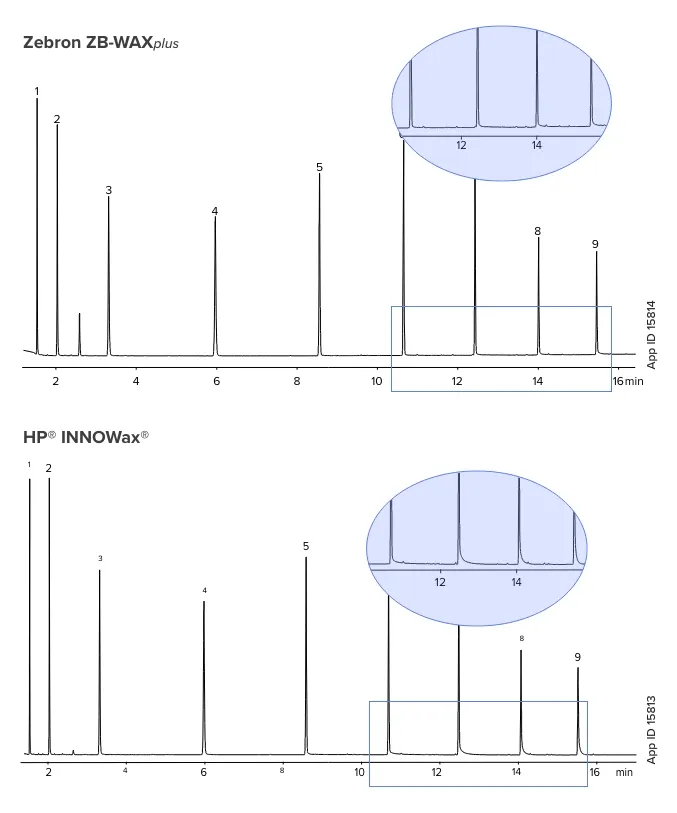
Conditions same for both columns:
Sample:
- Propanal
- Butanal
- Pentanal
- Hexanal
- Heptanal
- Octanal
- Nonanal
- Decanal
- Undecanal
Holds Up To Tough Conditions
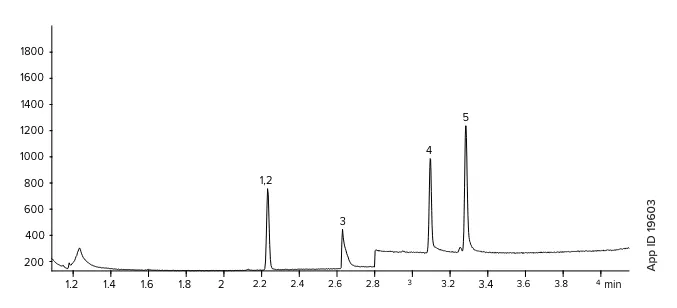
In addition to inertness, ZB-WAXPLUS columns maintain good performance with difficult matrices and contaminants! The example below shows good results with glycols from seawater, despite the salt and other contaminants commonly found in this matrix.
Glycols From Seawater By GC-MS
Analytical Procedure
Sample Preparation
8B-S123-HCH
(basified with ~25 µL of NH4OH)
GC/MS Conditions
Sample:
Analytes were extracted from seawater (1 mL load @ 5 ppm)
- D4-2-Butoxyethanol (IS)
- 2-Butoxyethanol
- Formic acid (from elution)
- Propylene glycol
- Ethylene glycol (IS)
Improve Resolution
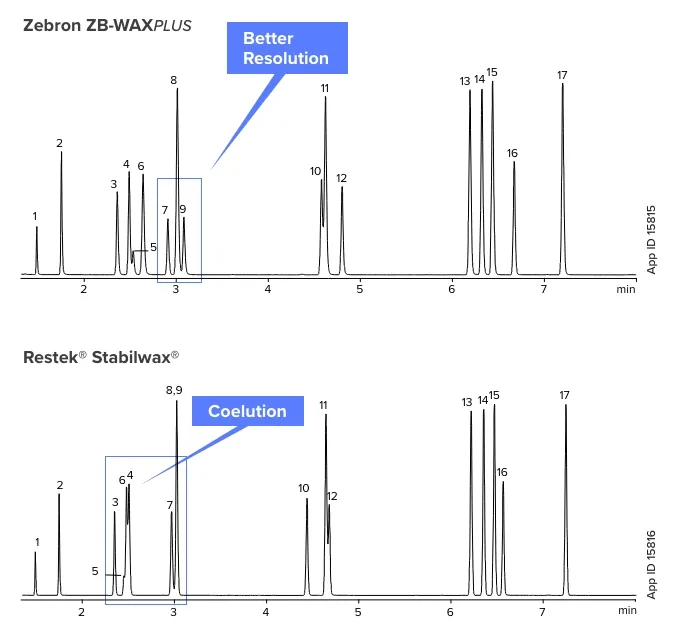
Conditions same for both columns:
Sample:
- Methyl Formate
- Acetone
- Ethyl Acetate
- Methyl Ethyl Ketone
- Methanol
- 2-Methyl-2-propanol
- Methylene Chloride
- Benzene
- Ethanol
- 2-Butanol
- Toluene
- n-Propanol
- Ethyl Benzene
- p-Xylene
- m-Xylene
- 1-Butanol
- o-Xylene
Faster analysis
ZB-WAXPLUS™ columns provide high efficiency with stable selectivity in a range of dimensions, so you can easily optimize your column dimensions and run up to 65 % faster.
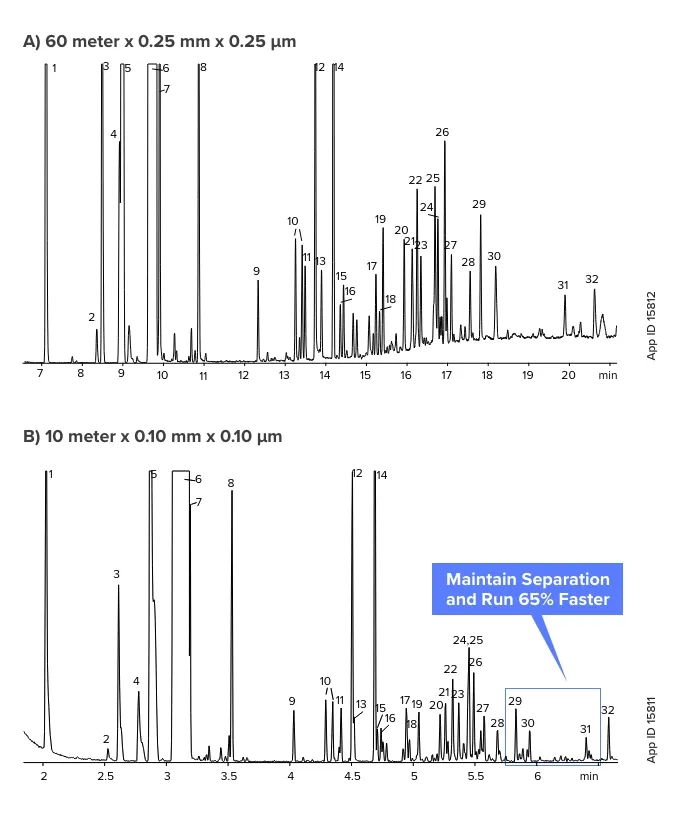
Conditions same for both columns:
B) 7CB-G013-02
B) Split 20:1 @ 220 °C, 0.2 μL
B) Helium @ 0.3 mL/min (constant flow)
A) 40 °C for 0.2 min to 210 °C @ 10 °C/min for 10 min
B) 35 °C for 1 min to 250 °C @ 30 °C/min for 5 min
Sample:
1. α-Pinene
2. β-Pinene
3. Sabinene
4. 3-Carene
5. β-Myrcene
6. Limonene
7. β-Phellandrene
8. Octanal
9. Nonanal
10. Limonene Oxides
11. Citronellal
12. Decanal
13. α-Cubebene
14. Linalool
15. β-Cubebene
16. Octanol
18. Caryophyllene
19. trans-p-Mentha-2,8-dienol
20. cis-p-Mentha-2,8-dienol
21. Gerenial
22. α-Terpineol
23. Dodecanal
24. Valencene
25. Citral
26. Carvone
27. Cadinene
28. Perillaldehyde
29. trans-Carveol
30. cis-Carveol
31. Perillol
32. Octanoic acid