
Micro LC Columns
What Are Micro LC Columns?
Micro LC columns deliver high-sensitivity separations with reduced solvent use and strong MS compatibility, ideal for proteomics, metabolomics, and other trace-level analyses. These liquid chromatography columns feature a small internal diameter, designed for efficient separations at microliter-per-minute flow rates. They typically range from 0.15 to 0.5 mm in diameter and operate at 1–50 µL/min. This smaller scale reduces sample requirements and enhances compatibility with MS ionization sources, improving sensitivity. Positioned between conventional LC and nano LC, micro LC offers an optimal balance of robustness, sensitivity, and throughput.
Phenomenex Micro LC Column Technologies
Phenomenex offers a full range of particle morphologies, including core-shell, fully porous, and thermally modified fully porous particles, available in silica and organo-silica compositions. These options combine the high efficiencies of core-shell and thermally modified particles with material versatility, enabling tailored chemical properties for specific analytical requirements. Within in these compositions, silica provides high mechanical strength and predictable surface chemistry, while organo-silica offers extended pH stability and compatibility with aggressive mobile phases.
Our micro columns feature hardware and surface chemistries engineered to ensure reliable performance and are available in 0.5 mm, 0.3 mm, and the new 0.15 mm internal diameters (IDs), supporting flow rates in the microliter-per-minute range for enhanced sensitivity and seamless MS integration.
Shop Micro LC Columns by Format
Achieve High Sensitivity and Efficiency with Phenomenex Micro LC Solutions. Delivering precision and performance for low-flow applications. Discover our complete lineup of micro LC columns designed for different flow requirements.
Browse Micro LC Columns
Core-Shell

Thermally Modified Fully Porous Silica


In addition to Micro LC solutions, Phenomenex also offers Nano LC columns for specialized applications. Our Biozen Nano LC columns are designed for high-sensitivity biomolecule separations and are particularly suited for omics workflows such as proteomics and metabolomics. These columns leverage advanced particle technology and innovative hardware to deliver superior performance, reproducibility, and ease of use.
Explore the full range of Biozen Nano phases to find your ideal column.
Why Choose Phenomenex Micro LC Columns?
Phenomenex Micro Low Flow Columns Offer:
High Sensitivity and Resolution
Micro LC columns are designed to provide high sensitivity and resolution, which is essential for analyzing small sample volumes and detecting low-abundance analytes. The reduced column diameter increases the sensitivity of mass spectrometry detection, making micro LC an excellent choice for proteomics, metabolomics, and other omics studies. With our new 0.15 mm column IDs, the smaller ID further improves to sensitivity and is available in Kinetex C18 and XB-C18 for a variety of reversed phase applications.
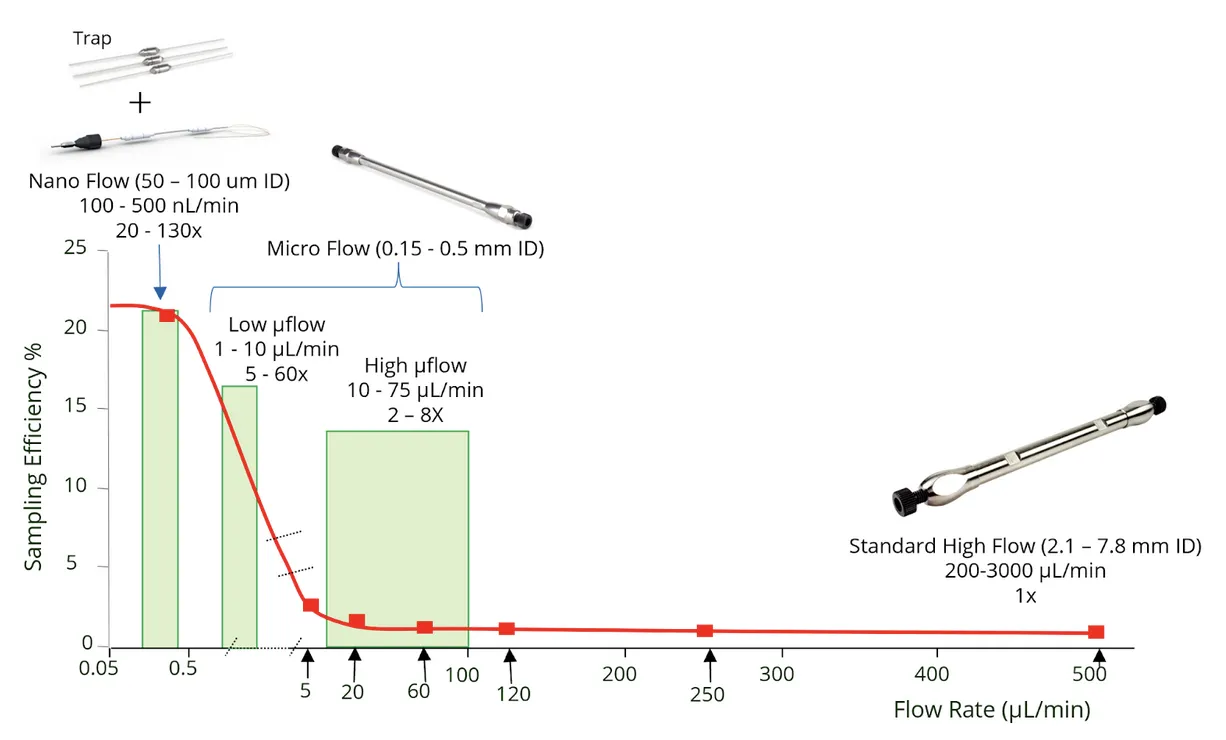
Reduced Solvent Consumption
The smaller internal diameter of micro LC columns leads to reduced solvent consumption, which is both cost-effective and environmentally friendly. This is particularly beneficial for laboratories looking to minimize their ecological footprint and operational costs.
Compatibility and Versatility
Phenomenex micro LC columns are compatible with a wide range of LC systems and can be used for various applications, including pharmaceuticals, environmental analysis, food and beverage testing, and more. Their versatility makes them an invaluable tool for diverse analytical needs.
Robust and Reproducible Performance
Engineered with precision, our micro LC columns offer robust and reproducible performance, ensuring consistent results across multiple runs. This reliability is critical for method development and routine analysis, providing confidence in your analytical data. Additionally, our new micro trap formats offer new solutions with integrated fittings that offer complementary selectivity.
Particle Technologies Available
Utilizing Phenomenex micro HPLC columns for analytical separations results in high sensitivity and efficient separations, available in a wide range of particle chemistries and column formats.
| New .15 µm Micro Columns | 50 x 0.15 mm | 150 x 0.15 mm |
| Kinetex EVO C18 | 00B-4725-AG | 00F-4725-AG |
| Kinetex XB-C18 | 00B-4496-AG | 00F-4496-AG |
| New Micro Trap Columns | 10 x 0.15 mm | 10 x 0.3 mm | 10 x 0.5 mm |
| Micro Trap Column C18 | 06N-4252-AG | 06N-4252-AC | 06N-4252-AF |
| Micro Trap Column PS | 06N-4753-AG | 06N-4753-AC | |
| Micro Trap Column Polar | 06N-4754-AG | 06N-4754-AC | 06N-4754-AF |
| Micro Trap Column Widepore C4 | 06N-4167-AC |
Choosing the Right Micro LC Column
Define the Application and Matrix
Start by identifying your analysis type and sample composition.
- Proteomics and Peptides: Require high sensitivity and narrow peak widths ideal for 0.15 mm ID columns.
- Metabolomics and Small Molecules: Benefit from 0.3 mm ID formats for balanced robustness and resolution.
- Complex Matrices (e.g., biological, environmental): Use trap-and-elute setups to improve recovery and protect the analytical column.
Select the Internal Diameter (ID) Based on Sensitivity and System Capability
- 0.15 mm: Provides maximum MS sensitivity with precise low-flow control.
- 0.3 mm: Offers balanced performance between sensitivity and robustness.
- 0.5 mm: Allows higher sample loading and easier handling on standard LC systems.
Choose Phase Chemistry by Analyte Polarity and Structure
Match stationary phase chemistry to analyte behavior:
- XB-C18 / EVO C18: Broad reversed-phase coverage and excellent stability for complex biological samples.
- Polar C18 / PS-C18: Ideal for polar analytes and mixed-mode separations.
- F5 / Biphenyl: Recommended for isomeric or aromatic compound selectivity (where available).
Incorporate a Micro Trap for Complex or Diluted Samples
When dealing with diluted samples or challenging matrices, integrate a micro trap before the analytical column. Selecting a trap phase with complementary selectivity enhances recovery and overall analytical performance.
Optimize Flow and System Setup During Transition
When transitioning from 2.1 mm ID columns to micro LC formats, maintain similar linear velocities by proportionally reducing flow rates and injection volumes. Minimize extra-column volume including tubing and fittings to preserve efficiency at low µL/min flows.
Related Resources and Support


FAQs
When should I use micro LC over standard LC?
Use micro LC when sample volume is limited or when high sensitivity is required especially in proteomics, metabolomics, and trace-level analysis.
What flow rates are typically used with Micro LC Columns?
Flow rates for micro LC columns generally range from 1 to 10 µL/min, depending on the column ID and system backpressure.
What is the typical lifespan of a Micro LC Column?
With proper care and filtration, a micro LC column typically lasts between 300–500 injections, depending on sample cleanliness and operating pressure.
What is the difference between micro LC and nano LC?
Micro LC operates at higher flow rates (1–10 µL/min) and column IDs (0.15–0.5 mm) compared to nano LC (≤1 µL/min, ≤0.1 mm ID), offering a balance of sensitivity, robustness and sample throughput.
How do I prevent clogging in Micro LC Columns?
Use well-filtered samples, guard columns, and appropriate solvents. Avoid abrupt pressure changes and flush the column regularly after runs.