Aggregate Analysis of a Bispecific Antibody

Authors: Brian Rivera and Bryan Tackett, PhD
Abstract
Accurate quantitation of low-level aggregates is important in monoclonal and bispecific antibody analysis, but sensitivity can become limiting when aggregate abundance falls below 0.2% by peak area. This application note evaluates size-exclusion chromatography for aggregate analysis of the bispecific antibody emicizumab using a Biozen 1.8 µm dSEC-2, 200 Å column and a phosphate-based mobile phase. A 100 µg protein load on a 4.6 mm internal-diameter column provided sufficient signal to quantify aggregate at 0.19% by peak area. The reported peak asymmetry of 1.2 indicated that the column was not overloaded at this mass load. The study demonstrates that a sub-2 µm SEC column, combined with sufficient sample loading, can support quantitation of very low aggregate levels. The note also recommends orthogonal analysis to assess whether adsorption may have caused aggregate loss.
Key Benefits
- Combines intact native SEC-MS and peptide mapping on one MS platform to characterize heterogeneous AOCs at both the intact-molecule and peptide levels.
- Determines intact AOC mass and OAR distribution while preserving the labile linkage between the siRNA linker and antibody under native conditions.
- Detects and confirms AOC building blocks, including unconjugated antisense oligonucleotide and linker-conjugated sense oligonucleotide and siRNA duplex species.
- Provides nearly complete antibody sequence coverage and localizes 26 lysine conjugation sites through reduced peptide mapping with CID and EAD.
- Uses EAD diagnostic fragmentation to support labile PTM localization, disulfide-bond mapping, and Asp versus isoAsp differentiation.
Overview
Size Exclusion Chromatography (SEC) is a technique focused on separating biomolecules based on their size in solution and is particularly useful for quantitating size variants and high molecular weight aggregates. This is a common analytical method for monoclonal antibodies (mAbs), as aggregate can be quantitated by percentage of peak area.
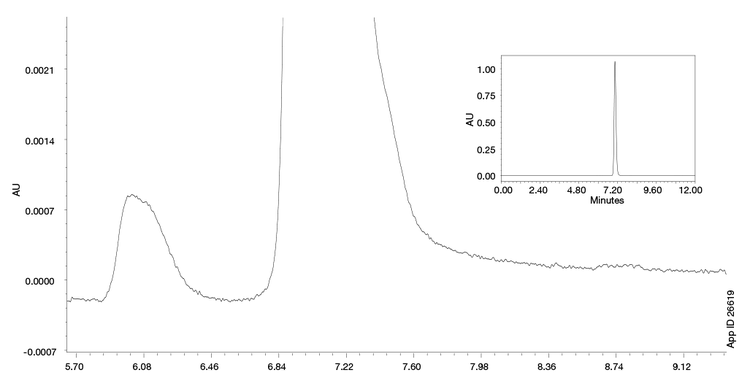
In this application note, we explore the use of standard phosphate containing buffers for aggregate analysis of a bispecific antibody, Emicizumab. Because aggregate is less than 0.2 % by peak areas, 100 μg of protein had to be loaded onto a 4.6 mm internal diameter (ID) SEC column to sufficiently quantitate. The use of a sub-2 μm column also was necessary as the additional improvements in efficiency help in detection.
Figure 1. SEC chromatogram for Emicuzimab. 100 μg load was necessary to quantitate aggregate by peak areas. Peak asymmetry of 1.2 indicates column is not overloaded. Aggregate is measured as 0.19 % by peak area.
Conclusion
In summary, SEC is an effective method for quantitation of mAb aggregate. Peak areas below 0.2 % can be obtained with sufficient mass load. With aggregate this low, it is prudent to investigate other orthogonal methods in confirming no aggregate was lost due to adsorption.
FAQs
Why is size-exclusion chromatography used for bispecific antibody aggregate analysis?
Answer: Size-exclusion chromatography separates biomolecules according to their size in solution. This makes SEC useful for measuring size variants and high-molecular-weight aggregates in monoclonal and bispecific antibody samples. Aggregate abundance can be calculated as a percentage of chromatographic peak area. In this application, SEC was used to quantify aggregate in emicizumab, a bispecific antibody, using UV detection at 280 nm.
How was aggregate below 0.2% quantified in the emicizumab sample?
The analysis used a 100 µg protein load on a 300 × 4.6 mm Biozen 1.8 µm dSEC-2, 200 Å column. The application note states that this sample load was necessary to generate sufficient response for quantitation because the aggregate level was below 0.2% by peak area. The resulting chromatogram measured aggregate at 0.19% by peak area.
Did the high protein load overload the SEC column?
The reported peak asymmetry was 1.2, which the application note identifies as evidence that the column was not overloaded. This result indicates that the 100 µg mass load provided the signal required for low-level aggregate measurement without producing the peak behavior associated with column overload under the evaluated conditions.
Why should an orthogonal method be considered when aggregate levels are very low?
The application note advises investigating other orthogonal methods when aggregate is measured at such a low level. Specifically, an additional method can help assess whether any aggregate was lost through adsorption rather than detected by SEC. The document does not prescribe a particular orthogonal technique, but it recommends confirmation when interpreting aggregate results below 0.2% by peak area.
Release Date: 10/2026 Reviewed Date: 10/2026