Mobile Phase Optimization for the Analysis of Synthetic Oligonucleotides by Ion-Pair Reversed Phase Liquid Chromatography
Authors: Brian Rivera and Dr. Bryan Tackett
Abstract
Therapeutic oligonucleotides present significant analytical challenges due to closely related impurities, phosphorothioate-induced diastereomers, oxidation products, and a variety of chemical modifications that can affect chromatographic behavior. This white paper examines the role of mobile phase optimization in ion-pair reversed-phase liquid chromatography (IP-RPLC) for oligonucleotide characterization using Biozen™ Oligo columns. The study evaluates how alkylamine ion-pairing reagents and hexafluoroisopropanol (HFIP) concentrations influence chromatographic separation, electrospray ionization (ESI) efficiency, charge state distribution, and cation adduct formation. Results demonstrate that alkylamine selection and concentration are critical to achieving optimal impurity resolution and MS performance, while lower HFIP concentrations can improve both chromatographic performance and ionization efficiency. The findings provide practical guidance for developing robust LC-UV and LC-MS methods for impurity profiling, characterization, and quantitation of synthetic oligonucleotides, including single-stranded and double-stranded modalities.
Key Benefits
Provides practical guidance for optimizing ion-pair mobile phases to improve separation of closely related oligonucleotide impurities and variants. Demonstrates how alkylamine concentration can improve chromatographic selectivity, reveal low-level impurities, and reduce cation adduct formation during LC-MS analysis. Shows that alternative ion-pairing reagents such as DIEA may enhance chromatographic performance for certain oligonucleotides while highlighting considerations for duplex RNA analysis. Identifies lower HFIP concentrations as a strategy to improve ionization efficiency and MS signal intensity without compromising chromatographic performance. Supports the development of more robust LC-UV and LC-MS methods for characterization, impurity profiling, and quantitation of synthetic oligonucleotides.
Results and Discussion
Ion-Pairing Agents and Their Role in Oligo Electrospray Desorption of Oligonucleotides
To understand the importance of acidic modifier and alkylamine in driving the separation of oligonucleotides, it is first prudent to discuss the fundamentals of electrospray desorption of oligonucleotides. Indeed, it is the ion-pair and the acidic modifiers themselves that not only drive the chromatographic separation but the electrospray ionization efficiency.
As a review, ion-pairing agents are commonly used to facilitate the retention of otherwise polar, charged compounds. With oligos being negatively charged, ion-pairs commonly used for oligo RPLC are alkylamines, as primary or secondary amines have a positive charge under most LC conditions. Triethylamine (TEA) is a commonly used ion-pairing agent, but as discussed later, there are other options that may have benefits.
In addition to the alkylamine ion-pair, an acidic modifier is used to buffer mobile phase and to ensure LC conditions are more reasonable for oligos that require high temperature for proper LC separation. Triethylammonium acetate buffers with an acetonitrile gradient is the most common for LC purification of DMT-off (i.e. unprotected) oligos. However, ammonium acetate has been shown to be deleterious to the ionization efficiency of oligos. The seminal work by Gilar and colleagues demonstrated the advantage of using a hexafluoroisopropanol (HFIP) to improve the ion-pairing effectiveness of TEA.4 Bartlett, et al was the first to formalize the mechanism for electrospray desorption for oligos.5 HFIP has a boiling point of 58.2 °C and during droplet formation, the pH is lowered with the TEA or other alkylamine donating a proton to water. This facilitates the oligo taking on negative charges at the surface of the droplet as it enters the gas phase.
Considerations for Ion-Pair
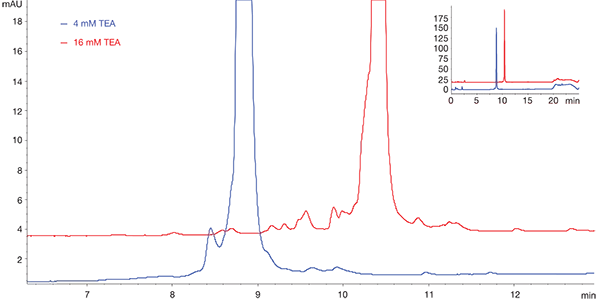
Although different types of alkylamine have been explored for improvements in ionization efficiency, the most common ion-pairing reagent used for oligo IP-RPLC methods remains TEA at varying concentrations, though sometimes as high as 16mM based on Gilar’s initial work. Indeed, a relatively high concentration of ion-pairing reagent is necessary for optimizing chromatographic performance and separation. Figure 1 shows a comparison of two different concentrations of TEA (4 mM vs 16 mM) in the mobile phase. Conditions use the same column packing and dimensions, along with relatively low concentration of HFIP. The gradient program was also identical between the two methods, with methanol as the strong solvent. Peak heights and selectivity are improved considerably with the higher concentration of ion-pair.
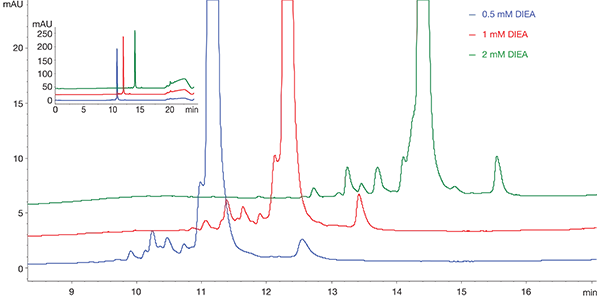
In addition to concentration of alkylamine, the type of ion-pair may also improve chromatographic separation, as using a more hydrophobic alkylamine should provide more retention than TEA. Figure 2 shows the chromatographic performance when modulating the concentration of N,N-diisopropylethylamine (DIEA), for a bridged nucleic acid. With concentrations as low as 0.5 mM DIEA, chromatographic performance is acceptable. Increasing the concentration of DIEA incrementally shows an improved separation and improved peak shapes for lower level impurities. In any case, the 2 mM concentration would be a much more suitable method if the intent is to maximize chromatographic performance while minimizing concentration of ion-pair.
Figure 1. Comparison of triethylamine concentration on chromatographic performance for a single stranded DNA oligonucleotide. In addition to increased retention, pre-peak separation improves and reveals several earlier eluting impurities.
| Biozen 2.6 μm Oligo |
| 100 x 2.1 mm |
A: 12.5 mM HFIP & TEA (as indicated) in Water
B: 12.5 mM HFIP & TEA (as indicated) in Methanol
Figure 2: Comparison of N,N-diisopropylethylamine concentrations, showing not only that increasing alkylamine can improve impurity profile, but as little as 0.5 mM DIEA can yield reasonably good chromatography.
| Biozen 2.6 µm Oligo |
| 100 x 2.1 mm |
A: 12.5 mM HFIP & DIEA (as indicated) in Water
B: 12.5 mM HFIP & DIEA (as indicated) in Methanol
There are two primary considerations for LC-MS when analyzing oligonucleotides. The first is the impact alkylamine has on charge envelope. As with all biopolymers, when analyzed by LC-MS oligos take on a multiply charge. Oligos commonly take on relatively high charge states as the phosphodiester backbone has the potential for each to take on a negative charge entering the gas phase. As such, charge states as high as -13 for a 20mer can be observed. This may prove somewhat beneficial for Multi-Reaction Monitoring (MRM) methods using nominal mass instrumentation. However, lower charge states can be used for specificity as well as to simplify spectrum. This has been postulated to be due to be the preservation of secondary structures associated to a duplex.6 Presumably for single stranded oligos, this may be Page 3 of 6
related to intramolecular interactions which would otherwise inhibit the oligo from taking on too many charges, thus yielding lower charge states and a wider charge state distribution.
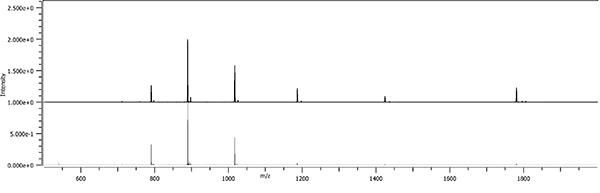
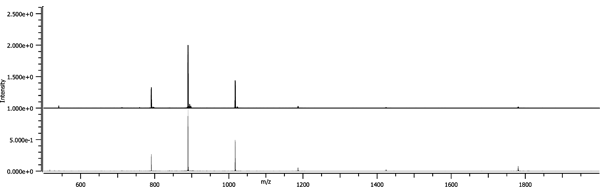
Figure 3 show spectra for a 20mer phosphorothioate, comparing to the charge envelope with TEA and hexylamine as ion-pairs. Axes have been normalized for comparison. Also, note that concentrations compared are not equivalent; 1 mM HA and 4 mM TEA. That said, as shown in Figure 4, the concentration of TEA plays little impact in the overall charge envelope; even as high as 16 mM, the charge envelope is still limited to -9 through -7. The more hydrophobic HA yields more of the lower charge states. Again, this could be useful for improving sensitivity and/or specificity of the MS method. As such, if the intent is to modulate charge envelope for improved specificity or simplification of spectra, more hydrophobic alkylamines like HA or octylamine might be advantageous.
Figure 3. Normalized spectra comparing charge envelope with different alkylamine ion-pair - triethylamine (bottom) and hexylamine (top). Hexylamine leads to wider charge state distribution, perhaps due to a minimal effect to any intramolecular interactions to the oligo, thus reducing charge state. The shifting of charge state distribution might be useful for improving method specificity or for simplifying spectra for characterization.
| Biozen 2.6 µm Oligo |
| 100 x 2.1 mm |
12.5 mM HFIP, 1 mM TEA in Water
12.5 mM HFIP, 4 mM HA in Water
12.5 mM HFIP, 1 mM TEA in Methanol
12.5 mM HFIP, 4 mM HA in Methanol
Figure 4. Normalized spectra comparing concentrations of TEA - 16 mM (bottom) and 1 mM (top). Minimal impact to charge state distribution, with only a nominal effect observed to the charge state distribution.
| Biozen 2.6 µm Oligo |
| 100 x 2.1 mm |
12.5 mM HFIP, 16 mM TEA in Water
12.5 mM HFIP, 1 mM TEA in Water
12.5 mM HFIP, 16 mM TEA in Methanol
12.5 mM HFIP, 1 mM TEA in Methanol
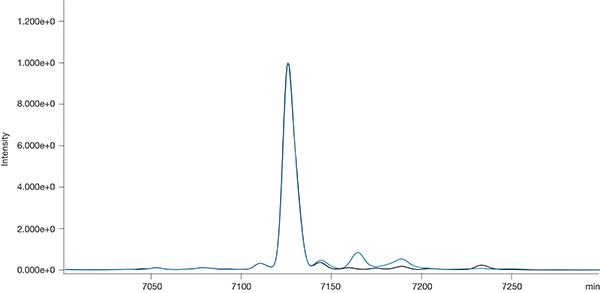
The other impact that type of alkylamine can have is on cation adduct formation. Akali metals such as sodium and potassium are attracted to the negatively charged phosphodiester and phosphorothioate backbone of oligos, negatively impacting ESI sensitivity.7 Figure 5 shows deconvoluted spectrum comparing two differences in concentrations for TEA, 16 mM vs 1 mM. This example shows differences in adduct formation, with a significant reduction in potassium adduct (7164.6 Da deconvoluted mass) and sodium/potassium adduct (7188.8 Da deconvoluted mass). There are some differences between types of alkylamine adduct formation (data not shown) though it is unclear if this is a result of differences in charge envelope and deconvolution artifacts, or if there is indeed a difference in adduct formation due to the alkylamine used. In either case, it is thought that the alkylamine ion-pair, rather than the sodium cation, preferentially binds to the phosphodiester backbone during the ESI process. Thus, adding more ion-pair, typically 10-16 mM, minimizes the cationic adduction.
Figure 5. Comparison of deconvoluted spectra for LC-MS analysis of phosphorothioate using different concentrations of ion-pair (Blue - 1 mM TEA, Gray -16 mM TEA). Significant reduction (15x) in cationic adduction of the potassium ion was observed (7164.6 Da deconvoluted mass). A reduction in sodium/potassium adduct (7188.8 Da deconvoluted mass) was also observed.
| Biozen 2.6 µm Oligo |
| 100 x 2.1 mm |
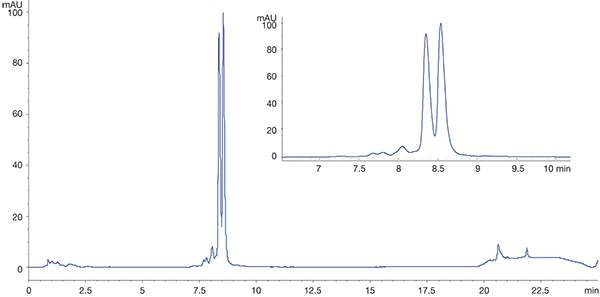
One final note on ion-pair is that some consideration should be made for single stranded oligos and duplex oligos. In general, more hydrophobic alkylamines are optimal for improved chromatography and specificity with ionization (i.e. lower charge states). However, some additional considerations should be made for duplex oligonucleotides. Figure 6 shows a 21mer double-stranded RNA using TEA as the ion-pairing reagent. The concentration of 12.5 mM HFIP is used and a reasonably shallow gradient of approximately 1 % B per column volume. The relatively low concentration of 4 mM TEA provides sufficient retention of the siRNA, with good resolution of sense and anti-sense strand. Although not baseline, this would be acceptable to obtain high quality spectral data if characterizing each strand separately by high resolution MS.
Figure 6. Separation of duplex RNA, with 4 mM triethylamine. Complementary strands are separated sufficiently, as shown in inset, for LC-MS applications to minimize spectral overlap.
| Biozen 2.6 µm Oligo |
| 100 x 2.1 mm |
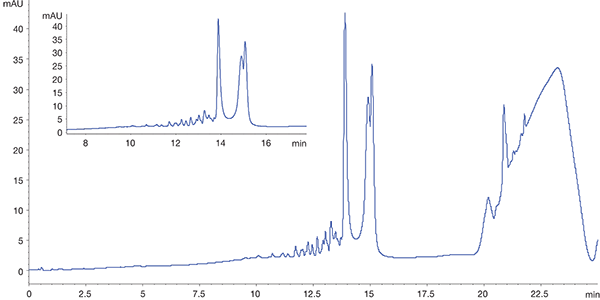
However, as in Figure 7, the separation of the duplex RNA with a more hydrophobic ion-pairing agent (DIEA) yields errant results with the duplex RNA. Although it might appear that the separation is improved because of the many earlier eluting impurities, this result was not repeatable. Further, more hydrophobic ion-pairing agents yielded worse chromatography, similar to the analysis of a duplex oligo when one does not run at sufficiently high temperature exceeding melting temperature (data not shown). As such, using triethylamine modulating concentration and optimizing gradient program is likely the more prudent approach for double stranded nucleic acids.
Figure 7. Duplex RNA separated using DIEA; running conditions are identical to Figure 6. Although there may be some separation of earlier eluting impurities, the separation injection to injection is not consistent. This may indicate that that these are not impurities but aberrations in chromatography due to the nucleic acids maintaining their secondary structure.
| Biozen 2.6 µm Oligo |
| 100 x 2.1 mm |
Hexafluoroisopropanol Concentration Effect on Chromatography and ESI Efficiency
Although there has been extensive work on alkylamine ion-pair and their effect on LC-MS separation and sensitivity, there has not been as much focus on HFIP as the acidic modifier, nor has there been many published data on other perfluorinated alcohols. Basiri and colleagues has demonstrated the use of hexafluoro-2-methyl-2-propanol (HFMIP), with some benefits with the use of more hydrophobic alkylamines.6 Otherwise, there has been minimal work exploring how HFIP concentration can impact LC separation and MS sensitivity. As mentioned previously, HFIP is used as an acidic modifier for oligonucleotide LC-MS analysis and facilitates ionization leading to a better signal in the mass. However, the use of relatively high concentrations (100-400 mM or 1-4 %) were mainly to improve the ion-pair effectiveness.8 Because of the minimal solubility of alkylamines in HFIP and other perfluorinated alcohols, alkylamines more effectively facilitate the hydrophobic retention of polar oligos. With modern particles being more hydrophobic than first generation pH-stable silica, the need for 400 mM HFIP (essentially the highest concentration soluble in aqueous buffers) may not be necessary. Further, as increases in ion-pair typically result in superior chromatography and spectral data, decreases in HFIP will allow for higher concentrations and/or different types of alkylamine. Nonetheless, with HFIP critical for ESI droplet desorption, a minimum amount is still required. However, mobile phase composition with less than 100 mM is not common practice.
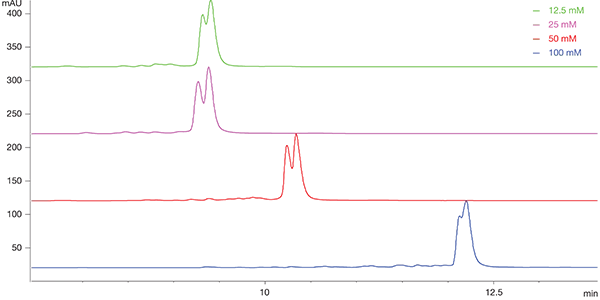
Figure 8. siRNA separating using different concentrations of HFIP (Blue - 100 mM, Red - 50 mM, Magenta - 25 mM, Green - 12.5 mM). Note the decrease in retention time as HFIP is decreased, though both 12.5 and 25 mM have similar retention.
| Biozen 2.6 µm Oligo |
| 100 x 2.1 mm |
In experiments to explore optimal concentration of acidic modifier, lower HFIP typically provided superior separation of earlier eluting impurities and overall better peak shapes and peak heights. This is somewhat counterintuitive, since the decrease in overall retention typically adversely impacts chromatography. Nonetheless, improvements in chromatographic performance can be observed in Figure 8, decreasing HFIP from 100 mM to 25 mM HFIP showed an improved separation of complementary strands of a siRNA, with some loss of resolution from 25 to 12.5 mM. This effect was observed with multiple oligonucleotides, irrespective of length, chemical modifications, and thioation.
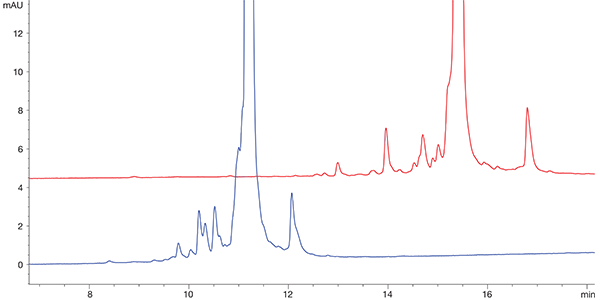
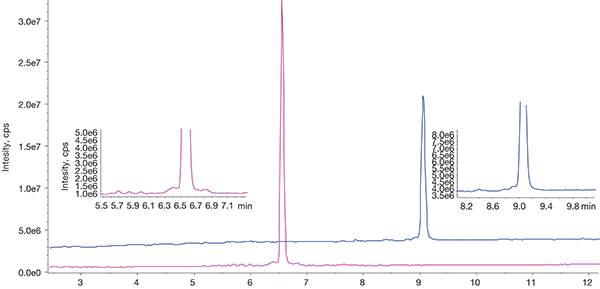
Although in some cases dramatic, there is a nominal effect observed with BNA, as seen in Figure 9, with separation and impurity profiles being relatively similar. Even though the impurity profile of BNA by LC-UV might not show a marked improvement, the differences are more apparent when the oligos are analyzed by high-resolution mass spectrometry. Decreasing the HFIP improves ionization efficiency 3x, as shown in differences in peak height in Figure 10. Interestingly, TICs do show the later eluting peaks with the 12.5 mM HFIP concentration have similar spectral quality as the main peak (data not shown); but they differ enough in physicochemical properties to retain longer by IP-RPLC. Being that this is a thioated oligo, these may be R/S isomers of full-length product, though extensive work beyond LC and mass spectrometry might be necessary to determine identity. Note that MS spectra may reveal more process-related and product related impurities; LC-UV should still be utilized for quantitation, so both should be considered. Further optimization with acidic modifiers might be exploring other perfluorinated alcohols such as HFMIP.
Figure 9. LC-UV chromatogram (260 nm) for BNA phosphorothioate oligo, Red - 100 mM HFIP, Blue- 12.5 mM HFIP. Somewhat nominal effect on separation, with slight improvements in pre-peak separation.
| Biozen 2.6 µm Oligo |
| 100 x 2.1 mm |
100 mM HFIP, 4 mM TEA in Water
12.5 mM HFIP, 4 mM HA in Water
100 mM HFIP, 4 mM TEA in Methanol
12.5 mM HFIP, 4 mM HA in Methanol
Figure 10. Effect of ionization efficiency for BNA phosphorothioate, TOF-MS (Pink -12.5 mM, Blue -100 mM). Peak height for lower concentration of HFIP is 3.6e7, for 100mM, peak height is 1.8e7.
| Biozen 2.6 µm Oligo |
| 100 x 2.1 mm |
100 mM HFIP, 4 mM TEA in Water
12.5 mM HFIP, 4 mM HA in Water
100 mM HFIP, 4 mM TEA in Methanol
12.5 mM HFIP, 4 mM HA in Methanol
Summary
In summary, ion-pair reversed phase is a powerful technique for the characterization and quantitation of synthetic oligonucleotides, which have a myriad of process and product related impurities. Alkylamines such as triethylamine can effectively separate various oligos, though others such as N,N-diisopropylethylamine may confer benefits for improved chromatographic separation. Higher concentrations of alkylamine, up to 16 mM, might improve not only LC separation but spectral data, as higher concentrations of alkylamine minimize cation adduct formation during electrospray ionization. Special considerations for alkylamines should be made for double-stranded oligonucleotide modalities, wherein the effect of the alkylamine on secondary structure of the oligo may compromise the chromatographic separation and thus overall repeatability of the method. Although less explored than alkylamine ion-pair, hexafluoroisopropanol is the most common acidic modifier used for LC-MS of oligos. Chromatographic performance is often improved by decreasing HFIP concentration, with acceptable or even optimal chromatography being obtained at 12.5 mM. Even more compelling is the improved ionization with the decrease in HFIP yielding significantly higher peak heights, facilitating characterization and quantitation.
Conclusion
- Basiri, B., & Bartlett, M. G. (2014). LC–MS of oligonucleotides: applications in biomedical research. Bioanalysis, 6(11), 1525–1542. doi:10.4155/ bio.14.94
- Wan, W Brad et al. “Synthesis, biophysical properties and biological activity of second generation antisense oligonucleotides containing chiral phosphorothioate linkages.” Nucleic acids research vol. 42,22 (2014): 13456-68. doi:10.1093/nar/gku1115
- Capaldi, D. et al (2017). Impurities in Oligonucleotide Drug Substances and Drug Products. Nucleic Acid Therapeutics, 6, 309-322. doi:10.1089/ nat.2017.0691.
- Gilar, M. et al (2003). Characterization of therapeutic oligonucleotides using liquid chromatography with on-line mass spectrometry detection. Oligonucleotides, 13(4), 229-243. doi:10.1089/154545703322460612
- Chen, B., et al (2013). The effect of organic modifiers on electrospray Ionization Charge-State distribution and Desorption efficiency for Oligonucleotides. Journal of The American Society for Mass Spectrometry, 24(2), 257-264. doi:10.1007/s13361-012-0509-5
- Basiri, B., van Hattum, H., van Dongen, W.D. et al. The Role of Fluorinated Alcohols as Mobile Phase Modifiers for LC-MS Analysis of Oligonucleotides. J. Am. Soc. Mass Spectrom. 28, 190–199 (2017). https://doi. org/10.1007/s13361-016-1500-3
- Cheng X., Gale D. C., Udseth H. R., Smith R. D.. Charge state reduction of oligonucleotide negative ions from electrospray ionization. Analytical Chemistry 1995, 67, 586.
- Gilar, Martin et al. “Ion-pair reversed-phase high-performance liquid chromatography analysis of oligonucleotides: retention prediction.” Journal of chromatography. A vol. 958,1-2 (2002): 167-82. doi:10.1016/s0021- 9673(02)00306-0
FAQs
Why is mobile phase optimization important for oligonucleotide IP-RPLC methods?
Oligonucleotides often contain closely related impurities such as n-1 and n+1 species, oxidation products, phosphorothioate variants, and chemically modified analogs. These compounds can be difficult to separate using standard reversed-phase conditions. The white paper shows that optimizing alkylamine ion-pairing reagents and acidic modifiers such as HFIP is essential for achieving the chromatographic selectivity and mass spectrometric performance needed for impurity characterization and quantitation.
How does alkylamine concentration affect oligonucleotide separations?
Answer: Increasing alkylamine concentration can significantly improve chromatographic performance. The paper demonstrates that higher concentrations of triethylamine (TEA) improved retention, peak shape, and separation of early-eluting impurities. Higher alkylamine concentrations can also reduce sodium and potassium adduct formation during electrospray ionization, leading to cleaner mass spectra and improved analytical confidence.
What are the advantages of using alternative ion-pairing reagents such as DIEA or hexylamine?
More hydrophobic alkylamines can alter retention characteristics, improve impurity resolution, and influence charge state distribution during LC-MS analysis. The study showed that N,N-diisopropylethylamine (DIEA) improved peak shape and impurity separation for certain oligonucleotides at relatively low concentrations, while more hydrophobic alkylamines such as hexylamine shifted charge state distributions that may help improve MS specificity or simplify spectral interpretation.
What role does HFIP play in oligonucleotide LC-MS methods?
HFIP acts as an acidic modifier that supports both chromatographic separation and electrospray ionization efficiency. It helps improve ion-pair effectiveness and facilitates ion formation during the ESI process. The paper shows that reducing HFIP concentration can often maintain or improve chromatography while significantly enhancing ionization efficiency and MS signal intensity.
Can lower HFIP concentrations improve MS sensitivity?
Yes. The study found that reducing HFIP concentration from conventional levels to as low as 12.5 mM improved ionization efficiency and generated substantially higher MS signal intensity for several oligonucleotide samples. In some examples, lower HFIP concentrations also improved peak shape and impurity resolution, making them attractive conditions for LC-MS characterization workflows.
Are the same ion-pairing conditions suitable for duplex RNA and single-stranded oligonucleotides?
Not necessarily. The paper highlights that duplex oligonucleotides may respond differently to more hydrophobic ion-pairing reagents because of effects on secondary structure and chromatographic behavior. For duplex RNA, TEA-based conditions produced more repeatable chromatographic performance, while more hydrophobic ion-pairing agents generated less consistent results. Method optimization should therefore consider oligonucleotide modality and structural characteristics.
Release Date: 10/2026 Reviewed Date: 10/2026