Kinetex F5 Core-Shell HPLC Columns

Maximize Retention Interactions and Performance
Combine core-shell performance, multiple retention mechanisms and the Kinetex F5 column’s ability to be run in a variety of separation modes (reversed phase, SFC, 2D LC, and 100% aqueous) and you now have an impeccable method development tool at your disposal.
- Compatible with All Analytical HPLC/UHPLC Systems*
- 100 % Aqueous Mobile Phases Stable
- 5 Mechanisms of Retention and Selectivity
- USP: L43
*Kinetex analytical columns are compatible with all LC system with standard LC column end-fittings threaded in 10-32. Please contact us at Phenomenex.com/chat for any questions and information about fitting compatibility and any other column internal diameters.

Order
Overview
F5 - A Novel Selectivity For Tough Separations
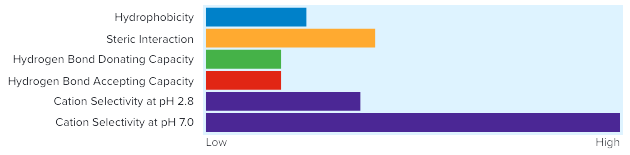
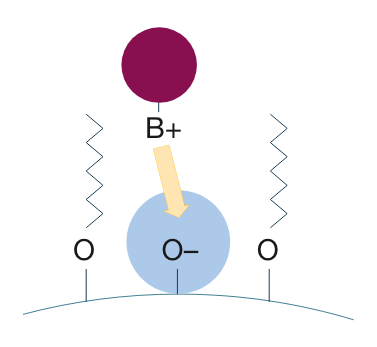
This pentafluorophenyl propyl column provides a very high degree of steric selectivity to separate structural isomers. The electronegative fluorine groups offer high selectivity for cationic compounds.
Dependable F5 Selectivity
While older pentafluorophenyl phases (PFP, PFPP, F5, etc.) are based on existing bonding techniques and technologies that promote irreproducibility. The Kinetex F5 was meticulously designed by Phenomenex R&D and its customers, to provide consistently accurate and high performance results.
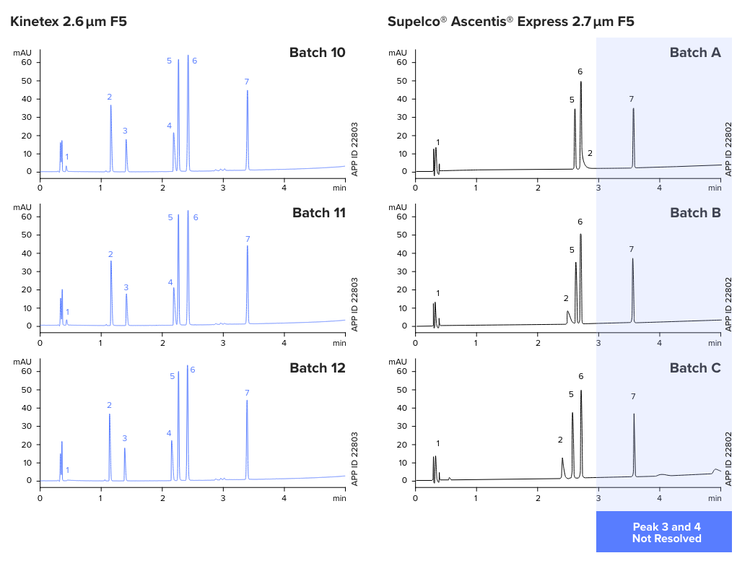
Conditions same for both samples:
Sample:
1. Uracil
2. Pindolol
3. Chlorpheniramine
4. Nortriptyline
5. 3-Methyl-4-Nitrobenzoic acid
6. 5-Methyl Salicyl Aldehyde
7. Hexaphenone
Take Advantage of Multiple Interactive Mechanisms
The multiple interactive mechanisms of the Kinetex F5 (pentafluorophenyl ) column successfully separate methoxybenzene isomers, while the Kinetex C18 column, which has minimal bonding interactions, cannot separate the methoxybenzene isomers. This demonstrates that columns that rely primarily on hydrophobic interactions may not be the first choice for the separation of isomeric compounds and a column with multiple interactive mechanisms may be required.
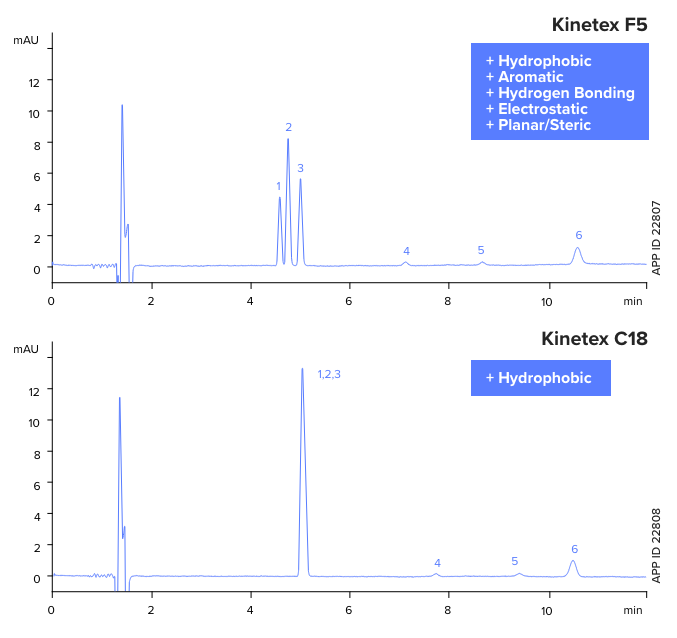
Conditions for all columns:
Sample:
1. 1,2,3-Trimethoxybenzene
2. 1,2-Dimethoxybenzene
3. 1,2,4-Trimethoxybenzene
4. 1,4-Dimethoxybenzene
5. Methoxybenzene
6. 1,3-Dimethoxybenzene