Lux i-Amylose-1 Chiral LC Columns

Your New First Choice Chiral Column!
The immobilization and bonding technology used within the Lux i-Amylose-1 promotes column stability in strong organic solvents, which affords you the ability to expand your chiral separation success with more solvent systems and separation modes.
- Wide Solvent Flexibility
- Broad Enantioselectivity
- Strong Solvent Compatibility

Your New First Choice Chiral Column!
The immobilization and bonding technology used within the Lux i-Amylose-1 promotes column stability in strong organic solvents, which affords you the ability to expand your chiral separation success with more solvent systems and separation modes.
- Wide Solvent Flexibility
- Broad Enantioselectivity
- Strong Solvent Compatibility
Your New First Choice Chiral Column!
The immobilization and bonding technology used within the Lux i-Amylose-1 promotes column stability in strong organic solvents, which affords you the ability to expand your chiral separation success with more solvent systems and separation modes.
- Wide Solvent Flexibility
- Broad Enantioselectivity
- Strong Solvent Compatibility
Your New First Choice Chiral Column!
The immobilization and bonding technology used within the Lux i-Amylose-1 promotes column stability in strong organic solvents, which affords you the ability to expand your chiral separation success with more solvent systems and separation modes.
- Wide Solvent Flexibility
- Broad Enantioselectivity
- Strong Solvent Compatibility
Your New First Choice Chiral Column!
The immobilization and bonding technology used within the Lux i-Amylose-1 promotes column stability in strong organic solvents, which affords you the ability to expand your chiral separation success with more solvent systems and separation modes.
- Wide Solvent Flexibility
- Broad Enantioselectivity
- Strong Solvent Compatibility
Your New First Choice Chiral Column!
The immobilization and bonding technology used within the Lux i-Amylose-1 promotes column stability in strong organic solvents, which affords you the ability to expand your chiral separation success with more solvent systems and separation modes.
- Wide Solvent Flexibility
- Broad Enantioselectivity
- Strong Solvent Compatibility
Order
Overview
Achieve Greater Chiral Separation Success
Lux columns are guaranteed to perform as well or better than the equivalent DAICEL® Chiral Technologies column. Lux phases can also provide alternative selectivity to other chiral selectors for the most challenging chiral separations. Lux columns offer a wide and complementary range of enantioselectivity for even the most difficult chiral separation projects.
The helical structure of the amylose creates a complex steric environment that provides stronger interactions and better chiral recognition abilities. Additionally, the selector’s constituents produce hydrogen bonding, dipole, and π π interactions that all affect the CSPs ability to separate your enantiomers effectively.
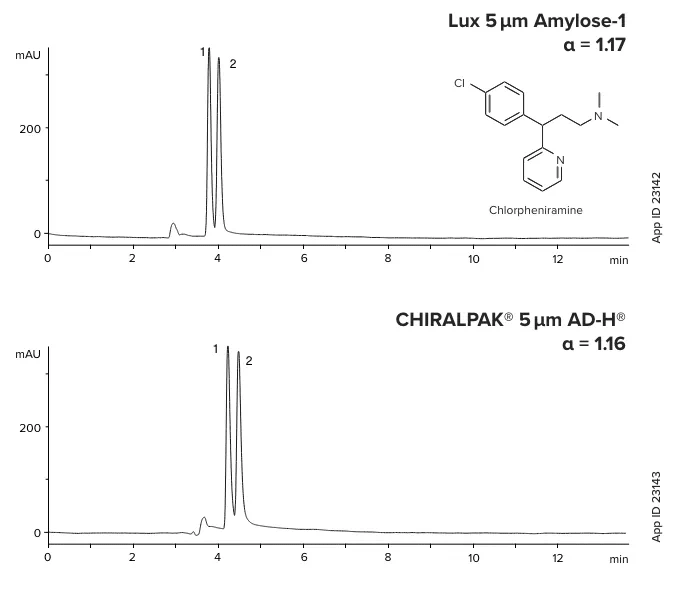
Comparative separations may not be representative of all applications.
Conditions for all columns:
Comparative separations may not be representative of all applications.
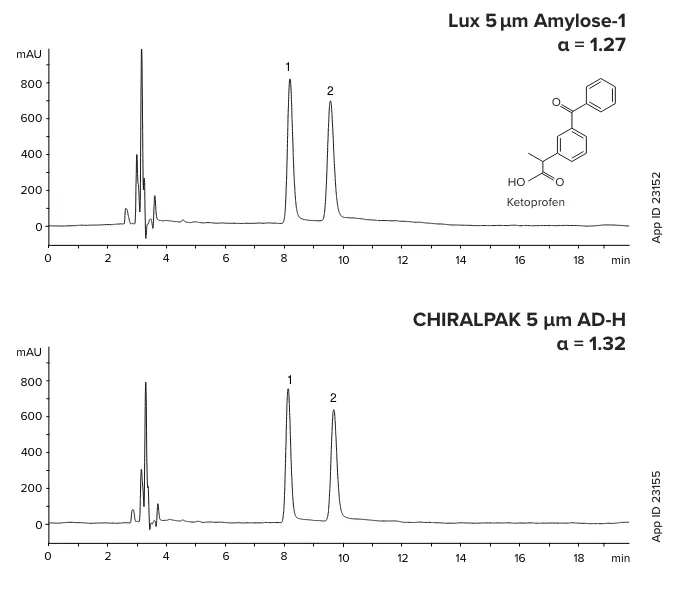
Comparative separations may not be representative of all applications.