








No Results Found
Clarity Oligo-MS

Rapid and Efficient LC-MS Separation for QC and Characterization
Clarity Oligo-MS C18 columns have been engineered for the MS characterization of synthetic DNA and RNA samples. This media is based on core-shell technology which generates extremely high efficiencies due to the innovative particle design. This increase in efficiency improves the resolution between critical oligo sequences, gives higher sensitivity for easier MS quantitation, and allows for a decrease in column length for higher throughput.
- Core-shell particle technology provides improved speed, resolution, and sensitivity
- 2.6 µm particles deliver increased efficiency at reduced backpressures
- Easily transfer quantitative LC-MS methods to any system with 2.6 µm particles
- 1.7 µm particles boost performance of existing sub-2 µm methods
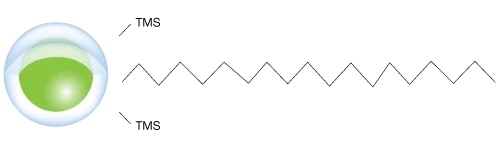
Recommended Use
Separation of very hydrophobic compounds such as Pharmaceuticals, Peptides, Estrogens, Basic Compounds, General Reversed Phase Applications, Mid-size to Large Peptides
Order
Overview
Core-Shell Technology for Synthetic DNA/RNA Analysis
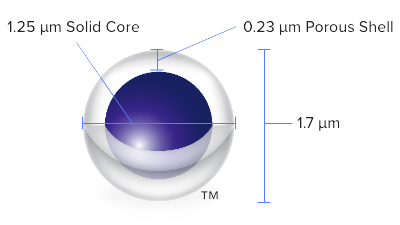
Clarity Oligo-MS media is not fully porous like traditional particles used for the analysis of oligonucleotides. It is a core-shell particle technology which uses a sol-gel processing technique to grow a homogeneous porous shell onto a solid core. This highly optimized process combined with uniform particle size distribution produces a column that generates extremely high plate counts.
1.7 µm Core-Shell Particle
- Reduced diffusion path maximizes efficiency
- Increased efficiencies compared to traditional fully porous sub-2µm columns. Typical operating backpressures > 400 bar
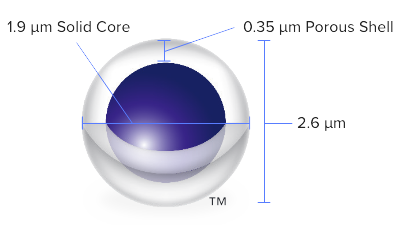
2.6 µm Core-Shell Particle
- Reduced diffusion path maximizes efficiency
- Ultra-high performance on any system with Clarity Oligo-MS 2.6 µm columns
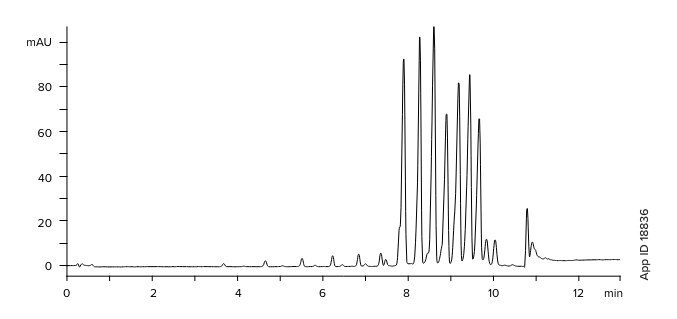
Achieve Baseline Resolution of N-1 and N+1 Oligo from Target
The high plate counts generated by the Clarity Oligo-MS material produce extremely high efficiencies and thus excellent resolution between oligonucleotides of similar length and structure. Scientists can achieve baseline resolution between synthetic oligonucleotides with just one base difference allowing easier quantitation.
Poly dT Standard (12-18mer)
Column: | Clarity 2.6 µm Oligo-MS C18 |
Dimension: | 50 x 2.1 mm |
Flow Rate: | 0.5 mL/ min |
Temperature: | 50 ˚C |
Detection: | UV @ 260 nm (22 ˚C) |
Mobile Phase: | A: 100 mM HFIP / 4 mM TEA / 2 % Methanol, B: 100 mM HFIP / 4 mM TEA / 98 % Methanol |
Part No.: | 00B-4479-AN |
Gradient: | A/B (95:5) to A/B (80:20) in 10 min |
Injection Volume: | 20 µL |
Sample Volume:
Poly dT (12-18)
Rapid Separation of Complex Oligo Samples
Due to the high resolving power of Clarity Oligo-MS columns, high-throughput methods for the separation of complex synthetic mixtures can be developed. Using short (50 mm length) columns, impurities are separated from the peak of interest in less than 12 minutes
Crude DNA 30mer
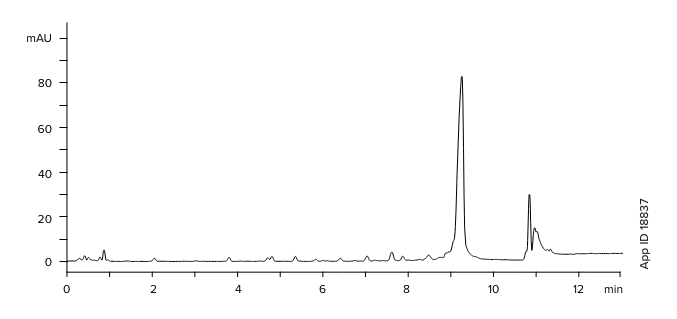
Column: | Clarity 2.6 µm Oligo-MS C18 |
Dimension: | 50 x 2.1 mm |
Flow Rate: | 0.5 mL/ min |
Temperature: | 50 ˚C |
Detection: | UV @ 260 nm (22 ˚C) |
Mobile Phase: | A: 100 mM HFIP / 4 mM TEA / 2 % Methanol, B: 100 mM HFIP / 4 mM TEA / 98 % Methanol |
Part No.: | 00B-4479-AN |
Gradient: | A/B (95:5) to A/B (80:20) in 10 min |
Injection Volume: | 20 µL |
Sample Volume:
Crude DNA 30mer
Documents

Applications
FAQs
What is void volume?Asked Mar 01, 2022

The void volume corresponds to the amount of mobile phase in an LC system. In most separation modes the void volume would be equivalent to the amount of mobile phase needed to elute a compound that doesn't interact with the stationary phase and is hence unretained. In size exclusion, analytes are not separated based on chemical interactions with the stationary phase but rather their ability, based on size, to enter pores in the stationary phase. Therefore, in size exclusion the terms total permeation and total exclusion volume have greater significance than void volume. The total permeation volume corresponds to the amount of mobile phase in the system, including that in the pores of the stationary phase, whereas the total exclusion volume does not include the mobile phase within the pores of the stationary phase. Consequently, the total permeation volume corresponds to the amount of mobile phase needed to elute a compound that is small enough to completely enter into the stationary phase pores and the total exclusion volume is the amount of mobile phase needed to elute a compound that is entirely excluded from the stationary phase pores.
How can I improve the separation of Oligonucleotides when working with LCMS.Asked Oct 01, 2020
Typically ion-pairing reagents are used to increase the retention and resolution of oligo’s separated by reversed-phase HPLC. High molarity amounts (100 mM triethylamine acetate [TEAA]) are typically added when analyzing oligonucleotides, however the high level of TEAA leads to ion suppression that makes MS detection of oligonucleotides difficult at therapeutic and reagent concentrations. With LCMS we recommend hexafluoroisopropanol (HFIP) as a mobile-phase additive which has enabled reasonable sensitivity by MS. Our standard recommendation is 100mM HFIP and 4mM TEA in both A and B of a gradient mixture however more recent studies have shown some oligonucleotides work well even at concentrations as low as 10mM HFIP.
What impact does changing the alkylamine have on the separation of oligonucleotidesAsked Oct 01, 2020
The alkylamine used directly affects retention time, with longer chains leading to increased retention, e.g. hexylamine will show longer retention times than triethylamine. There is also a difference in solubility so generally gradients need to be adjusted to allow for this. Generally, the effect of ion-pair is oligo-specific; for example, Gapmers longer amines offer better resolution whereas for siRNA shorter amines offer an improvement in resolution
What is the reason for low recovery of Phosphorothioate (PS) in Oligonucleotides extraction from biological matrices, how can I achieve good recovery?Asked Oct 02, 2020
Phosphorothioate (PS) can frequently desulfurize in to Phosphodiester (PO) and can result in reduced recoveries during solid phase extraction and sample clean-up step. To abstain PS in oxidizing back to PO we can add anti-oxidants like Cysteine in to the loading buffers. For e.g. in Clarity OTX Loading / Lysis buffer add approx. 1gm Cysteine in 1L bottle of the buffer.