Zebron ZB-Semivolatiles GC Columns

A New Generation of Performance for Semi-Volatiles Analysis
5 Reasons Chromatographers Love It
- Delivers supreme inertness for acids, amines, and other notoriously active compounds
- Hold calibrations and increase productivity up to 58%
- Detect down to ultra low levels (0.2 ng on column)
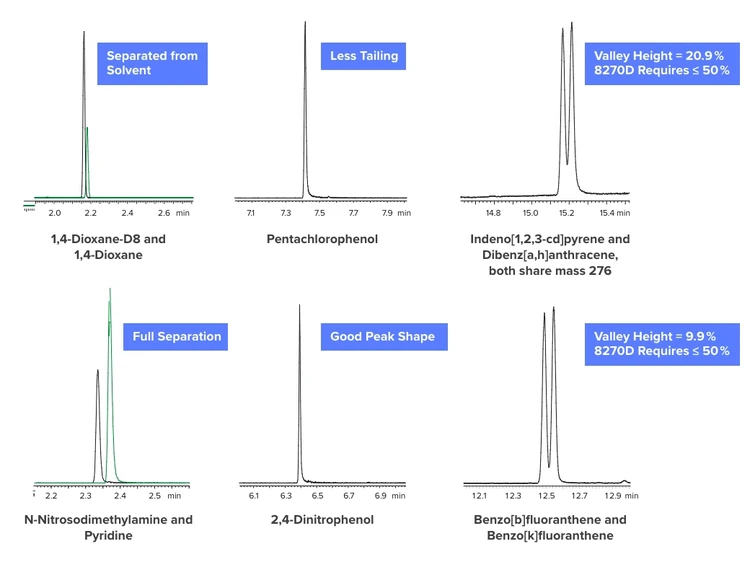
- Improve critical pair resolution (valley height 9.9% for benzo[b] and benzo[k])
- The most popular choice for testing of semivolatiles, PAHs, and PBDEs
Recommended Use
Semivolatiles (SVOCs), PAHs, PBDEs, EPA Methods (525, 610, 625, 8100, 8270D)

Order
Overview
Upgrade to Zebron from any 5 %-phenyl or 5 % phenyl-arylene / 95 % dimethylpolysiloxane phase:
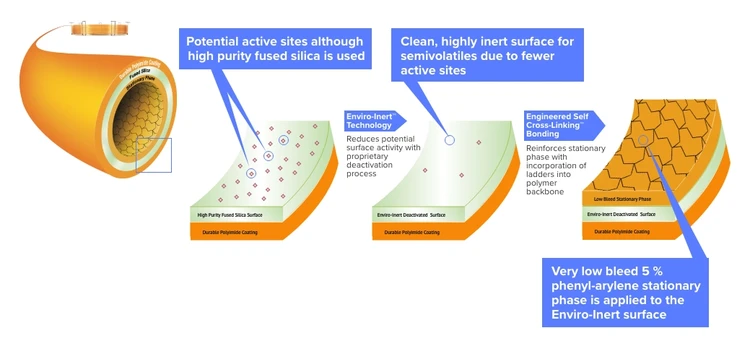
Enviro-Inert™ Technology: A New Generation In Environmental Testing
Why Is Reduced Activity Important?
Poor inertness as a result of increased column activity can lead to low acid/base sensitivity or analyte misidentification, causing incorrect data and big headaches! ZB-SemiVolatiles is designed with new Enviro-Inert technology to ensure:
- Inert, rugged performance without compromising separation
- Improved resolution of key critical pairs like Benzo[b]fluoranthene and Benzo[k]fluoranthene
- Better peak shapes and response for acids, amines, and PAHs
Enviro-Inert Technology Improves Inertness Without Changing Selectivity
You Spoke, You Tested, You Approved
Your input fueled the research and development of Zebron ZB-SemiVolatiles – the column specifically designed to overcome your EPA Method 8270D obstacles. Several environmental labs have verified real-world performance on ZB-SemiVolatiles:
- TestAmerica Laboratories, Inc. Buffalo
- Phoenix Environmental Laboratories, Inc.
- Other labs like yours!
“Zebron ZB-SemiVolatiles is a very stable and durable semi-volatile column. This has reduced TestAmerica’s downtime and increased our productivity, enabling us to better serve our clients’ needs.”
David Wilkes, GC-MS Semi-Volatile Department
TestAmerica Laboratories, Inc. Buffalo
The opinions stated herein are solely those of the speaker and not necessarily those of any company or organization.
We QC Test for the SVOC Compounds You Analyze
We take the guesswork out of meeting method requirements by aggressively testing ZB-SemiVolatiles with two different test mixes. We incorporated troublesome analytes from your samples (Pyridine) and compounds in the 8270D tuning standard (DDT, Pentachlorophenol, and Benzidine) into our QC test, so you can be sure your column is ready to meet suitability requirements for the method.
Pyridine (PYR)
Very active amine – exposes any basic activity
Pentachlorophenol (PCP)
PCP peaks disappear and exhibit tailing on columns with acid activity
Benzidine
Active amine that tails when basic activity is present
DDT
Breaks down in an active system to DDE & DDD
*Requirement of 0.5 for 60 m x 0.25 mm x 0.25 µm and 10 m Guardian™ dimensions
Competitor Columns Put to Our Test
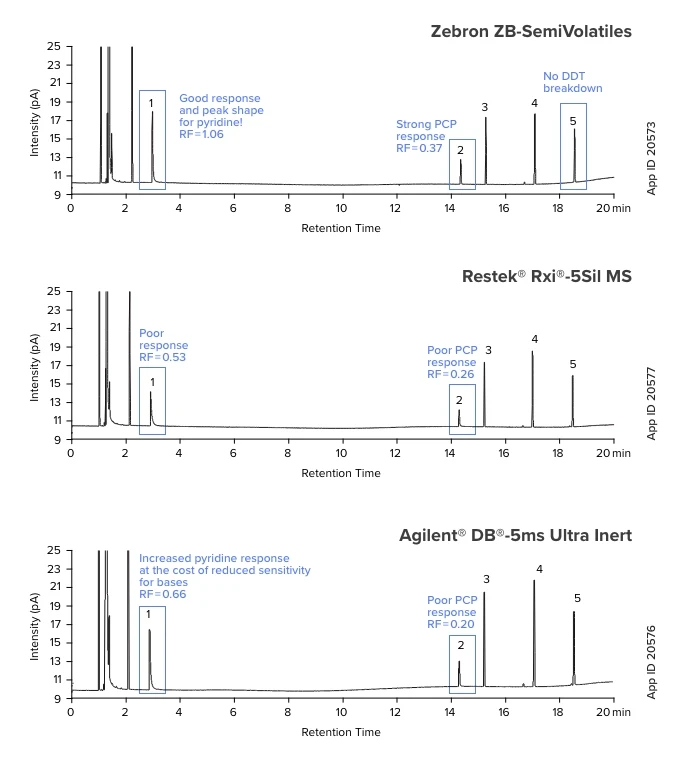
Our QC test exposed poor performance for key compounds on competing columns. Enviro-Inert™ technology improves inertness, so you experience increased responses, lower limits of detection (LOD), and virtually no breakdown when using a ZB-SemiVolatiles GC column.
A New Generation of Performance for Semi-Volatiles Analysis
Conditions were the same for all columns tested. Comparative separations may not be representative of all applications.
Conditions for all columns:
FID @ 325 °C
Sample:
Analytes are 20 ppm in Dichloromethane
1. Pyridine
2. Pentachlorophenol
3. DFTPP
4. Benzidine
5. DDT
6. DDD
Why Is Pyridine Response Important?
Pyridine is a very active amine and a good indicator for both column lifetime and sensitivity. Columns with higher initial peak responses can be expected to maintain performance over time. Additionally, higher responses allow you to run at lower levels of detection, improving the sensitivity of your analysis.
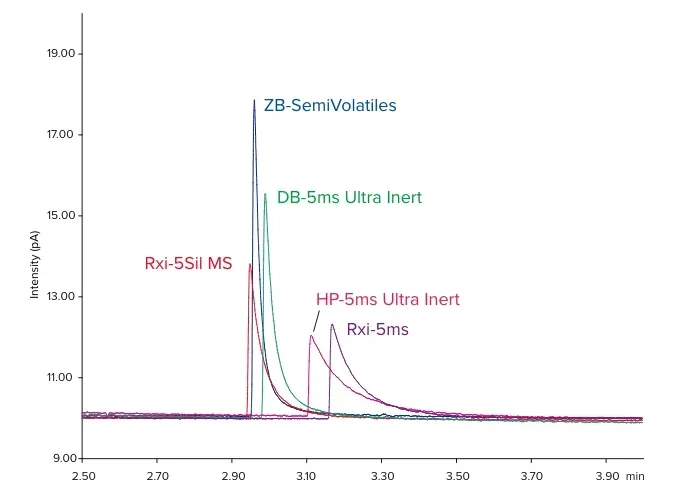
Competing Columns Fail Our Stringent QC Requirements
As part of our QC requirements, columns must meet minimum Pyridine and Pentachlorophenol responses. Each of the four competitor columns would have been failed by our QC department and would not have shipped to our customers.
QC Test Mix Results: Pyridine and PCP Response Levels
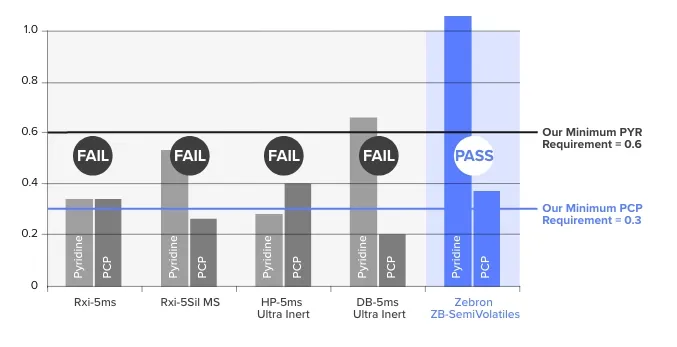
Conditions were the same for all columns tested. Comparative separations are not representative of all applications.
Response Factor (RF)
RF is calculated by dividing peak height of analyte by peak of height of DFTPP as internal standard.
Great Resolution of Key Critical Pairs and Improved Peak Shapes
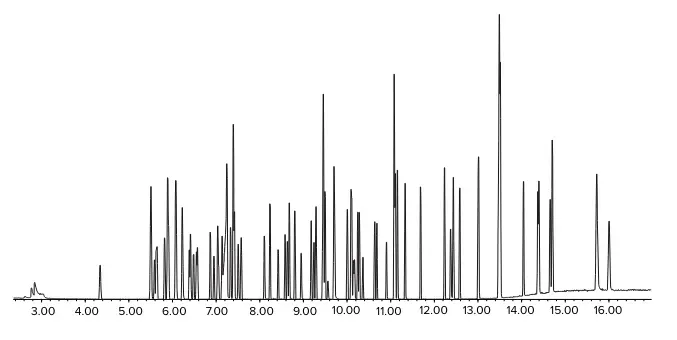
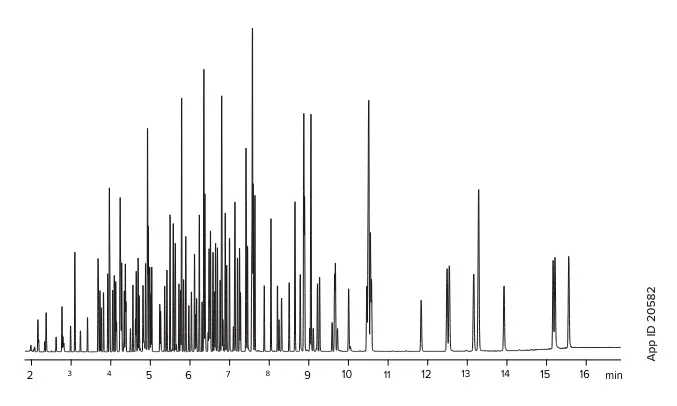
Enviro-Inert™ technology allows Zebron ZB-SemiVolatiles to provide improved productivity with shorter run times for SVOC methods, while maintaining resolution of key critical pairs.
EPA Method 8270D: SemiVolatile Organic Compounds
25 °C/min for 2 min
135 compounds in EPA Method 8270D
Improved Peak Shapes