
Technical Tip: Fronting Peaks

HPLC users: it's time to get your fronting peaks back on track
The most common causes for peak fronting are overloading the column (resulting in too much injection mass on-column) or a column installation error, such as fittings swaged to a port depth different than that of the column in use. Another possible cause could be a matrix mismatch with the injection solvent (sample diluent) and the mobile phase. Such mismatches could include different pHs, immiscible solvents, or injection solvents of a significantly stronger elution strength than the mobile phase. An installation error would tend to cause all peaks to front, while a difference in pH could potentially distort only specific peaks that correspond to some particular ionizable compounds. If the injection solvent is of a greater elution strength than the mobile phase, the earliest eluting peaks would tend to be the most affected. Injecting immiscible solvents would tend to yield the most erratic effects, including random peak shape distortions, unpredictable retention time shifting, missing peaks, and baseline distortions. The first chromatogram below is of a conditioning injection on a new column for an established reversed phase method:
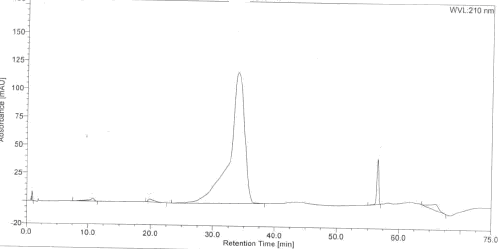
The overall response appeared comparable to what was typically observed on that system for this method, and PEEK fingertight connective fittings were used—essentially ruling out overloading and installation errors. However, it was uncovered that a normal phase method was being run on this system just prior, and after further examination, it was realized that the mobile phase lines were properly flushed prior to introducing reversed phase solvents. The injector and needle wash remained in an iso-octane based solution. After purging the injector loop and replacing the needle wash with reversed phase solutions, the following chromatogram was obtained from the same sample in a subsequent injection:
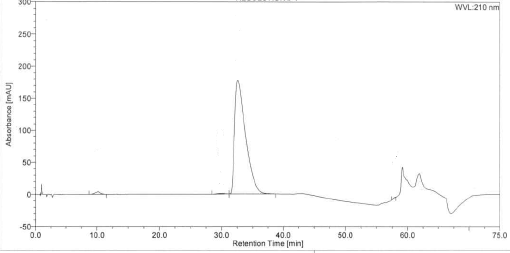
This is still not an ideal chromatogram for this method, but it shows the improvement as the residual iso-octane—that was inadvertently introduced to the column—is eluting. This can take extensive flushing and, in some cases, be impossible to completely remove.
More technical support:
- Request-a-Method™: Contact our Method Development Team for a tailored solution!
- Applications: We have thousands of them! Search by analyte name or structure.
- Free Guides and Posters: Download free guides and posters for troubleshooting, method development, and more.
- Product Videos: See the technology in action. Watch our product videos and demonstrations.
- The Technical Library: Check out our helpful collection of technical notes, posters, webinars, how-to videos, guides, and more.
- Interactive Web Tools: Simple, interactive tools to instantly find the right products and solutions.
- FAQ Portal: Find answers to popular technical questions here.
- Quality and Safety Documents: Download your CQA, C of A, and MSDS.
- Product Care and Use: Love your products and treat them right using these handy guides.
- Training & On-Site Support: We’ll come to you! Classroom training or in-lab demonstrations—you pick the topic.
- Troubleshooting: Did something go wrong? We’ll fix it!