HPLC Columns

High-Performance Liquid Chromatography Column

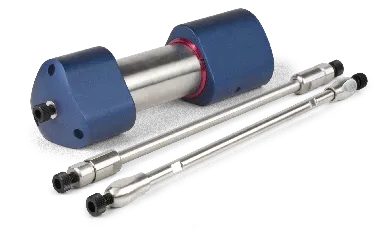
HPLC columns are critical components in the HPLC system, responsible for the actual separation of the sample components. These columns are typically made of stainless steel and packed with tiny, uniform particles known as the stationary phase. The choice of stationary phase material and the column's dimensions (length, diameter, and particle size) significantly influence the separation process and the efficiency of the analysis.

Coupled with sensitive detector systems, HPLC has become a widely employed method for confirming drug identity, providing quantitative results, and monitoring therapeutic progress in disease management.

Know what you need? Fast-track your checkout.

Overview

Phenomenex HPLC Column Portfolio

Looking for high-performance columns tailored to your application? Phenomenex offers a comprehensive portfolio of HPLC columns designed to deliver exceptional resolution, reproducibility, and efficiency across diverse analytical techniques. Explore our featured HPLC columns and find the ideal solution for your chromatography needs.

How to Choose the Correct HPLC Column?

  1. Sample Properties: Understand the properties of the sample being analyzed, such as polarity, size, and chemical nature. Match these characteristics with the appropriate stationery phase chemistry and column type.
  2. Analyte Stability: Consider the stability of the analytes during the separation process. Choose column and mobile phase conditions that minimize degradation or internation with the stationary phase.
  3. Separation Objective: Determine the specific compounds or classes of compounds you need to separate and analyze. Select a column type that provides the required selectivity, resolution, and efficiency for your application.
  4. Column Dimensions: Consider the dimensions of the column, including length, diameter, and particle size. Longer columns with smaller particle size typically offer higher resolution, but may require longer analysis times.
  5. Mobile Phase Compatibility: Ensure compatibility between the mobile phase and stationary phase chemistry to prevent interactions that could affect separtion efficiency and column performance.
  6. Sample Matrix: Consider the composition of the sample matrix and potential interferences. Choose a column that can effectively separate the target analytes from matrix components.
  7. Budget and Resources: Consider practical factors such as budget constraints, availability of columns, and equipment compatibility.

HPLC Column Types

Particle Types

Core-Shell Particles (Superficially Porous Particles)
Superficially porous particles, also known as core-shell particles, consist of a solid, non-porous core surrounded by a thin, porous layer. This unique design reduces the diffusion path of analytes, leading to faster separations with high efficiency, often comparable to sub-2 micron particles but with the advantage of lower back pressure. These particles are ideal for applications requiring rapid analysis without compromising the resolution.

Fully Porous Particles
Fully porous particles are the traditional particles used in HPLC columns. These particles have pores that allow the mobile phase and analytes to diffuse throughout the entire particle. This leads to a high surface area, enabling good separation efficiency. Fully porous particles are versatile and are often applied in a wide range of analytical applications, particularly when high resolution is required.

Monolithic Particles
Monolithic particles are made from a continuous porous rod rather than packed particles. This structure offers high permeability, which allows for faster flow rates with lower back pressure. Monolithic columns are known for their robustness and are particularly effective in handling complex matrices. They are well-suited for high-speed separations and are often used in bioanalytical applications, such as the analysis of proteins and peptides.

Polymer-Based
Made from materials like polymethacrylate or polystyrene-divinylbenzene, offer excellent chemical stability across a wide pH range. They tolerate extreme acidic or basic conditions, making them ideal for analyzing organic acids, sugars, and non-water-soluble polymers. These columns are widely used in pharmaceutical, environmental, and food testing for reliable, high-efficiency separations.

Sub-2 Micron Particles
Sub-2-micron particles are extremely small, providing a very high surface area that results in high efficiency during separations. These particles are commonly used in Ultra-High Performance Liquid Chromatography (UHPLC), a technique that operates at higher pressures to achieve faster and more efficient separations. Sub-2-micron particles are ideal when the highest possible resolution and speed are required, particularly in complex separations involving closely related compounds.

What is HPLC?

High-Performance Liquid Chromatography (HPLC) is an analytical technique used to separate, identify, and quantify components in complex mixtures. Operating typically at pressures below 6,000 psi, HPLC systems pump a liquid mobile phase through a column packed with fine stationary-phase particles, usually 3–10 µm in diameter. These particles create extensive surface area for interaction between analytes and the stationary phase, enabling efficient and reproducible separations. By precisely controlling mobile-phase composition, flow rate, and temperature—and coupling the system with sensitive detectors—HPLC provides high-resolution and quantitative results across diverse applications, including drug identity confirmation, purity testing, and therapeutic monitoring.

Benefits of HPLC

  • Robustness & Reliability – HPLC systems are extremely durable, less sensitive to minor pressure fluctuations, and can handle “dirtier” samples (like food, environmental, or plant extracts) without clogging as easily.
  • Method Transferability – Most regulatory and compendial methods (USP, EP, JP) are written for HPLC, making it the default platform in QC and regulated environments.
  • Cost Efficiency – HPLC instruments, columns, and maintenance are generally less expensive. UHPLC columns and hardware can be more costly and can wear faster under high pressure.
  • Sample Load Capacity – Because HPLC columns typically use larger particle sizes (3–5 µm), they often tolerate higher injection volumes, which can be useful for preparative work or when analytes are at low concentrations.
  • Ease of Use – HPLC has broader accessibility; analysts may prefer it for routine, high-throughput work where speed isn’t the primary concern.

How Do High-Performance Liquid Chromatography (HPLC) Columns Work?

Columns for HPLC are key components that facilitate the separation of analytes in chromatographic analysis. These analytical columns in HPLC contain a stationary phase, which interacts with the sample components as they pass through the column under high pressure. Choosing the column type and conditions is crucial for achieving efficient and selective separation of analytes in HPLC analysis.

Phases of HPLC

Mobile Phase

  • The HPLC mobile phase, typically a liquid solvent or a mixture of solvents, carries the analyte through the column.
  • It plays a crucial role in the separation process by interacting with the stationary phase and the analytes.
  • The choice of mobile phase composition, including solvent type, pH, and buffer concentration, influences the selectivity, resolution, and efficiency of the separation.
  • Common mobile phase solvents include water, acetonitrile, methanol, and various buffers, depending on the analyte's properties and separation requirements.
  • Optimization of the mobile phase column chromatography is essential for achieving optimal chromatographic performance in HPLC analysis.

Stationary Phase

  • The stationary phase is a solid or liquid material packed inside the HPLC column, where the analytes are separated.
  • It interacts with the analytes based on differences in polarity, size, charge, and other chemical properties.
  • The choice of stationary phase chemistry, such as reversed-phase, normal-phase, ion exchange, or affinity chromatography, determines the selectivity of the separation.
  • Stationary phases can be made of silica-based materials, polymers, or other specialty materials, depending on the application.
  • Tailoring the stationary phase to match the analyte properties and separation objectives is critical for achieving accurate and reliable results in HPLC analysis.

Phenomenex offers a comprehensive range of high-performance HPLC columns—including Biologics, Oligonucleotide, Core-Shell, Chiral, and Omega Robust High-Performance options—to meet diverse application needs. Not sure which column is right for you? Our live chat team is ready to help you find the perfect fit.

Product Finder

Select your ideal HPLC phase based on separation mode or workflow

FAQs

Yes, the guard columns for Biozen are biocompatible. Though the holder is not titanium, the analyte flow path is biocompatible.
Chromatography is the separation of components in a mixture based on their chemical nature. Chromatography can be performed in either liquid (HPLC) or gas (GC) forms. Liquid chromatography, specifically High Pressure Liquid Chromatography (HPLC), involves a stationary phase (sorbent), a mobile phase (liquid) and the analyte or compounds of interest. Analytes or compounds of interest are injected onto an HPLC column (packed with sorbent that contains a variety of chemistries) in mobile phase. As the mobile phase, which is carrying the analyte or compounds of interest, travels across the stationary phase, the analyte or compounds of interest separate from each other as they interact with the stationary phase, each eluting from the column at various times. Gas chromatography (GC) is similar to HPLC in that is utilized with working analytes or compounds of interest that can be vaporized without decomposing. In GC, gas is used instead of a liquid (like in HPLC). As analytes or compounds of interest travel in the gas mobile phase and interact with the stationary phase, eluting at various times.
A cap port is an opening (1/4in.) in the cap that extends from the top of the cap through the bottom of the cap. The ports are used for the tubing to pass through into the solvent container. It is important to have enough ports for the desired number of tubing and one port for the SecurityCAP safety filter. It is also important to plug all non-used open ports with a sealing plug. This will ensure the solvent safety system air tight and leak free.
The void volume corresponds to the amount of mobile phase in an LC system. In most separation modes the void volume would be equivalent to the amount of mobile phase needed to elute a compound that doesn't interact with the stationary phase and is hence unretained. In size exclusion, analytes are not separated based on chemical interactions with the stationary phase but rather their ability, based on size, to enter pores in the stationary phase. Therefore, in size exclusion the terms total permeation and total exclusion volume have greater significance than void volume. The total permeation volume corresponds to the amount of mobile phase in the system, including that in the pores of the stationary phase, whereas the total exclusion volume does not include the mobile phase within the pores of the stationary phase. Consequently, the total permeation volume corresponds to the amount of mobile phase needed to elute a compound that is small enough to completely enter into the stationary phase pores and the total exclusion volume is the amount of mobile phase needed to elute a compound that is entirely excluded from the stationary phase pores.
Luna NH2 (amino) columns are shipped in 99:1 hexane:acetonitrile. If the column is to be used in reversed phase or HILIC conditions, it is recommended to flush with IPA at low flow rate (10 column volumes) prior to introducing water:acetonitrile or water:methanol mixtures.
Strata SE SLE utilizes a proprietary sorbent architecture that minimizes co-extracted matrix components, resulting in ultra-clean eluates. This reduces ion suppression/enhancement effects and improves signal-to-noise ratios in LC-MS/MS assays.
During a 40-hour working week, under regular laboratory conditions SecurityCAP filters can be used effectively to adsorb solvent vapors for more than 6 months. However, due to the variety of factors in adsorption (solvents types, solvent purity, pressure, temperature, humidity, size/shape of the canisters) we recommend replacing filters every 6-months.
When installing a Rezex column one should hook up the inlet of the column and flow mobile phase at a low flow rate (slowly ramp up to 0.2 or 0.3 mL/min for a 7.8mm ID column). Have the outlet of the column flow directly into a beaker or attach it to a waste line bypassing the detector. A gray or brownish discharge will come out the column outlet for quite some time (5-50 mL). This is perfectly normal for all ion exclusion columns and part of prepping the column for use. After the discharge fades, slowly shut down the column, install the column into the heater and the outlet line and use the column once equilibrated to operating conditions.
To safely transfer a Lux column from normal phase to polar organic or reverse phase conditions, flush the column with methanol:ethanol 9:1 (V/V) as transition solvent at a flow rate of 0.5 mL/min. First, flush the column with at least ten column volumes (i.e. 25 mL for a 250 x 4.6 mm i.d. column or 15 mL for a 150 x4.6 mm i.d. column) to completely remove the initial mobile phase. When the column has been flushed, equilibrate the column with at least ten column volumes of the polar organic or reverse phase solvent mixture to condition the column. In addition, when the buffer salt additive of the reverse phase mobile phase is insoluble in methanol/ethanol, flush the column briefly with water before switching to the buffered mobile phase. When the column has been flushed equilibrate the column with at least ten column volumes with the reverse phase solvent mixture. To safely transfer a column from polar organic to normal phase conditions flush the column with at least ten column volumes of methanol:ethanol 9:1 (V/V) as transition solvent at a flow rate of 0.5 mL/min. When the column has been flushed with methanol/ethanol equilibrate the column with at least ten column volume of the normal phase solvent mixture to condition the column. We do not recommend switching from reverse phase mode back to normal phase mode.
Using high pH mobile phase, the retention of polar bases will be increased. Signal response does depend upon ionization state, so if we use high pH, we are actually de-ionizing our bases and should lose sensitivity. But this doesn’t happen actually. When we increase the retention of the polar base analytes using high pH, it elutes later in the gradient run and in a high percentage of organic (acetonitrile or methanol). For example, when using formic acid, the polar base analyte peak is eluting in about 5-10% acetonitrile, but when we switch to pH 10, the polar base analyte peak is coming off in about 30-40% acetonitrile. The increased % of acetonitrile in the source is what allows the ions to be ionized thoroughly, thereby giving you a better response in ESI-MS.
Proteins tend to diffuse very slowly due to their large size, which can make peaks appear broad, even on well optimized columns. By increasing the temperature, the diffusion coefficient of the solvents in the mobile phase are reduced, allowing for faster mass transfer of the protein analytes, resulting in better peak shapes. A further advantage of using high temperature is that selectivity can be manipulated by altering temperature, allowing for better separations in some cases.
We recommend 1 M as the maximum salt concentration that should be used in the mobile phase with Biozen SEC columns. Theoretically, a higher salt concentration should be acceptable and would not be incompatible with the columns. However, as salt molarity increases hydrophobic interactions increase, protein solubility decreases and column backpressure increases.