Monolithic Chromatography: Fast Separations for Complex Samples
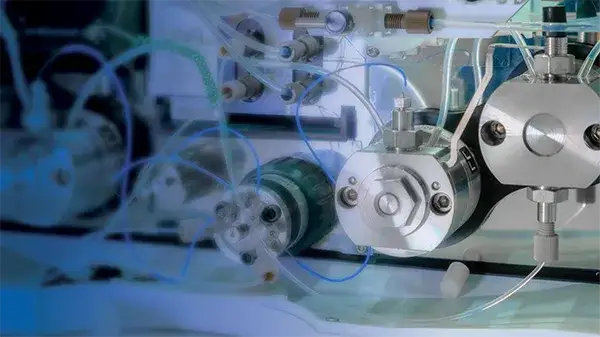
Analytical laboratories constantly seek faster separation methods. Monolithic chromatography serves as a liquid chromatography technique that uses a continuous, single-piece porous stationary phase instead of conventional packed particles. This unique structure creates a contiguous block of solid material featuring a macroporous network [1].
The design makes monolith chromatography a high-value option for fast separations, bioprocessing, and dirty-sample applications. This article covers the structure, types, comparisons, and applications of this technology.
What is Monolithic Chromatography?
A monolithic column acts as a separation medium formed into a hermetically sealed rod, disk, or capillary of silica or polymer. Because manufacturers fabricate the stationary phase as a single unit with highly interconnected channels, the solid structure easily resists high pressures during long analytical runs [2].
The term “monolithic chromatography” refers to the broader scientific concept and methodology, whereas “monolithic column chromatography” specifically describes analytical separations performed using monolithic columns.
How Does Monolithic Chromatography Work?
Understanding how monolithic chromatography works requires a look at fluid dynamics. The mobile phase flows through interconnected through-pores via convective mass transfer, rapidly pushing the liquid through large channels. Meanwhile, analytes interact with the high-surface-area mesopores. This dual-pore architecture gives monolith chromatography high permeability and high resolving power.
By eliminating the diffusional resistance and dead spaces seen in typical porous particle systems, this setup prevents trapped liquid [2]. As a result, backpressure stays low even at high flow rates, a combination that particle-packed columns cannot match.
Types of Monolithic Columns
Analysts select different types of monolithic columns based on the target analytes and the sample matrix. Each type offers specific chemical properties for monolithic column chromatography.
Silica-Based Monolithic Columns
Manufacturers prepare silica monoliths via sol-gel methods [3]. These columns provide good mass transfer and low backpressure [3]. You can use monolithic silica columns for the separation of small enantiomers and peptides. Phenomenex products such as Onyx monolithic HPLC columns offer excellent performance for small molecule analysis.
Polymer-Based Monolithic Columns
Chemists synthesize polymer monoliths using organic monomers. When evaluating a silica monolith vs. a polymer monolith, remember that polymers suit large biomolecules perfectly.
Specialty Formats: Capillary, Disk, and CIM Monoliths
Researchers use capillary monoliths for nano-liquid chromatography. Disk formats process biological fluids quickly. Convective Interaction Media (CIM) monolithic tubes provide an excellent format for scaling up the bulk purification of viruses and large biomolecules [4].
Monolithic vs. Packed Columns: Key Differences
Laboratory professionals compare a monolithic vs. packed column when developing a new HPLC method. Monolithic columns generate significantly lower backpressure at high flow rates compared to standard packed silica particles [3]. They eliminate the need for retaining frits and lack intraparticular void volume, which improves separation efficiency [5]. The separation performance in monolith chromatography is largely independent of flow rate [2].
The structural differences make monoliths ideal for demanding applications. Analysts save time because they can run methods at much higher speeds.
Advantages of Monolithic Chromatography
The advantages of monolithic chromatography center on speed and structural integrity. They enable rapid processing of complex biological mixtures with high flow rates at a very low pressure drop [6]. The benefits of monolith chromatography also include high resolving power for large biomolecules.
The design exerts very low shear stress on the sample, which safely protects fragile viruses and lipid envelopes during purification. The columns easily tolerate particulate-rich and viscous samples. The solid bed provides mechanical durability, allowing you to scale these columns from analytical formats up to preparative sizes.
Limitations of Monolithic Chromatography
Analysts must also understand the limitations of monolithic chromatography. Monoliths can be difficult to produce with strict batch-to-batch reproducibility [3]. The final morphology and pore structure of polymer monoliths depend heavily on the exact composition of the polymerization mixture [5]. These columns often show lower retention for very small molecules when compared to modern sub-2-µm particles.
Another major drawback of monolithic columns is the limited range of available chemistries [3]. Consequently, transferring methods from packed columns often requires substantial optimization to achieve comparable selectivity and resolution.
Applications of Monolithic Chromatography
The applications of monolithic chromatography span many scientific disciplines.
Biopharmaceutical and Bioprocessing Applications
Monolithic columns are widely used for the purification of viruses and viral vectors because they enhance virus binding while allowing contaminating proteins to pass through [4]. This makes monolith chromatography virus purification highly effective for gene therapy development.
Small-Molecule Analysis in HPLC
Analysts apply these columns to pharmaceutical quality control. The high permeability allows for rapid screening of drug candidates. The fast flow rates drastically reduce total analysis time.
Chiral and Enantiomeric Separations
Chemists use monoliths to resolve complex chiral compounds. The fast mass transfer helps separate enantiomers that typically co-elute on traditional media.
Affinity and Immunoaffinity Chromatography
The open-pore structure provides large adsorbing surfaces, leading to increased binding capacities for large molecules [4]. This feature supports monolith chromatography for protein purification and antibody isolation.
Environmental, Food, and Beverage Analysis
Environmental scientists analyze contaminated water samples directly on monoliths. The columns resist clogging from soil particulates. Food safety labs use them to detect pesticides in complex matrices like milk and honey.
How to Choose the Right Monolithic Column
Knowing how to choose a monolithic column prevents poor peak shape and low recovery. You should pick a silica monolithic column for small molecules, high-throughput testing, and small enantiomer applications. Keep in mind that silica possesses a limited working pH range (3). Select a polymer monolithic column for large biomolecules and bioprocessing tasks, especially when your method requires broad pH stability.
Always review your target analytes before making a final monolithic column selection. Capillary formats work best for nano-liquid chromatography, while CIM formats excel at affinity work and process intensification [4]. For a broader understanding of method development, review our guide on choosing the right HPLC column. You should also calculate your system’s column volume and extra-column volume to maximize performance.
FAQs on Monolithic Chromatography
Are monolithic columns suitable for small molecules or only biomolecules?
Monolithic columns work exceptionally well for both categories. Silica-based monoliths provide the necessary surface area for small-molecule separations. Polymer-based monoliths offer the ideal macroporous structure required for separating large biomolecules and intact proteins.
Why do monolithic columns have lower backpressure?
The stationary phase features a continuous network of large through-pores. This open structure allows the mobile phase to flow through the column using convective transport. The liquid avoids the tight interstitial spaces found in packed beds, which keeps the pressure low.
Can monolithic columns be used for dirty samples without sample preparation?
Yes, they handle dirty samples much better than packed columns. The large flow channels prevent particulates from clogging the inlet. Analysts frequently inject biological fluids and environmental water directly onto the column to save time.
How long does a monolithic column last compared to a packed column?
A monolithic column often lasts significantly longer when analyzing complex matrices. The lack of retaining frits eliminates the primary source of column clogging. The solid structure also prevents the stationary phase from collapsing under high flow rates.
References
- National Center for Biotechnology Information. (2012). Modeling of Dispersion in a Polymeric Chromatographic Monolith. PubMed Central. https://www.ncbi.nlm.nih.gov/pmc/articles/PMC3327764/
- National Center for Biotechnology Information. (2011). Self-interaction chromatography of proteins on a microfluidic monolith. PubMed Central. https://www.ncbi.nlm.nih.gov/pmc/articles/PMC3022334/
- National Center for Biotechnology Information. (2012). Affinity monolith chromatography: A review of principles and applications. PubMed Central. https://www.ncbi.nlm.nih.gov/pmc/articles/PMC3578177/
- National Center for Biotechnology Information. (2014). Concentration and purification of enterovirus 71 using a weak anion-exchange monolithic column. PubMed Central. https://www.ncbi.nlm.nih.gov/pmc/articles/PMC4042139/
- National Center for Biotechnology Information. (2010). Surfactant-Bound Monolithic Columns for Capillary Electrochromatography. PubMed Central. https://www.ncbi.nlm.nih.gov/pmc/articles/PMC2856648/
- National Center for Biotechnology Information. (2011). Selectivity of monolithic supports under overloading conditions and their use for separation of human plasma and isolation of low abundance proteins. PubMed Central. https://www.ncbi.nlm.nih.gov/pmc/articles/PMC3074050/