Gel Permeation Chromatography (GPC)
Gel Permeation Chromatography (GPC) is an effective means of separating and analyzing polymers, resins, oils, plastics, plasticizers, and small organics whose molecular weight can vary from 100-10,000,000 Daltons. It separates molecules by hydrodynamic volume using a porous polymer matrix. HPLC columns used for GPC are packed with polymeric media that can range in pore size from 50 Å to 10E6 Å and can be used with organic solvents such as toluene, THF, methanol, DMF, and methylene chloride.
Ideal gel permeation chromatography requires a GPC HPLC column that has superior mechanical strength and extreme solvent and temperature compatibility.
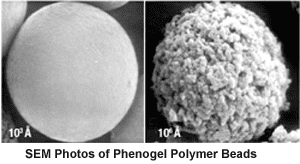
Overview
Phenomenex's Premier Gel Permeation Column
Principle of Gel Permeation Chromatography
Gel permeation chromatography operates on a straightforward principle: molecules are separated by size as they travel through a column packed with porous beads.
How the gel permeation chromatography principle works:
- Porous polymer beads create defined flow paths: Each bead contains pores of controlled size that determine how much a molecule can enter.
- Larger molecules elute earlier: They cannot enter most pores and move through the column more rapidly.
- Smaller molecules elute later: Their ability to access more pore volume increases their path length and retention.
- No chemical interactions: Separation is based solely on physical exclusion, supporting highly reproducible results.
- Direct link to molecular weight: Elution time correlates with molecular size when compared with calibration standards.
Molecular sieving effect enables GPC to provide consistent data for:
- Molecular weight averages (Mn, Mw, Mz)
- Polydispersity (PDI)
- Structural and compositional variations in polymers and macromolecules
The technique is simple to operate, compatible with a wide range of organic solvents, and well-suited for both routine QC and advanced materials research. With predictable performance and minimal method complexity, GPC remains an essential tool for laboratories that need accurate molecular size characterization.
Applications of Gel Permeation Chromatography
Gel-permeation chromatography supports diverse analytical needs by delivering fast, consistent insight into molecular size and distribution. Its size-exclusion mechanism makes it adaptable to many sample types and industries.
Key Application Areas
Polymer Characterization
How the gel permeation chromatography principle works:
- Determine molecular weight averages and distributions.
- Assess batch consistency, degradation, and branching.
- Support materials development in plastics, elastomers, coatings, and resins.
Biomolecules and Proteins
- Evaluate aggregation, oligomerization, and structural integrity.
- Characterize polysaccharides, PEGylated molecules, and other biopolymers.
- Monitor purity profiles in research and development workflows.
Pharmaceutical Quality Control
- Analyze polymeric excipients and drug delivery materials.
- Track molecular stability throughout formulation.
- Support regulatory compliance with consistent size-based analysis.
Environmental and Industrial Testing
- Analyze humic substances, microplastics, and organic matter.
- Characterize lubricants, oils, and industrial additives.
- Monitor polymer breakdown in wastewater and process streams.
Gel permeation chromatography provides actionable data that drives better material design, quality assurance, and product performance, making it a versatile and future‑ready tool for modern analytical labs.
FAQs
Is GPC the same as SEC?
GPC gel permeation chromatography is SEC performed in organic solvents, typically for synthetic polymers, while “SEC” is a broader term that also covers aqueous separations, including gel filtration chromatography (GFC).
Can GPC be used to analyze biological macromolecules?
Yes, GPC can analyze proteins, polysaccharides, and other biological macromolecules, provided they are soluble and stable in the chosen organic mobile phase or mixed‑solvent system.
What detectors are commonly used in GPC?
Commonly used detectors include refractive index (RI), UV/Vis, multi‑angle light scattering (MALS), and evaporative light scattering (ELSD). In multi‑detector GPC systems, RI measures concentration, MALS provides absolute molecular weight, and UV/Vis or ELSD adds selectivity and sensitivity for specific analyte classes.
What recent advances or innovations exist in GPC technology?
Recent advances include higher‑efficiency, low‑bleed GPC columns, high‑temperature and bio‑compatible phases, more stable calibration standards, and integrated multi‑detector platforms that combine RI, MALS, and viscometry for richer structural and branching information. Automated and fast‑GPC or APC‑style systems also shorten run times while maintaining resolution.
What is the difference between GPC and GFC?
GPC uses organic solvents and polymeric packing materials and is typically applied to synthetic polymers and hydrophobic macromolecules, whereas GFC (gel filtration chromatography) is its aqueous counterpart used for proteins and other hydrophilic analytes.