Liquid Chromatography Separation Modes
Liquid chromatography (LC) offers several separation modes, each based on specific chemical interactions between the analyte, stationary phase, and mobile phase.
Choosing the right separation mode is important as it affects retention, resolution, peak shape, and sensitivity. The primary LC separation modes and their underlying principles are outlined below:
Separation Principle in Chromatography
Chromatographic separation is based on how analytes interact with two phases:
- Stationary phase: A chemically modified solid support packed in the column
- Mobile phase: The liquid solvent flowing through the system
Compounds with weaker interactions elute earlier, while those with stronger interactions are retained longer.
Each separation mode is based on a different principle:
- Reversed Phase and Normal Phase: Hydrophobic and polar interactions
- Ion Exchange: Electrostatic interactions
- Size Exclusion: Molecular size
- HILIC: Polar interactions and partitioning
- Chiral LC: Stereospecific recognition
Highlights:
- Reversed phase chromatography accounts for over 80% of HPLC applications due to its versatility.
- Retention can be adjusted by modifying solvent composition, pH, or temperature.
- The degree of interaction depends on the analyte’s structure and properties.
- Careful selection of column chemistry and mobile phase enables fine-tuning for optimal resolution.
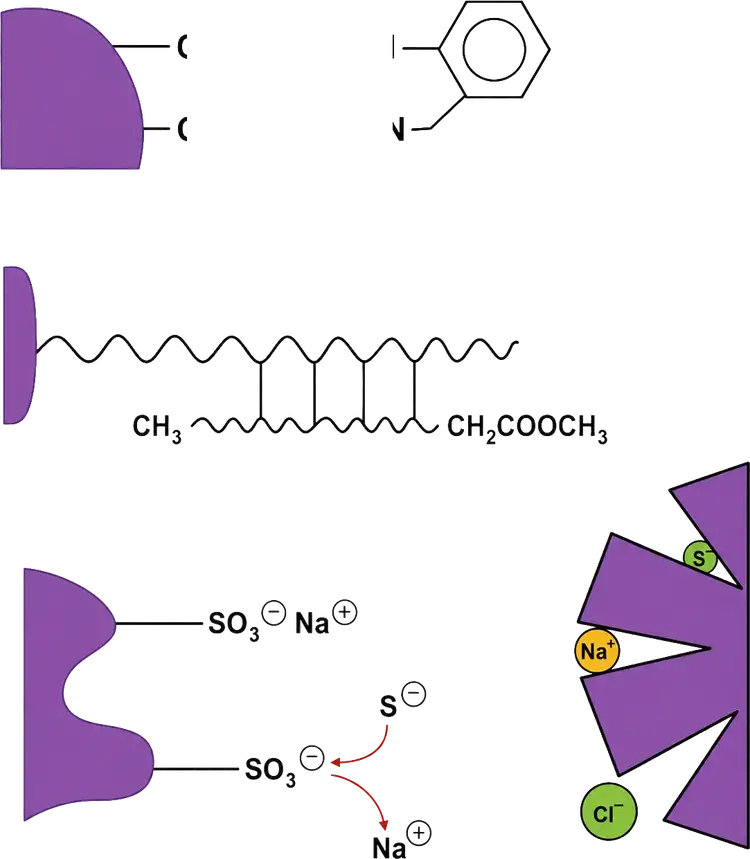
Column Types and Separation Modes
How to Choose the Right Separation Mode
Start by evaluating your analyte’s characteristics, polarity, ionizability (pKa), molecular size, chirality, solubility, and detector compatibility.
- Reversed Phase: Best for nonpolar to moderately polar compounds; a wide variety of HPLC columns support this mode.
- HILIC: Ideal for highly polar compounds; consider dedicated HILIC column chemistries to improve retention.
- Ion Exchange: Designed for charged molecules such as proteins and peptides; optimize recovery and resolution by selecting the appropriate ion exchange column.
- Size Exclusion: Polymers and aggregates where size matters.
- Chiral LC: Enantiomer separation and purity assessment.
Also consider solubility, sample stability, and detector compatibility when finalizing your choice.
FAQs
Can one sample be analyzed using multiple separation modes?
Yes. Applying different separation modes can provide complementary insights into a sample’s components. For example, polar compounds behave differently in HILIC compared to reversed-phase (RP) systems, offering distinct selectivity profiles. Switching between modes, such as normal phase and reversed phase, can also help resolve isomers or co-eluting compounds. This improves peak purity and overall characterization. In metabolomics, it is common to use both RP and HILIC to maximize coverage across a wide polarity range.
What Are the Main Separation Modes in HPLC?
The primary HPLC modes include reversed phase, normal phase, ion exchange, hydrophilic interaction (HILIC), size exclusion (SEC), and chiral chromatography. Each mode targets specific molecular properties such as polarity, charge, size, or chirality. Reversed phase is the most widely used, accounting for more than 80% of HPLC applications.