Supported Liquid Extraction (SLE)
Supported Liquid Extraction (SLE) is a simple, reliable sample preparation technique that provides cleaner extracts with minimal hands-on time. By performing liquid–liquid partitioning on a solid sorbent rather than in traditional Liquid-Liquid Extraction (LLE), SLE eliminates emulsions, inconsistent mixing, and manual phase separation. The aqueous sample is immobilized within the sorbent bed, enabling a water-immiscible organic solvent to pass through and extract analytes with high efficiency. The result is a fast, reproducible workflow ideal for subsequent LC and GC analyses.
For laboratories working with challenging biological or complex matrices, SLE offers a streamlined alternative to traditional LLE, improving analyte recovery while reducing matrix effects and variability. Phenomenex provides advanced SLE solutions, including Novum™ and Strata™ DE, engineered for robust, high-throughput environments.
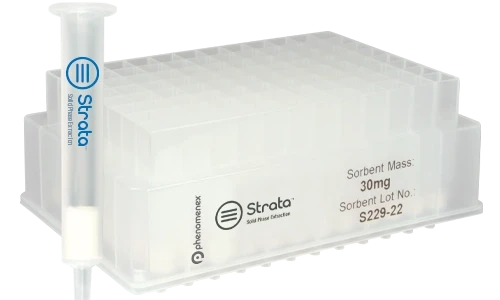
Overview
Synthetic supported liquid extraction product
96-well plates, 2 pk
Extraction of aqueous liquids using a synthetic solid support sorbent.
96-well plates, 1,3, and 6mL Tubes, and giga tubes (12 - 150mL tubes)
Interference free SLE sample prep designed for low level extractions. Get clean extracts and high recoveries from biological samples.
96-well plates, 2 pk
Phenomenex SLE Product Solutions
Novum SLE
Novum SLE features a high-purity synthetic sorbent engineered for fast flow, high capacity, and exceptional reproducibility. Its uniform architecture supports efficient aqueous immobilization and strong analyte recovery, even with viscous biological samples. Novum formats are automation-friendly, enabling high-throughput labs to achieve cleaner extracts with reduced matrix interference in LC-MS/MS methods.
Strata DE
Strata DE utilizes natural diatomaceous earth for dependable, cost-effective SLE cleanup. Its strong adsorption capability ensures complete aqueous uptake and controlled solvent elution, making it ideal for routine clinical, environmental, and food testing applications.
Strata SE
Strata SE is a synthetic, high-purity SLE sorbent specifically designed for the most sensitive analyses. It gives high and consistent recoveries from biological matrices with minimal background interferences.
What Is Supported Liquid Extraction (SLE)?
In SLE, the aqueous sample is applied to a porous sorbent such as diatomaceous earth or a synthetic support where it is instantly immobilized. A water-immiscible organic solvent then passes through, allowing analytes to partition into the organic solvent and elute cleanly for LC or GC analysis. Because the aqueous phase remains fixed, SLE avoids shaking, mixing, and phase separation steps, delivering higher reproducibility and consistently cleaner extracts for bioanalytical, clinical, and toxicology workflows.
Principle and Mechanism of SLE
SLE uses the same partitioning principles as LLE but performs them on a solid support. Capillary forces distribute the aqueous sample evenly throughout the porous sorbent, creating a thin, consistent layer with high surface area. When an organic solvent such as ethyl acetate or dichloromethane is added, analytes partition into the solvent, which flows through the bed and is collected as a clean extract.
Step-by-Step SLE Workflow
- Dilute and Prepare Sample
The biological or environmental sample is diluted with an appropriate aqueous buffer to reduce viscosity and render any ionizable analytes in a neutral state. Neutral analytes are more hydrophobic than ions, allowing them to partition into the organic solvent (which is added in Step 3) to a greater extent, increasing recovery. This step ensures consistent penetration and distribution across the sorbent bed. - Load Sample onto SLE Sorbent
The diluted sample is applied to the SLE cartridge or plate. The sorbent immediately adsorbs the entire aqueous phase, immobilizing it as a uniform thin layer. No mixing, shaking, or manual phase separation is required. - Elute Analytes with Organic Solvent
A water-immiscible organic solvent is added to the column or well. As it flows through, analytes partition from the immobilized aqueous layer into the organic phase and elute into a collection vessel. The resulting extract is cleaner, has lower matrix content, and is typically ready for direct injection into LC-MS or GC-MS systems.
Dilute → Load → Elute
This straightforward workflow minimizes hands-on time, lowers risk of technique-based variability, and provides consistent recovery across sample types.
Advantages of Supported Liquid Extraction (SLE)
SLE offers several advantages over traditional LLE, making it a preferred technique for modern analytical laboratories:
- No Emulsions: The aqueous phase is immobilized within the sorbent, preventing turbulence and eliminating emulsion formation, a common cause of method failure in LLE.
- Higher Repeatability and Reproducibility: Uniform sorbent structure ensures consistent extraction conditions, reducing analyst-to-analyst variability.
- Cleaner Extracts: Lower matrix interference improves accuracy, enhances LC-MS ionization efficiency, and supports lower limits of detection and quantitation.
- Faster and Easier Workflow: No shaking, vortexing, or manual phase separation is needed, decreasing hands-on time and improving lab productivity.
- Automation-ready: SLE plates and cartridges integrate easily into automated liquid handling systems for high-throughput extraction.
SLE vs LLE Comparison Table
Applications of Supported Liquid Extraction (SLE)
SLE is widely used across industries that rely on clean, reproducible sample preparation for trace-level analysis.
Pharmaceutical and Bioanalytical
Ideal for extracting drugs, metabolites, and biomarkers from plasma or serum. SLE provides cleaner extracts and better LC-MS/MS sensitivity for PK/PD, bioequivalence, and preclinical studies.
Clinical and Forensic
Used for routine analysis of drugs of abuse, therapeutic drug monitoring, and toxicology screening. SLE simplifies the cleanup of urine, serum, and oral fluid samples while preserving analyte integrity.
Food and Environmental
Effective for isolating pesticides, additives, contaminants, and organic pollutants from complex matrices such as juices, water samples, or processed foods. The cleaner extracts reduce interference and improve detection accuracy.
Toxicology
Offers rapid and reproducible cleanup of challenging matrices prior to GC-MS or LC-MS analysis, supporting both targeted and broad screening panels. Across all application areas, SLE improves throughput, reduces matrix suppression, and delivers more robust method performance.