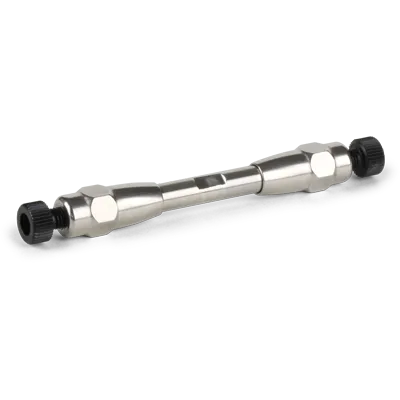


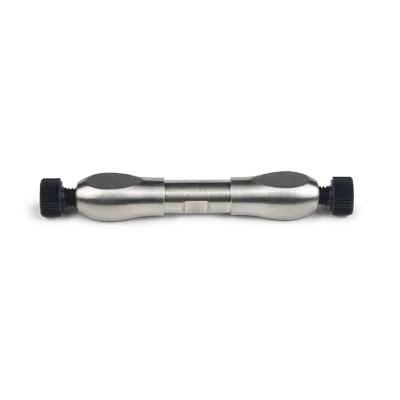
Kinetex Core-Shell C18 HPLC Column

The Go-To Core-Shell Selectivity for Hydrophobic Compounds!

The well-rounded, all-purpose core-shell Kinetex C18 HPLC column produces high efficiencies compared to traditional, fully porous columns. HPLC C18 columns come in various configurations to ensure outstanding performance and are recognized as the most retentive among alkyl-bonded phases. When used with UHPLC systems, the 2.6 µm size achieves similar performance to fully porous sub-2 µm particles but at significantly lower backpressure. Yielding remarkable chromatographic resolution, higher peak capacities, and greater sensitivity, the Kinetex C18 columns maximize the efficiency of every HPLC or UHPLC analysis.

Advantages of Kinetex Core-Shell C18 HPLC Columns

  • Compatible with all Analytical HPLC/UHPLC Systems*
  • Four fully scalable particle sizes available
  • Excellent Reproducibility and Batch-to-Batch Confidence
  • USP: L1

*Kinetex C18 analytical columns are compatible with all LC systems with standard LC column end-fittings threaded in 10-32. Please contact us for any questions and information about fitting compatibility and any other column internal diameters.

Particle Size
1.3, 1.7, 2.6, 5
Recommended Use
All-purpose hydrophobic retention and methylene selectivity

Order

Select Attributes:

Internal Diameter (mm)

0.3

0.5

1

2.1

3

4.6

10

21.2

30

50

50

Length (mm)

30

50

75

100

150

250

Particle Size (µm)

1.7

2.6

5

Pore Size (Å)

100

Showing 1-5 of 64 Results
$958.00 USD (Ea)

Sign In

$892.00 USD (Ea)

Sign In

$958.00 USD (Ea)

Sign In

$905.00 USD (Ea)

Sign In

$905.00 USD (Ea)

Sign In

Overview

Compatibility

The Kinetex C18 column is fully compatible with all UHPLC instruments, ensuring seamless integration into any lab setup. This column is designed for easy installation and optimal performance. For installation, loosen the collet, place the tool between the gold compression screw and collet for quick release, adjust the tubing to the correct port depth, and connect the Kinetex column to the end-fitting. This universal compatibility allows you to leverage the powerful sub-2 µm column technology across different systems effortlessly.

Balances Retention and Performance

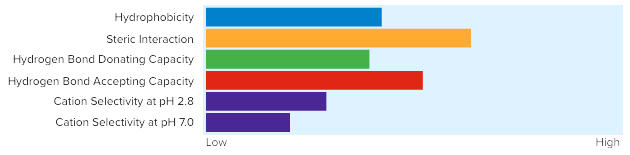
The Kinetex C18 column offers a well-balanced C18 phase that delivers the highest level of hydrophobic selectivity compared to other Kinetex phases

Upgrade from Traditional Fully Porous to Kinetex Core-Shell

Enhance your analytical method instantly by upgrading to the Kinetex C18 column for superior performance. Take advantage of the fully scalable available particle sizes of Kinetex C18 to bring improved performance to any LC system!

Core-shell columns are best suited for the rapid and precise separation of complex drug mixtures. Improve the quality control process with Kinetex Core-Shell columns.

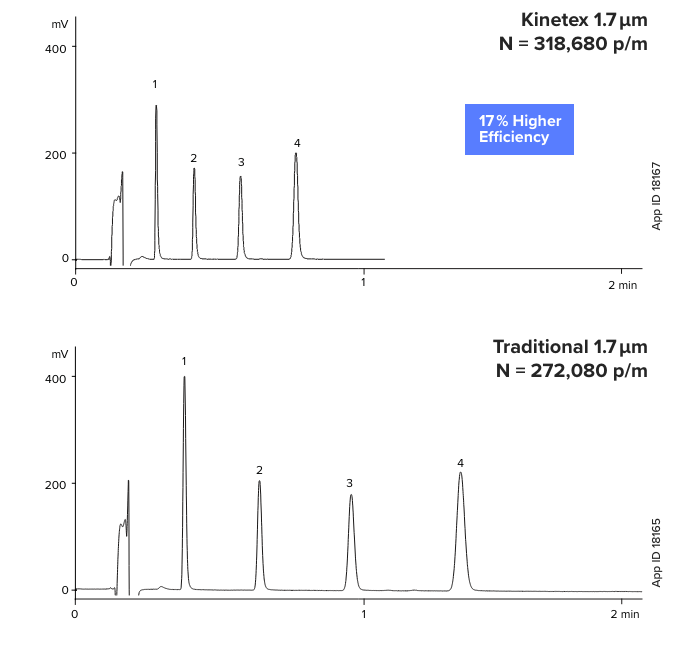
1.7 µm Fully Porous vs. 1.7 µm Core-Shell

Conditions for all columns:

Columns:

Kinetex 1.7 µm C18, Traditional 1.7 µm C18

Dimension:

50 x 2.1 mm

Flow Rate:

0.6 mL/min

Temperature:

25 °C

Detection:

UV @ 254 nm

Mobile Phase:

Acetonitrile / Water (50:50)

Instrument:

*Waters® ACQUITY® UPLC®

Sample:

1. Acetophenone
2. Benzene
3. Toluene
4. Naphthalene

Fully Porous vs. Core-Shell

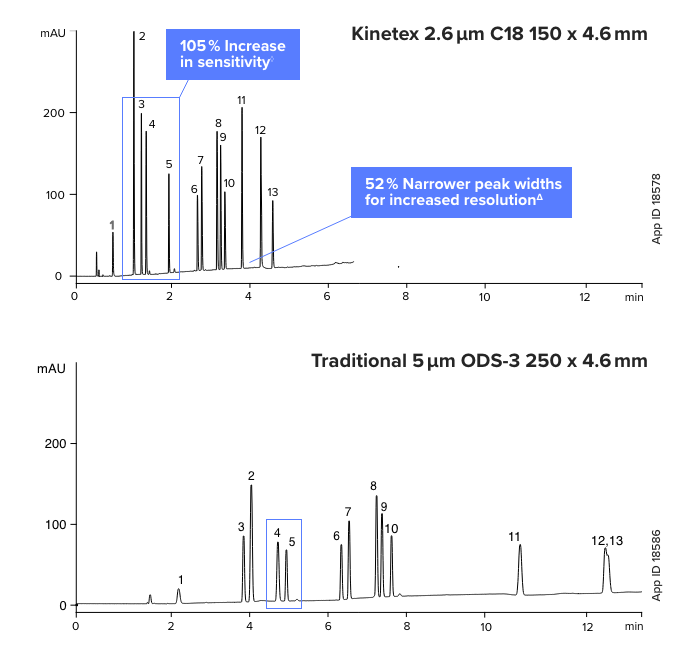
◊ Signal-to-noise ratio of peak 2; ∆ Based on average peak widths; *Waters, ACQUITY, and UPLC are registered trademarks of Waters Corporation. Phenomenex is not affiliated with Waters Corporation. Comparative separations may not be representative of all applications. Conditions same for both columns except where noted.

Conditions for both columns:

Columns:

Kinetex 2.6 µm C18 100 Å, Traditional 5 µm ODS-3 100 Å

Dimension:

Kinetex: 150 x 4.6 mm, Traditional: 250 x 4.6 mm

Flow Rate:

1.8 mL/min

Temperature:

50 °C

Detection:

UV @ 215 nm (22 °C)

Mobile Phase:

A: 0.1 % Phosphoric acid in  Water, B: 0.1 % Phosphoric acid in Acetonitrile

Gradient:

5 % to 95 % B in 9 min (150 x 4.6 mm), 5 % to 95 % B in 15 min (250 x 4.6 mm)

Sample:

1. Procainamide
2. Acetaminophen
3. Folic acid
4. Sulfathiazole
5. Acebutolol
6. Dextromethorphan
7. Diphenhydramine
8. Propafenone
9. Amitriptyline
10. Fluoxetine
11. Naproxen
12. Diflunisal
13. Indomethacin

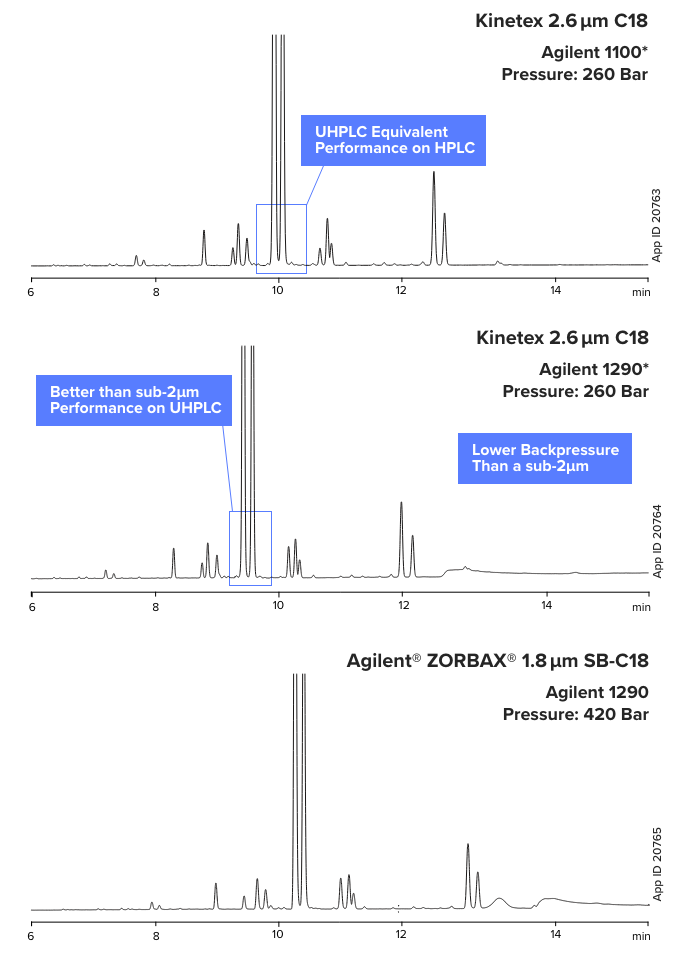
Performance with Kinetex C18 on HPLC and UHPLC Systems

Quickly improve the productivity and performance of your existing methods and utilize the core-shell advantage to deliver the performance you need at backpressures the system can handle.

Fully Porous vs. Core-Shell

*Agilent 1100 was optimized with the Core-Shell Performance Enhancement Kit AQ0-8892. Agilent and ZORBAX are registered trademarks of Agilent Technologies, Inc. Phenomenex is not affiliated with Agilent Technologies. Comparative separations may not be representative of all applications.

Columns:

Kinetex 2.6 µm C18 (Agilent 1100*), Kinetex 2.6 µm C18 (Agilent 1290), ZORBAX 1.8 µm SB-C18 (Agilent 1290)

Dimension:

100 x 4.6 mm

Flow Rate:-

1.2 mL/min

Temperature:

Ambient

Detection:

UV @ 210 nm

Mobile Phase:

A: Water with 0.1% TFA, B: Acetonitrile with 0.1% TFA

Gradient : Time (min)

% B

010
2070

Sample:

Mupirocin degradants

FAQs

As with any column, loading capacity of Kinetex 1.3 µm C18 depends on a number of variables: the chemical nature of the analyte (acid, base, or neutral) the running conditions (mobile phase and flow rate, temperature) the dead-volume system of the system the method limitations for the specific method (one customer may find that a 10% increase in peak width is unacceptable, while another may not mind a 40% increase in tailing as a function of overload). That said, in general, loading capacities for the same media is independent of particle size (i.e. a 3 µm media should have the same loading capacity as a 5 µm media of identical base media and surface chemistry). So, in general, one would predict that the loading capacity of Kinetex 1.3 µm would be identical to that of similar core-shell C18 columns.
There are several C18 columns that we have shown work very well for PFAS analysis and provide adequate resolution for LC-MS/MS. The Luna™ Omega column is 100 % aqueous stable with a positive surface modification that demonstrates a unique selectivity and increased retention of acidic compounds such as PFAS. Of course, the ligand provides excellent retention for hydrophobic interactions as well. Similar to the structure of PFAS compounds. As an alternative, the Kinetex™ EVO is a core-shell developed for UHPLC separations. Coreshell particles show less band broadening, compared to fully porous particles, giving greater efficiency. We also carry the Gemini™ column portfolio developed for extended lifetime and extreme pH conditions. All have been shown to work well for PFAS separations which you can find on our website.
The two culprits are often the methanol and the lab consumables. Be sure to use high grade methanol from a reputable source, as well as high grade ammonium acetate. Some vendors have cleaner methanol than others, it is recommended that you test each lot before using. Also, the gases used for the LC-MS/MS can be another source of contamination. With respect to consumables, we wary of any consumables that are advertised as “low binding” or “low retention” as these often contain PFAS.
LCs use plastic tubing that is made of fluoropolymers which will slowly leach and cause high background levels. Ultimately this results in higher LOQs. To mitigate this PFAS leaching we replace the tubing with PEEK, wherever possible. Another source of PFAS contamination can be the solvent mobile phase filters. However, there can still be some fluoropolymer remaining in the LC which cannot be replaced. Therefore, a “delay” column is added between the pump mixer and the autosampler to chromatographically separate the LC PFAS contamination from the analytical peak. The good news is that this does NOT impact your ability to analyze other chemicals and is fully compatible with your other assays. The delay column can be quickly removed or left in place. In fact, it may even be beneficial for reducing background for other compounds such as plasticizers commonly found in the LC.
Graphitized Carbon Black (GCB) has been known to bind long chain PFAS and is used by some laboratories as a SPE sorbent. Some problems can occur where low recoveries are achieved due to irreversible binding of certain PFAS compounds, most likely the longer chain PFAS. Therefore, the method has comments to exercise caution when using GCB cleanup and to minimize the contact time between the PFAS and GCB.
This is quite a challenge as many of the products that we use, including our solvents, reagents, glassware, sample prep, and LC instrumentation can have PFAS background. Some general tips are to clean all equipment prior to, and after each use, make sure your reagent water, solvents such as methanol and ammonium hydroxide, are as PFAS free as possible. You may have to inquire from your vendor for details or if they can have some guarantee on background levels. There can also be PFAS in disposable plastics such as pipette tips and filters. Some methods recommend baking glassware, deterrent washing and rinsing with clean water, and proper storage for air drying. You can also implement a pre-rinse procedure using methanol with 0.1% ammonium hydroxide, toluene, and methanol. If you are using automated sample preparation, rinse the system with the same solvents. The LC pump should have a delay column between the pump and the autosampler as Teflon seals are common in LC systems. It’s advisable to review validated method guidance which often provide more detail on dealing with interferences within your lab, your system, and also within samples.