
Core-Shell Technology Improving HPLC Methods Within USP: Part 4

Part IV: More about the Chromatographic Impact of Making Adjustments to Existing Methods
Welcome to the fourth part of the series that is examining the effects of modifying existing European Pharmacopeia (Ph. Eur.) or United States Pharmacopeia (USP) methods.
In the last article, I started going over various adjustments that could be made to USP and Ph. Eur. Methods without having to go through a complete re-validation, and had finished with the role of adjusting the injection volume. So now let’s continue the list so that you can have a pretty clear picture of how the various acceptable adjustments to compendial methods will impact your chromatography.
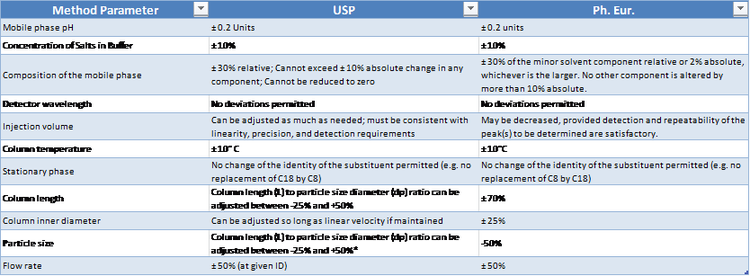
Table 1 lists out the current allowable adjustments to USP and Ph. Eur. methods, respectively. For many of the method parameters, both the Ph. Eur. and USP have identical allowable adjustment specifications, but for some (particularly when it comes to column format) there are slight differences. Again, as we go through these, remember that these adjustments pertain only to ISOCRATIC methods.
Table 1. Allowable adjustments to isocratic USP and European Pharmacopeia methods.
Column Temperature
Both the Ph. Eur. and USP allow for small, yet significant adjustment (± 10°C) in oven temperature for your HPLC column. Temperature actually plays a pretty big role in chromatography, and changing the temperature within that range can dramatically influence column pressure, analyte retention time, selectivity, and resolution.
- Pressure will be inversely affected by changes to temperature due to the effect on viscosity of your mobile phase.
As the temperature increases, back pressure will decrease as mobile phase viscosity is reduced. As pressure is rarely a consideration in system suitability, you are unlikely to pass or fail a suitability requirement due to changes in operating pressure.
However, you may find that increasing the temperature is a useful tool in reducing operating pressures when you combine it with other adjustments. For example, moving from a 5 µm particle to a 3 or 2.6 µm particle will dramatically increase operating pressure, particularly with high viscosity methanol-containing mobile phases. Increasing the column temperature can offset some of that increase in pressure.
- Analyte retention times will decrease as the temperature increases.
The degree of change in retention is difficult to predict with any high degree of accuracy, so you will probably need to learn through experimentation.
- Selectivity and Resolution
Not all analytes will shift at the same rate, which is why you many see changes in selectivity and resolution as temperature is changed as well. Because individual sample analytes (or matrix components) will respond differently to changes in temperature, it is possible that you can shift the elution order of analytes as you increase or decrease temperature.
This can lead to co-elution in the worst cases, but in other cases you may find changing the temperature improves your selectivity and resolution.
The problem is that it is very difficult to predict and, if you have complex samples, you are likely to find that an adjustment in column temperature that improves resolution in one region of the chromatogram can cause a co-elution somewhere else. Due to changes in selectivity and resolution that can occur when you adjust temperature, I would hesitate to view this as a tool to “improve” an existing method.
However, I would HIGHLY encourage anyone that develops a validated method to use temperature control (as opposed to operating under ambient temperature conditions) as a way of adding an additional layer of method robustness, especially if you work in an environment where room temperatures can fluctuate.
Stationary Phase
No adjustments are allowed with regards to your bonded phase. However, it is important to note that there can be a tremendous amount of variability in the performance of the same stationary phase (e.g. C18 or L1) from different vendors, or even from different LC brands offered by the same vendor. This is because the chemical nature of the bonded phase itself is only one component that contributes to the overall chromatographic performance of a column.
Retention and selectivity will also be influenced by numerous other factors including (but not limited to) particle pore size, surface area, bonding density, chemical nature of the bonding itself (polymeric versus monomeric versus mixed), end capping, as well as the type of silica used (modern base-deactivated versus older silica). Thus, a person could screen three different “L1” columns of the same exact dimension from three different manufacturers and obtain three very different results.
Column Length
Here is where things can begin to get a bit more complicated.With regards to column length, the USP and Ph. Eur. provide very different guidelines. The Ph. Eur. provides the simpler guideline – you may adjust the length of the column by ± 70%. This is quite a broad range and allows you to adjust from a standard 250 mm long column down to a 75 mm column length, and an older method that calls for a 300 mm column length could be scaled down to 100 mm in length. For isocratic methods, run time will be directly proportional to column length (all other things being equal), so if you cut the column length in half, you would cut your run time in about half (not quite perfectly due to system volume contributions).
Column efficiency is also proportional to length, so as you decrease the size of your column, you will also decrease the efficiency and hence the resolving power of that column. To offset the loss of efficiency when moving to a shorter column, increase the efficiency of your media by either moving to a smaller, more efficient particle (e.g. a 3 µm particle instead of 5 µm), and/or moving to core-shell media that creates a higher efficiency than fully porous media. We will discuss this in more detail below when we discuss particle diameter. When it comes to the USP guidelines, it is a bit more complex.
For isocratic separations, the ratio of column length (L) to the particle size (dp) must remain constant or within range between -25% to +50% of the prescribed L/dp ratio.
For example, let’s assume you are currently running a method using a 250 mm long column packed with 5 µm particles (0.005 mm) and you want to decrease your analysis time. For this method, your initial L/dp ratio would be 250 mm/0.005 mm = 50,000. Let’s say you wanted to move to a shorter format of 150 x 4.6mm, 3 µm (0.003 mm). The L/dp ratio for that would be 150 mm/0.003 mm = 50,000, so that would be a direct scale down from the original column.
You could make that adjustment and be within the acceptable guidelines. Now, what if you wanted to use a core-shell column with a 100 x 4.6 mm column packed with 2.6 µm core-shell media?
The resulting L/dp ratio would be 100 mm/0.0026 mm = 38,461, which is a 23% decrease from the original ratio, and so that falls within the -25% to +50% guidelines, but clearly you could not go any shorter or you would exceed the allowable adjustment. Keep an eye out as the series will finish up with a review of these guidelines in the next blog.
Related Articles
USP Chapter 621: Overview & Key Points