
Fast and Economical PFAS Extraction Using Strata PFAS - SCIENCE UNFILTERED

PFAS are a class of highly stable synthetic organic compounds used in a wide variety of industrial and commercial applications. They are also highly stable in the environment and strongly bioaccumulate. As a result, they have become ubiquitous throughout the globe and are often referred to in today's media as "Forever Chemicals". Consequently, PFAS levels need to be tested in drinking water and more recently methods have been developed to measure PFAS in other environmental matrices that require more complex clean-up solutions, such as wastewater, soils, and sediments.
Accurate, Precise, and Economical PFAS Extraction Solution
The United States Department of Defense (DOD) is dealing with extensive PFAS contamination owing to the widespread use of PFAS-based Aqueous Film Forming Foam (AFFF) used as fire suppression foams at many military installations. As a result, DOD developed its own PFAS analytical guideline to help solve their installations' unique environmental monitoring and clean-up challenges. The US EPA and DOD have been working jointly to validate EPA 1633 Analysis of Per- and Polyfluoroalkyl Substances (PFAS) in Aqueous, Solid, Biosolids, and Tissue Samples by LC-MS/MS. A single-lab validated draft method is the result of this collaboration method and calls for the use of a polymeric weak anion exchange (WAX) SPE sorbent in combination with graphitized carbon black (GCB) powder. For water samples, the process involves an initial SPE using a WAX cartridge followed by dGCB or the use of a second cartridge. For solid samples, dGCB is added to an initial ammonium hydroxide wash, followed by the WAX SPE cartridge.
Both methods add time, cost, and chances for increased errors to the clean-up procedure and present the opportunity for loss of analytes and introduction of imprecision.
Strata PFAS SPE, wherein the two sorbents are contained within a single tube, offers the opportunity for decreased sample processing time and increased accuracy and precision. Strata PFAS is a stacked single cartridge solution with polymeric WAX and GCB sorbents that functions as a traditional Solid Phase Extraction (SPE) cartridge with a built-in polishing step. When comparing different recoveries for a small subset of analytes for a WAX SPE and dSPE GCB method versus Strata PFAS, the recovery is greatly improved using Strata PFAS. The results are shown in Table 1.
A routine Laboratory Control Sample (LCS) was conducted by a commercial testing laboratory highly experienced with PFAS analysis. The LCS had been spiked with all 32 target analytes at 25 μg/L and was analyzed with a batch of field samples to demonstrate method performance and data acceptability.
As shown in Table 2, all 32 analytes were well within method recovery limits with an average recovery of 98.8% and a mean recovery of 99.0%, thereby demonstrating acceptability of the use of Strata PFAS in the performance DOD QSM5.1/5.3 as well as draft EPA 1633.
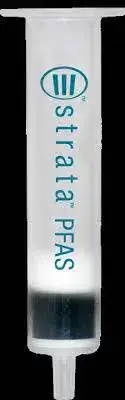
SPE Conditions for Analyte Extraction Using Strata PFAS SPE
Cartridge: Strata PFAS 200 mg WAX/50 mg GCB/ 6 mL)
Part No.: CS0-9207
Condition 1: 4 mL 0.3 % Ammonium hydroxide
Condition 2: 4 mL Methanol
Equilibrate: 5 mL Water
Load: Add sample at 4 mL/min
Wash: 2x 4 mL Water
Elute: 2x 4 mL 0.3 % Ammonium hydroxide in
Evaporate: Methanol to dryness and reconstitute to 1 mL with Methanol/Water (96:4)
Table 1: Recovery Comparisons of WAX SPE and dSPE using GCB vs Strata® PFAS Single Cartridge Method
% Recovery
% Recovery
Table 2: Recovery of QSM 5.3 Target Analytes from a Laboratory Control Sample Using Strata PFAS SPE (WAX/GCB)
Method Recommendation
Limits
Andrew Patterson1 , Charles Neslund2 , Robert Brown2 , Sam Lodge3 , David Kennedy3 , and Brian Marshall3
1 Eurofins Environment Testing America, 800 Riverside Pkwy, Sacramento, CA, 95605, USA 2 Eurofins Environment Testing America, 2425 New Holland Pike, Lancaster, PA 17601, USA 3 Phenomenex, Inc., 411 Madrid Ave., Torrance, CA 90501, USA