
How to Fix Early Eluting Peak Shape in Gas Chromatography

Early eluting peak shape in gas chromatography (GC) depends on analytical method conditions, and early eluting compounds tend to have poor peak shapes. The distortion appears as one of three symptoms. Tailing is a peak with a stretched trailing edge, fronting is asymmetry toward the leading (front/left) side of the peak and splitting is a peak that breaks into two. This guide explains why early peaks distort and gives six fixes, each with its trade-off.
Use a Split Injection
Early peak distortion often comes from a sample solvent that is not well matched to the stationary phase. Some analytes may not fully focus onto the column well because the initial oven temperature may be too high. Polarity mismatch can also occur if a solvent does not dissolve well in the phase. The solvent pools on the column phase and moves down the column with the carrier gas, and some compounds travel with the solvent pools and may lead to tailing or split peaks.
When vapor leaves the injector and enters the cooler column, the solvent condenses at the front of the column as a liquid band. Vapors condense in this band and are trapped and refocused, a process called the solvent effect. Too much solvent or sample on the column and the injection technique can also distort early peaks and degrade GC peak shape.
Six Ways to Fix Early Eluting Peak Shape
These six fixes help minimize distortion of early peaks, and some trade away sensitivity, so analysts who want sharper peak shape and higher sensitivity in GC should weigh each trade-off.
Use a Split Injection
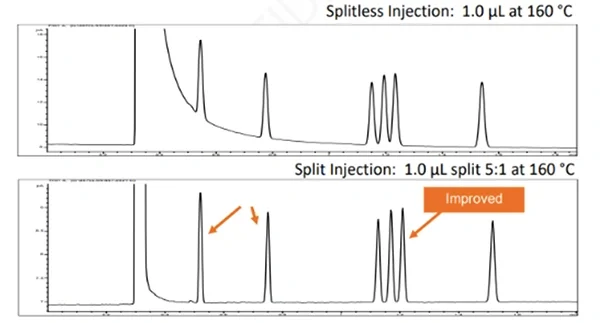
A split injection limits the amount of solvent that gets onto the column and reduces how much analyte dissolves in pooled solvent. It also reduces peak widths because the higher flow through the inlet moves compounds from the inlet to the column faster, which improves peak shape considerably. The downside is that a split sacrifices sensitivity, so this option suits methods with sensitivity to spare or a more concentrated sample. More details on split injections/inlet discrimination are available.
Figure (chromatogram): Peak widths decreased by adding a split ratio
Decrease the Injection Volume
A smaller injection volume reduces the amount of solvent that reaches the column. It reduces the amount of analyte too, so it also sacrifices sensitivity.
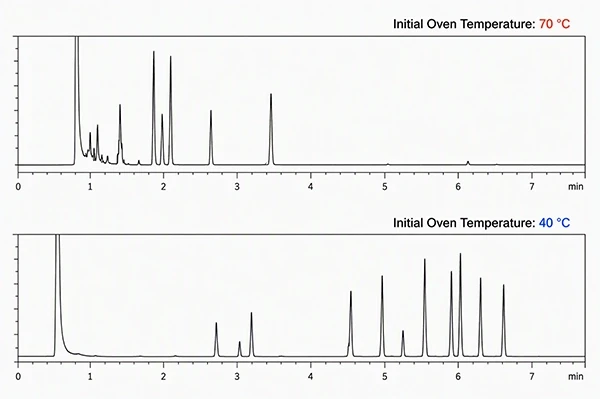
Lower the Initial Oven Temperature
Lowering the initial oven temperature forces compounds to condense more into the phase and limits their migration during injection. This process is known as analyte focusing, and volatile analytes condense into a narrow band at the column head before the temperature program starts. Solutes that boil at 150 °C or more above the initial column temperature do not require the solvent effect to refocus, and these high-boiling compounds condense in a short band at the beginning of the column without the aid of the solvent. This process is called cold trapping. The downside is slightly longer cycle times because cooling to a lower temperature may take longer.
Use a Pressure Pulsed Injection
A pressure pulsed injection increases the flow onto the column, but only temporarily. This helps focus the compounds and results in a narrower peak shape. A pulsed injection typically runs about 10–15 psi (pounds per square inch) above the normal pressure for the duration of the injection, although the exact value depends on the instrument. Afterward, the pressure and flow return to normal. Early eluting compounds can elute even earlier, so a solvent delay may need to be reduced if you use a mass spectrometry (MS) detector.
Use a Guard Column
When used with volatiles, a guard column is sometimes called a solvent gap. It can help separate the analytes from the solvent and reduce the solvent pool effect. A guard column can also improve separation and peak shapes, especially for early eluters, and improve the sensitivity and accuracy of quantitative results. It can extend column lifetime in some instances because the guard can be trimmed or replaced when dirty samples contaminate it, which would otherwise sacrifice the performance of the column.
Increase the Column Film Thickness
A thicker film dissolves volatile compounds better and increases retention for early eluting peaks. It also increases capacity and dissolves greater amounts of solvent, which helps minimize distortion due to solvent mismatch, at the cost of some efficiency and a longer run. Columns with larger diameter or thicker stationary phase coatings generally have larger sample capacities, but resolution may be reduced. Analysts who choose a column for early eluting peaks can browse Zebron GC columns.
Quick Reference: Symptom to Fix
Use this table to match an early peak symptom to its likely cause and a fix to try first. Broader issues such as baseline, late-peak, detector, or carrier-gas problems fall outside this page, and the GC troubleshooting guide covers them.
FAQs
What causes early eluting peaks to tail or split in GC?
Early eluting peaks can tail or split when the solvent pools on the column phase and some compounds travel with the pools. Polarity mismatch can occur if a solvent does not dissolve well in the phase, and the carrier gas pushes the pools down the column. An initial oven temperature that is too high can also keep analytes from fully focusing onto the column, which is one reason early eluting compounds are apt to have poor peak shapes.
What is analyte focusing in gas chromatography?
Analyte focusing is the condensing of compounds into the phase when you lower the initial oven temperature, which limits their migration during injection. Volatile compounds condense into a narrow band at the column head before the temperature program starts. The cost is slightly longer cycle times because cooling to a lower temperature may take longer.
How does a split injection improve early peak shape?
A split injection improves early peak shape by limiting the solvent that gets onto the column and reducing how much analyte dissolves in pooled solvent. The higher inlet flow also moves compounds to the column faster, which reduces peak widths. The trade-off is lower sensitivity.
What is the solvent effect in GC?
The solvent effect in GC is the trapping and refocusing of vapors in a liquid solvent band at the front of the column. When vapor leaves the injector and enters the cooler column, the solvent condenses as this band, and vapors condense in it.
Does increasing film thickness help early eluting peaks?
Yes, a thicker film does help early eluting peaks because it dissolves volatile compounds better and increases retention. It also dissolves greater amounts of solvent, which helps minimize distortion due to solvent mismatch. The trade-offs are some efficiency, a longer run, and possibly reduced resolution.