









What Is a Chiral Molecule? Understanding Chirality and Chiral Chromatography


Hold your hands out in front of you, palms facing the same direction. They look identical at first glance, yet no matter how you rotate or flip them, one hand can never perfectly overlap the other. This everyday observation is the simplest way to understand what is chiral.
Chirality is the property of a molecule that makes it non-superimposable on its own mirror image, and that single geometric feature has profound consequences across pharmaceutical science, drug safety, and analytical chemistry.
This guide covers the chiral meaning, the distinction between chiral and achiral molecules, how chiral column chromatography works, and how Phenomenex can help you screen and select the right column for your separation needs.
What Does “Chiral” Mean?
The word “chiral” derives from the Greek word for hand, and the hand analogy is not accidental. Chirality is a fundamental geometric property in chemistry that describes how certain molecules, with the same atom-to-atom bonds, exist in two distinct three-dimensional forms called enantiomers. In organic chemistry, a chiral molecule typically contains a carbon atom bonded to four different substituents, whether individual atoms or groups of atoms. That carbon is called a chiral center, and it is the origin of the molecule’s asymmetry.
When four different groups surround a tetrahedral carbon, two spatial arrangements become possible. These two arrangements are mirror images of one another, and they cannot be superimposed regardless of how you rotate them in space. The chiral meaning, in practical terms, is that a single compound can have two structurally distinct versions that behave differently in biological, chemical, and physical environments.
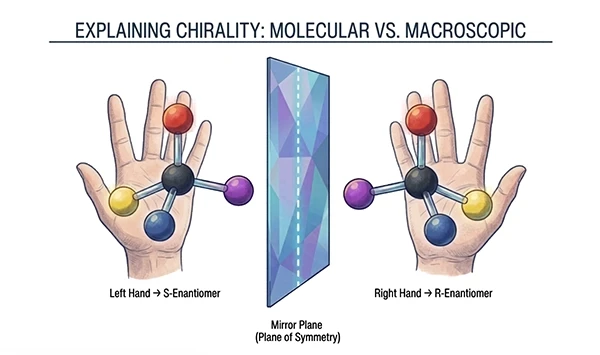
Common examples of chiral molecules can be amino acids, glucose, or ibuprofen, all of which exist as two non-superimposable mirror-image forms with distinct biological behaviors. Recognizing a chiral center is the first step toward understanding why enantiomers need to be separated during pharmaceutical analysis.
What Is the Difference Between Chiral and Achiral?
Not every molecule is chiral. An achiral molecule is one that can be superimposed on its mirror image, which means its two mirror forms are identical. The key structural feature that makes a molecule achiral is the presence of a plane of symmetry, an imaginary plane that divides the molecule into two mirror-image halves. An achiral organic molecule generally carry two identical substituents on its central carbon, removing the asymmetry that chirality requires.
A chiral object, by contrast, lacks any plane of symmetry. The same logic applies at the molecular level: your left hand has no plane of symmetry that maps it perfectly onto your right hand, and neither does a chiral molecule.
Two enantiomers share a key physical distinction, as they rotate polarized light at the exact same angle but in opposite directions. A single chiral center is sufficient to generate this optical activity. An achiral molecule shows no such rotation.
This is not the only consequence of chirality. From a chemical and biological perspective, chirality has consequences for how pharmaceuticals interact with biological receptors, which is why the chiral vs. achiral classification matters to every method developer working with drug compounds.
This is because in a crowded biological environment, these molecular interactions are dictated by 3D geometry. A chiral drug molecule approaching a chiral receptor creates an encounter that is highly sensitive to spatial arrangement. It works much like fitting a right foot into a right shoe versus a left shoe. Both the drug and the receptor possess "handedness", the resulting interaction forms a distinct structural pair. One enantiomer may lock in perfectly to trigger a healing response, while its mirror image clashingly points the wrong way, rendering it ineffective or even toxic.
By contrast, an achiral molecule acts more like a symmetrical tube sock. Lacking any inherent left or right orientation, it interacts identically with either version of a chiral receptor. For a method developer, recognizing this distinction is crucial: chiral molecules require specialized chiral environments to be separated and studied, whereas achiral molecules remain entirely indifferent to the spatial handedness of their surroundings.
The table below contrasts a chiral molecule with an achiral molecule across the properties most relevant to analytical chemists:
Property | Chiral Molecule | Achiral Molecule |
|---|---|---|
| Mirror image | Non-superimposable | Superimposable |
| Plane of symmetry | Absent | Present |
| Example | Ibuprofen (S and R forms) | Methane (CH₄) |
| Optical activity | Rotates plane-polarized light | No optical rotation |
| Interaction with other chiral molecules | Varies with the S or R configuration | S/R-configuration independent |
| Chromatography | Requires chiral stationary phase for enantiomer separation | Standard reversed-phase column sufficient |
Why Chirality Matters in Pharmaceuticals
Because biological systems are so sensitive to this spatial configuration, one enantiomer of a drug may carry the desired therapeutic effect while the other produces no effect at all, or worse, causes a severe adverse reaction.
A historical example of this is thalidomide, where one enantiomer successfully treated morning sickness, while the other caused severe congenital disabilities. This case fundamentally changed how regulators approach chiral drugs. Regulatory agencies now require manufacturers to thoroughly characterize and often isolate individual enantiomers, making enantiomeric separation a core analytical requirement in pharmaceutical development.
The same compound, with identical atomic composition and connectivity, can exhibit vastly different pharmacokinetic profiles depending on the configuration of a single chiral center. Achieving reliable chiral separation and analysis of racemic mixtures is no longer optional in modern drug development; it is a strict regulatory and safety imperative.
What Is Chiral Column Chromatography?
Chiral HPLC is a separation technique that resolves enantiomers by passing a racemic mixture through a column packed with a chiral stationary phase (CSP). The CSP contains a chiral selector, a molecule with its own defined three-dimensional structure that interacts differently with each enantiomer of the analyte. These differential interactions create different retention times for the two mirror-image forms, allowing them to elute separately and be detected and quantified independently.
Standard reversed-phase columns separate compounds based on polarity. Chiral column chromatography separates compounds that are structurally identical , relying entirely on the spatial arrangement of atoms around a chiral center to achieve resolution.
What Makes Chiral Column Chromatography Unique?
Both standard reversed-phase columns and chiral HPLC columns separate compounds through differential affinity for the stationary phase. What sets a CSP apart is that its three-dimensional chiral selector adds enantioselectivity: the capacity to distinguish one mirror image from the other. The chiral selector is anchored to a silica support either through a surface coating or through covalent immobilization, each approach offering a different range of compatible mobile phases.
Unfortunately, enantioselectivity is not as easy to predict as it could be a dipole-dipole interaction. So there is no universal chiral column, and this is not a limitation of current technology. Each chiral selector has a unique three-dimensional structure, and its affinity for a given enantiomer is unpredictable and depends entirely on the structural features of the analyte. Thus, column screening across multiple CSPs is a necessary step in any chiral method development workflow, not a workaround for inadequate columns.
Types of Chiral Stationary Phases
Several classes of chiral stationary phases are available for chiral screening and method development, each relying on different interaction mechanisms:
- Polysaccharide Phases (cellulose and amylose derivatives): The most widely used class among analytical chemists, valued for their broad applicability and high success rates across a diverse range of chiral compounds. These phases achieve separation through a combination of steric, hydrogen-bonding, and hydrophobic interactions within their helical polymer structure. Phenomenex Lux columns line belongs to this type of CSPs.
- Pirkle Phases (brush-type): Low-molecular-weight chiral selectors covalently bonded to silica. Phenomenex offers this CSP class through the Chirex column line, which covers four stationary phases designed for the direct and indirect resolution of amines, alcohols, carboxylic acids, amino acids, hydroxy acids, ketones, lactones, and other biologically active compounds.
- Cyclodextrin Phases: Cyclic oligosaccharide selectors that separate enantiomers through inclusion complex formation, where the analyte fits into the cyclodextrin cavity. Particularly useful in reversed-phase and polar organic modes.
- Ligand Exchange Phases: Coordinate enantiomers through metal-ligand complexes, most commonly applied to amino acid separations.
- Protein-Based Phases: Use immobilized proteins such as albumin or alpha-1-acid glycoprotein as chiral selectors, mimicking biological binding environments. Useful for drug–protein binding studies but limited in loading capacity.
Polysaccharide phases cover more structural ground than any other class, which is why they serve as the standard starting point for chiral method development.
Chiral Column Screening with Phenomenex Lux
Phenomenex offers a line of nine polysaccharide-based chiral stationary phases under the Lux Chiral column family. Each Lux phase carries a distinct chiral selector, and each one brings a different selectivity profile to the screening process. Covering all seven in a single screen gives method developers the broadest possible view of which CSP will resolve their target enantiomers.
To understand more about chiral columns method screening you can download the simplified Lux guide for chiral column screening or request support to a Phenomenex expert.
FAQs on Chirality and Chiral Chromatography
What does chiral mean in chemistry?
In chemistry, chiral means a molecule that is non-superimposable on its own mirror image. The term comes from the Greek word for hand, reflecting how left and right hands are mirror images that cannot overlap. A chiral molecule typically contains a carbon atom bonded to four different substituents. The two mirror-image forms are called enantiomers, and they can differ significantly in biological activity despite having identical molecular formulas.
What is a chiral center?
A chiral center is a carbon atom bonded to four different substituents arranged in a tetrahedral geometry. This asymmetric substitution pattern prevents the molecule from being superimposed on its mirror image, which is the defining feature of chirality. In organic chemistry, identifying the chiral center of a molecule is the first step in predicting whether enantiomers exist and whether chiral column chromatography will be needed to separate them.
Author


Subscribe
Stay updated! Enter your email address to subscribe to Science Unfiltered for new blog alerts.

Contact the Editor
blog@phenomenex.comShare


You may also be interested in

Lifestyle Peptides: Demand vs Safety and Testing
Lifestyle peptide demand is outpacing safety oversight. See why analytical testing for identity, purity, and impurities matters as regulation evolves.
Modernizing Pharmacopeia HPLC Methods
Learn how allowable adjustments, L/dp ratio optimization, and particle morphology modernize pharmacopoeial HPLC methods without revalidation.
Dr. Dapremont on Chiral SMB in Pharma
Dr. Olivier Dapremont answers the biggest questions those in prep chromatography ask regarding Chiral Simulated Moving Bed technology or Chiral SMB