Chromatogram vs. Chromatograph: Key Differences Explained
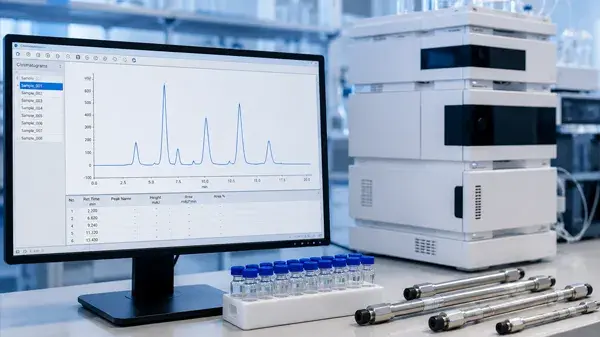
A chromatograph is the instrument used to perform chromatography, while a chromatogram is the recorded detector response generated during the separation. Chromatography is the analytical separation technique that connects both concepts. Using the two terms precisely helps analysts, method developers, and quality reviewers communicate consistently when writing standard operating procedures, reviewing batch records, or transferring methods between laboratories. For example, labeling a detector trace as a chromatograph in a deviation report can create confusion about whether the reference is to the instrument or to the data.
Chromatogram vs. Chromatograph vs. Chromatography: The Quick Answer
Understanding the difference between chromatography and chromatogram starts with distinguishing an analytical process from its recorded data. Comparing the chromatogram and chromatograph follows the exact same logic, separating the mechanical hardware from the final visual trace. 1
Chromatography
The physical separation process
Chromatograph
The instrument performing the separation
Chromatogram
The recorded signal profile
To summarize the relationship in plain terms: chromatography is the separation technique; the chromatograph is the instrument used to perform it, and the chromatogram is the resulting data profile. The printing analogy offers a simple mental model for routine laboratory training, although actual separations depend on physicochemical interactions among the sample, mobile phase, and stationary phase.
Planar chromatography introduces an important practical nuance to this printout analogy. During thin-layer chromatography (TLC), the stationary phase coats a flat glass or aluminum plate rather than resting inside a packed stainless-steel column. Analysts inspect the developed plate directly under ultraviolet illumination or chemical visualization reagents, meaning the physical plate itself functions as the chromatogram.
What Is a Chromatograph?
A modern chromatograph is an integrated instrument that separates complex sample mixtures into their individual components. Depending on the analytical mode, the system incorporates a mobile-phase delivery system (or carrier-gas supply), an injector, a separation column, a detector, and data acquisition software. Common examples include gas chromatographs alongside high-performance and ultra-high-performance liquid chromatographs. These advanced liquid systems operate under elevated hydraulic pressures to drive solvents through columns packed with fully porous particles or superficially porous particles (core shell). UHPLC columns normally are packed with sub-2 micron particles.
The data acquisition software acts as the control center of modern chromatographic equipment. Digital workstations control binary or quaternary gradient proportions, coordinate autosampler needle mechanics, regulate column oven temperatures, and record the signal from the detector.
Beyond basic hardware control, the software packages process baseline integration, compute signal-to-noise ratios, and calculate system suitability parameters across analytical sequences. Method developers seeking to shorten run times, extend column lifetimes, or improve selectivity across complex matrices can review practical instrument configurations on our dedicated HPLC solutions page.
What Is a Chromatogram?
A chromatogram provides the visual or digital representation of detector signal plotted against retention time or elution volume. Under suitable separation conditions, individual peaks typically correspond to components eluting from the chromatographic column. Peak position along the horizontal time axis defines retention time, which analysts evaluate to identify unknown compounds against established reference standards.
Peak position and shape provide important information about retention behavior and separation quality. Symmetrical, narrow peaks reflect favorable thermodynamic mass transfer, minimal extra-column band broadening, and uniform column packing. Tailing peaks often indicate secondary silanol interactions, while fronting typically signals sample overload or an injection-solvent mismatch; broad peaks can point to extra-column effects or a deteriorating inlet frit.
Incomplete separation leaves closely related compounds co-eluting as an unresolved peak, signaling that the chemist must adjust mobile-phase pH, organic modifier strength, column temperature, or stationary-phase selectivity. Method developers looking to troubleshoot baseline drift, fronting peaks, or co-eluting contaminants can explore our comprehensive technical guide on what are chromatograms.
Why the Terms Get Confused
Lexical confusion between a chromatograph vs. chromatogram persists because both words share the Greek stem chromato-, originally denoting color analysis. An early 20th-century botanist developed the chromatographic method, thereby laying out the foundation of related terminology across chemical literature. Rapid bench conversations encourage casual shortcuts, leading analysts to abbreviate intricate hardware stacks and graphical outputs into interchangeable terms.
Grammar adds another layer of historical confusion. Historically, the word “chromatograph” has occasionally been used as a verb (to chromatograph a sample), but in modern analytical practice it most commonly refers to the instrument itself. We rarely speak of chromatographing an assay today, preferring precise operational phrasing like injecting a standard or eluting a gradient. Treating “chromatograph” strictly as a physical noun eliminates ambiguity during technical transfers, ensuring everyone understands whether a spoken instruction concerns hardware maintenance or peak evaluation.
FAQs
Is chromatography the same as a chromatogram?
No, chromatography refers to the physical science and separation technique, whereas a chromatogram represents the recorded signal output. Chromatography describes how solute molecules partition dynamically between a mobile phase and a stationary phase. A chromatogram visualizes that thermodynamic outcome as an intensity curve plotted across elapsed run time.
Is a chromatograph the same as an HPLC or GC system?
An HPLC or GC platform represents a specific engineering category of a chromatograph. The word “chromatograph” serves as the overarching engineering classification for any complete apparatus assembly running chromatographic separations, including pumps, injectors, columns, and data stations. Calling an HPLC instrument a liquid chromatographic process is accurate, as the platform contains every component needed to execute the liquid chromatographic process.