








Gel Permeation Chromatography (GPC)
Gel Permeation Chromatography (GPC) is an effective means of separating and analyzing polymers, resins, oils, plastics, plasticizers, and small organics whose molecular weight can vary from 100-10,000,000 Daltons. It separates molecules by hydrodynamic volume using a porous polymer matrix. HPLC columns used for GPC are packed with polymeric media that can range in pore size from 50 Å to 10E6 Å and can be used with organic solvents such as toluene, THF, methanol, DMF, and methylene chloride.
Ideal gel permeation chromatography requires a GPC HPLC column that has superior mechanical strength and extreme solvent and temperature compatibility.
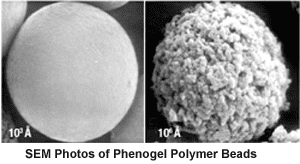
Overview
Phenomenex's Premier Gel Permeation Column
Principle of Gel Permeation Chromatography
Gel permeation chromatography operates on a straightforward principle: molecules are separated by size as they travel through a column packed with porous beads.
How the gel permeation chromatography principle works:
- Porous polymer beads create defined flow paths: Each bead contains pores of controlled size that determine how much a molecule can enter.
- Larger molecules elute earlier: They cannot enter most pores and move through the column more rapidly.
- Smaller molecules elute later: Their ability to access more pore volume increases their path length and retention.
- No chemical interactions: Separation is based solely on physical exclusion, supporting highly reproducible results.
- Direct link to molecular weight: Elution time correlates with molecular size when compared with calibration standards.
Molecular sieving effect enables GPC to provide consistent data for:
- Molecular weight averages (Mn, Mw, Mz)
- Polydispersity (PDI)
- Structural and compositional variations in polymers and macromolecules
The technique is simple to operate, compatible with a wide range of organic solvents, and well-suited for both routine QC and advanced materials research. With predictable performance and minimal method complexity, GPC remains an essential tool for laboratories that need accurate molecular size characterization.
Applications of Gel Permeation Chromatography
Gel-permeation chromatography supports diverse analytical needs by delivering fast, consistent insight into molecular size and distribution. Its size-exclusion mechanism makes it adaptable to many sample types and industries.
Key Application Areas
Polymer Characterization
How the gel permeation chromatography principle works:
- Determine molecular weight averages and distributions.
- Assess batch consistency, degradation, and branching.
- Support materials development in plastics, elastomers, coatings, and resins.
Biomolecules and Proteins
- Evaluate aggregation, oligomerization, and structural integrity.
- Characterize polysaccharides, PEGylated molecules, and other biopolymers.
- Monitor purity profiles in research and development workflows.
Pharmaceutical Quality Control
- Analyze polymeric excipients and drug delivery materials.
- Track molecular stability throughout formulation.
- Support regulatory compliance with consistent size-based analysis.
Environmental and Industrial Testing
- Analyze humic substances, microplastics, and organic matter.
- Characterize lubricants, oils, and industrial additives.
- Monitor polymer breakdown in wastewater and process streams.
Gel permeation chromatography provides actionable data that drives better material design, quality assurance, and product performance, making it a versatile and future‑ready tool for modern analytical labs.
FAQs
Is GPC the same as SEC?
GPC gel permeation chromatography is SEC performed in organic solvents, typically for synthetic polymers, while “SEC” is a broader term that also covers aqueous separations, including gel filtration chromatography (GFC).
Can GPC be used to analyze biological macromolecules?
Yes, GPC can analyze proteins, polysaccharides, and other biological macromolecules, provided they are soluble and stable in the chosen organic mobile phase or mixed‑solvent system.
What detectors are commonly used in GPC?
Commonly used detectors include refractive index (RI), UV/Vis, multi‑angle light scattering (MALS), and evaporative light scattering (ELSD). In multi‑detector GPC systems, RI measures concentration, MALS provides absolute molecular weight, and UV/Vis or ELSD adds selectivity and sensitivity for specific analyte classes.
What recent advances or innovations exist in GPC technology?
Recent advances include higher‑efficiency, low‑bleed GPC columns, high‑temperature and bio‑compatible phases, more stable calibration standards, and integrated multi‑detector platforms that combine RI, MALS, and viscometry for richer structural and branching information. Automated and fast‑GPC or APC‑style systems also shorten run times while maintaining resolution.
What is the difference between GPC and GFC?
GPC uses organic solvents and polymeric packing materials and is typically applied to synthetic polymers and hydrophobic macromolecules, whereas GFC (gel filtration chromatography) is its aqueous counterpart used for proteins and other hydrophilic analytes.

FAQs
What is chromatography?Asked Dec 02, 2025

Chromatography is the separation of components in a mixture based on their chemical nature. Chromatography can be performed in either liquid (HPLC) or gas (GC) forms. Liquid chromatography, specifically High Pressure Liquid Chromatography (HPLC), involves a stationary phase (sorbent), a mobile phase (liquid) and the analyte or compounds of interest. Analytes or compounds of interest are injected onto an HPLC column (packed with sorbent that contains a variety of chemistries) in mobile phase. As the mobile phase, which is carrying the analyte or compounds of interest, travels across the stationary phase, the analyte or compounds of interest separate from each other as they interact with the stationary phase, each eluting from the column at various times. Gas chromatography (GC) is similar to HPLC in that is utilized with working analytes or compounds of interest that can be vaporized without decomposing. In GC, gas is used instead of a liquid (like in HPLC). As analytes or compounds of interest travel in the gas mobile phase and interact with the stationary phase, eluting at various times.
What is the best approach to separate polymers over a very wide range of molecular weights?Asked Mar 04, 2022
It’s very common to use multiple columns of varying pore size in series in order to separate polymers with vastly different molecular weights. Traditional logic suggests that the columns should be placed in order of increasing pore size (smallest pore size column closest to the injector). In practice, however, the order is typically not important as long as it is documented (perhaps experimentally determined) to remain consistent in subsequent analyses. In general, however, the order in which columns are placed has very little effect on the resulting separation. Another option is to use mixed/linear columns that contain particles with various pore sizes. The main benefit of mixed pore size columns is that you may be able to get adequate separation with a single column. Generally, if fewer columns are used there is less analyte dispersion in the mobile phase, so peaks are sharper and sensitivity is better. However, when polymers are relatively close in size (<30% difference), it may still be necessary to have the additional plates provided by multiple columns in series to obtain adequate separation.
What cleaning procedure can I use to regenerate my GPC column?Asked Mar 04, 2022
The sample solvent in GPC should normally dissolve the entire sample, negating the need for the column to be cleaned. However if it is evident that the column is contaminated, the first consideration is what component of the sample is likely to be sticking. Once the source of contamination has been identified, a solvent which is suitable for dissolving it should be selected. Note that it is important to consider whether the solvent chosen is miscible with the current mobile phase, and also what degree of swell the two different solvents impart on the packing material. Provided there is not a large difference in swell, and the two solvents are miscible, the column can then be flushed with the cleaning solvent for 20 column volumes, before returning to the method mobile phase.
What solvent should I use for my separation using Phenogel?Asked Nov 16, 2020
The main factor on solvent use is solubility. What solvent is your analyte soluble in? That will dictate the mobile phase used for your separation because your analytes must be soluble in the mobile phase to be separated by the column. Sometimes poor resolution or low recovery of an analyte can be caused by poor solubility of the analyte in the selected mobile phase.
What impact does temperature have on GPC separations using Phenogel?Asked Nov 16, 2020
Temperature typically only has minor impacts on GPC separations, but it should be considered nevertheless. Elevating the column temperature can help improve solubility of some analytes which may improve the resolution of poorly soluble analytes. Further, increased column temperature can also reduce mobile phase/diluent viscosity mismatches which can improve the performance of a separation. One caution one must consider with elevated temperature relates to the flash point or boiling point of your mobile phase solvent. Although it is sometime tragically overlooked, one does not want to do a separation at a temperature anywhere close the flash point of a mobile phase.
How do I determine molecular weight of my Polymer using Phenogel GPC columns?Asked Nov 16, 2020
Especially for large polydisperse polymers one may only see one peak on their GPC run. So how do you figure out the polymer’s average molecular weight (MW) and polydispersity? There are a lot of different software programs that determine that for you, but key is using molecular weight standards that are most similar to the compounds you are separating (there are several vendors that sell specific GPC standards). The Retention time of your polymer peak compared to a standard gives the mean molecular weight and the width of the peak provides information on the polydispersity of the polymer being analyzed.
How do I optimize the resolution of my analytes in a GPC method using Phenogel?Asked Nov 16, 2020
This is probably the #1 question we receive about GPC. The main selectivity adjustment is the column. Different pore size columns have a different molecular weight separation ranges, depending on the size of your analyte there are probably 2 or 3 Phenogel columns that might work for that size range. If the most suited column for a molecular weight does not provide the best separation, then the range above or below might be a better separation option. The Phenomenex catalog or web site are good sources of additional information on column options. Flow rate and solvent selection can also have an impact on the resolution of a GPC method.
My GPC method uses 3 columns in series. Does it matter what order the columns are in?Asked Nov 16, 2020
Column order does matter for a separation. Key is consistency in the column order. Most methods typically go from large pore size to small pore size, others do it in opposite order. They key is to be consistent and use the same column order run to run to not change the resolution of your method.
Are the guard columns for Biozen also biocompatible?Asked Dec 03, 2018
Yes, the guard columns for Biozen are biocompatible. Though the holder is not titanium, the analyte flow path is biocompatible.
What is a cap port?Asked Feb 23, 2022
A cap port is an opening (1/4in.) in the cap that extends from the top of the cap through the bottom of the cap. The ports are used for the tubing to pass through into the solvent container. It is important to have enough ports for the desired number of tubing and one port for the SecurityCAP safety filter. It is also important to plug all non-used open ports with a sealing plug. This will ensure the solvent safety system air tight and leak free.
What is void volume?Asked Mar 01, 2022
The void volume corresponds to the amount of mobile phase in an LC system. In most separation modes the void volume would be equivalent to the amount of mobile phase needed to elute a compound that doesn't interact with the stationary phase and is hence unretained. In size exclusion, analytes are not separated based on chemical interactions with the stationary phase but rather their ability, based on size, to enter pores in the stationary phase. Therefore, in size exclusion the terms total permeation and total exclusion volume have greater significance than void volume. The total permeation volume corresponds to the amount of mobile phase in the system, including that in the pores of the stationary phase, whereas the total exclusion volume does not include the mobile phase within the pores of the stationary phase. Consequently, the total permeation volume corresponds to the amount of mobile phase needed to elute a compound that is small enough to completely enter into the stationary phase pores and the total exclusion volume is the amount of mobile phase needed to elute a compound that is entirely excluded from the stationary phase pores.
What is the shipping solvent for Luna NH2?Asked Sep 13, 2016
Luna NH2 (amino) columns are shipped in 99:1 hexane:acetonitrile. If the column is to be used in reversed phase or HILIC conditions, it is recommended to flush with IPA at low flow rate (10 column volumes) prior to introducing water:acetonitrile or water:methanol mixtures.