Size Exclusion Chromatography (SEC)
Size exclusion chromatography (SEC) is a chromatographic method that separates analytes solely based on their size, where molecules are separated on the basis of their exclusion from pores in the size exclusion chromatography column packing material. Larger analytes will elute first, while the smaller molecules interact more with the stationary phase and will elute later.
Based on the analytes and the mobile phases used, size exclusion chromatography can be broken into two main categories: aqueous size exclusion/gel filtration chromatography (GFC) and non-aqueous size exclusion/gel permeation chromatography (GPC).
Aqueous Size Exclusion/Gel Filtration Chromatography (GFC)
Analyze and/or characterize proteins, peptides, and other biomolecules such as antibodies, immunoglobulins, protein complexes, protein aggregates, and desalting.
Non-Aqueous Size Exclusion/Gel Permeation Chromatography (GPC)
Analyze polymers such as adhesives, oils, plasticizers, plastics, resins, and rubbers/elastomers.
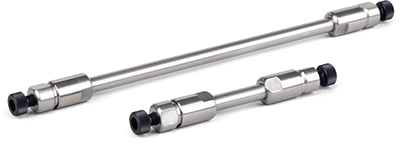
Size Exclusion Chromatography Columns
Enhance your analytical capabilities with Phenomenex’s advanced SEC-HPLC columns, designed for precise molecular size analysis and consistent, high-resolution separation. Ideal for both analytical and preparative applications, these columns offer excellent reproducibility and long column lifetimes. Whether you're characterizing monoclonal antibodies, fragments, aggregates, or analyzing biomolecules and polymers in aqueous or organic phases, Phenomenex’s SEC technology delivers the accuracy and reliability your workflows demand.
How does size exclusion chromatography work?
SEC employs porous particles, commonly composed of natural polymeric gels such as cross-linked dextran, agarose, or polyacrylamide, as well as synthetic materials like silica or cross-linked polystyrene, packed into a chromatographic column.. These beads contain pores of specific sizes, creating a molecular "sieve." Large molecules cannot enter the pores and flow around the particles, eluting first in the void volume of the column. Intermediate molecules partially enter the pores, leading to delayed elution based on their size. Small molecules fully penetrate the pores, taking the longest path and eluting last. This results in an elution order from largest to smallest molecular size (or weight).
When is the right time to use analytical size exclusion chromatography?
Analytical size exclusion chromatography is primarily used when separation and characterization of biomolecules or polymers based on size are required, particularly in scenarios demanding high-resolution analysis without chemical interactions. It is also widely used when scientists want to maintain the native state of a molecule, as other techniques may alter its shape or conformation, whereas SEC does not. Analytical SEC is also employed to assess sample quality or study biomolecular properties. Choosing the right column for analytical size exclusion chromatography is crucial for achieving optimal separation and analysis of biomolecules.