

Blog
Cannabis Part 1: HPLC Method Development
Dr. Jeff Layne explains how chromatography is used to test for the potency of cannabis by exploring HPLC method development and discussing the results
Posted on May 4, 2017
Initial HPLC Gradient Screening for Potency Testing by LC-UV.
Guest Author: Jeff Layne
Hello everyone and welcome to the first of what I hope will be a series of articles on the topic of HPLC method development for cannabis-related analyses. My name is Jeff Layne, and I am head of the Product Management team here at Phenomenex. As the number of states legalizing cannabis for medicinal and/or recreational use increases, the subject of testing and analyzing cannabis and cannabis-based products has become one of the hottest topics for those of us involved in separations sciences. Unfortunately, our lawyers have made it clear that I cannot touch the stuff and certainly cannot bring the actual plant material into our labs. But herein lies the problem—how can we learn more about analytical methods for testing cannabis products when we aren’t able to work hands-on with the material? My goal with starting this article series is to generate conversation with other scientists who are “fortunate” enough to do hands-on work with cannabis related products. The field of legal marijuana testing is so new that the number of guidelines is exceptionally low. So many analysts (including myself) are brimming with technical questions. I am hoping that we can uncover the answers to the questions everyone is asking by bringing together those with a variety of experiences and knowledge of chromatography in the world of cannabis testing. Through my mission for answers, I’ve found that there are two main types of cannabis testing that specifically require liquid chromatography. The first being potency testing, which is the determination of concentrations of various cannabinoids (e.g. THC or cannabinol) present in a particular sample. This is most often performed using HPLC with a UV detector (LC-UV). The second type of testing is the analysis of residual pesticides. These substances tend to be (hopefully) present at very low concentrations. Due to the complexity of the matrix and the many types of pesticides that may be present, liquid chromatography-mass spectroscopy (LC-MS) is the preferred or required technique for analysis.
Other analytical tests may be required or desired (e.g. metals), but they are performed using methods that do not involve liquid chromatography. Although I mentioned that we (currently) cannot do any testing on physical cannabis products in our lab, we can create method development using analytical reference standards. To begin my series on cannabis-related method development articles,I'd like to share some of our observations on mobile phase selection, specifically in regards to potency testing. To keep things simple, I will assume that most of you, if not all, are working in reversed phase mode (RP), that you are probably using a C18 column, and that you have a basic understanding of the HPLC method development process.
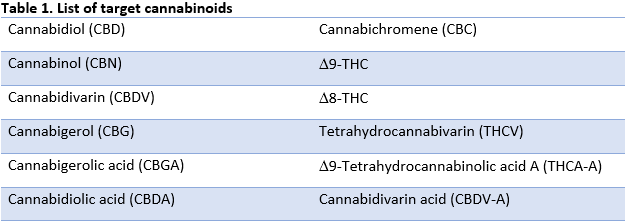
I became involved with this project when a customer came to us asking for help in developing an analytical method to separate 12 naturally occurring cannabinoids (see Table 1), with the restriction of needing to operate on a standard HPLC-UV system, ideally with a pressure of less than 300 bar.
This brings me to my first question for those of you who are working with cannabinoids everyday: Are these the same cannabinoids that you are interested in for your own method, or am I missing some key analytes?
Through my mission for answers, I’ve found that there are two main types of cannabis testing that specifically require liquid chromatography. The first being potency testing, which is the determination of concentrations of various cannabinoids (e.g. THC or cannabinol) present in a particular sample. This is most often performed using HPLC with a UV detector (LC-UV). The second type of testing is the analysis of residual pesticides. These substances tend to be (hopefully) present at very low concentrations. Due to the complexity of the matrix and the many types of pesticides that may be present, liquid chromatography-mass spectroscopy (LC-MS) is the preferred or required technique for analysis.
Other analytical tests may be required or desired (e.g. metals), but they are performed using methods that do not involve liquid chromatography. Although I mentioned that we (currently) cannot do any testing on physical cannabis products in our lab, we can create method development using analytical reference standards. To begin my series on cannabis-related method development articles,I'd like to share some of our observations on mobile phase selection, specifically in regards to potency testing. To keep things simple, I will assume that most of you, if not all, are working in reversed phase mode (RP), that you are probably using a C18 column, and that you have a basic understanding of the HPLC method development process.
I became involved with this project when a customer came to us asking for help in developing an analytical method to separate 12 naturally occurring cannabinoids (see Table 1), with the restriction of needing to operate on a standard HPLC-UV system, ideally with a pressure of less than 300 bar.
This brings me to my first question for those of you who are working with cannabinoids everyday: Are these the same cannabinoids that you are interested in for your own method, or am I missing some key analytes?
Initial Gradient Screening
Everybody has their own way of beginning a new method. For me, it usually begins with a few simple gradient screens to determine where my target analytes elute during the gradient profile. I generally start with a mid-size column of 10 cm length (in this case a core-shell Kinetex® 2.6 µm C18 column) giving me the flexibility to go to a longer length if I need more resolution, or to move to a shorter 5 cm column if I have plenty of separation and want to reduce analysis time. For a gradient, I will usually start with a simple linear gradient with a gradient time in minutes equivalent to the column length in centimeters (i.e. for a 10 cm column, I would use a 10 min long gradient). Cannabinoids are very hydrophobic, with THC having a Log P value of around 7. That is SUPER STICKY, which means that I can start at a modest percentage of organic (e.g. 25%) for my gradient, but I would probably need to get close to 100% organic to elute them from the column. With the initial screening, I like to use an acidic aqueous component and acetonitrile as the organic mobile phase to keep the pressure low. In this case, I used 0.1% formic acid in water and acetonitrile as it gives us the flexibility of easily transferring the method to an LC-MS system if we wanted to go down that route. You can see from the results of the initial screening (Figure 1), that as I gradually increased the starting percentage of acetonitrile of my gradient from 25% to 50% and then finally to 75%, I started to get better resolution. Considering that I kept the total gradient time constant at 10 minutes for each run, as the starting percent organic increased, a shallower gradient profile was generated. Please note that the x-axis time scales are not the same – I have zoomed in on the region containing our peaks of interest to better display the elution profiles. Using the 75-100% gradient profile (Fig. 1c), I can partially resolve 11 of the twelve target analytes. Considering that the first peak is eluting early in the run (~1.2 min), I would hesitate to make another gradient at an even higher percent of organic as we would have our early eluters coming out too close to the front of the run where there are typically a lot of interferences. Figure 1. Initial gradient screening using Kinetex 2.6 µm C18 100 x 4.6mm column and a mobile phase of water/acetonitrile with 0.1% formic acid. a. 25-100% in 10 min (10 peaks) b. 50-100% in 10 min (10 peaks)
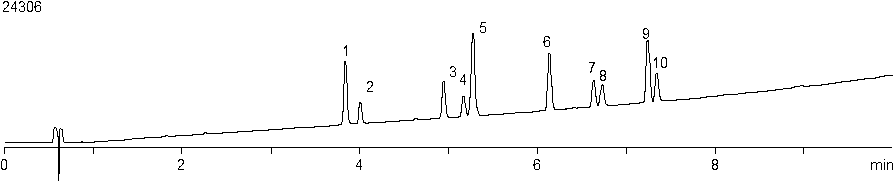 c. 75-100% in 10 min (11 peaks)
 At this point I have not identified the individuals, so somewhere in that forest of peaks our 12th analyte is hiding. Looks like there is more work to be done, but this is a good start!
I’d love to hear some feedback from readers on how they might have done things differently, and perhaps some suggestions for moving forward. In my next method development series article, I will be looking at the effects of the use of different mobile phase modifiers on the separation of these 12 cannabinoids.
See you soon!
At this point I have not identified the individuals, so somewhere in that forest of peaks our 12th analyte is hiding. Looks like there is more work to be done, but this is a good start!
I’d love to hear some feedback from readers on how they might have done things differently, and perhaps some suggestions for moving forward. In my next method development series article, I will be looking at the effects of the use of different mobile phase modifiers on the separation of these 12 cannabinoids.
See you soon!