
Organic Solvents in Liquid Chromatography (LC): Common Choices, Trade-offs, and What to Avoid
Choosing the best organic solvent for LC is more than a preference; it directly shapes the quality, reliability, and longevity of your separation. Selecting the right organic solvent for LC comes down to viscosity, UV cutoff, polarity, and how well the solvent works with your detector and column chemistry. Whether you are using UV/Vis detection, mass spectrometry (MS), Evaporative Light Scattering Detection (ELSD), or other detectors, solvent selection affects sensitivity, baseline stability, and overall method performance. Each solvent behaves differently under high pressure, and using the wrong one can lead to excessive backpressure, distorted peak shapes, or reduced sensitivity.
What Is an Organic Solvent?
Organic solvents are carbon-based liquids used to dissolve or transport analytes within the mobile phase. In liquid chromatography, the organic solvent meaning extends beyond simple solubility; it directly influences the overall separation.
Solvents in HPLC are identified by unique physicochemical characteristics like strength, viscosity, polarity, volatility, and UV absorbance. These properties determine how the solvent interacts with both the analytes and the stationary phase, and so ultimately, how well your analytes resolve. Selecting the right organic solvent ensures stable system pressure, efficient mass transfer, and optimal detector compatibility throughout your workflow.
Key Characteristics for Selecting an Organic Solvent in LC
Understanding how parameters such as solvent strength, viscosity, UV cutoff, and polarity influence chromatographic performance helps you design more reliable methods and protect your system from unnecessary stress. For additional best practices, visit our complete HPLC solvent selection guide.
Solvent Strength
In HPLC, “solvent strength” refers to a mobile phase’s ability to elute analytes by competing with interactions at the stationary phase. Crucially, solvent strength is technique-dependent: in
reversed-phase LC, increasing organic content increases elution strength, while in normal-phase LC, more polar modifiers are considered stronger because they more effectively disrupt polar interactions. Understanding this context helps prevent misapplication of “strong” and “weak” solvent concepts across different LC modes.
Viscosity
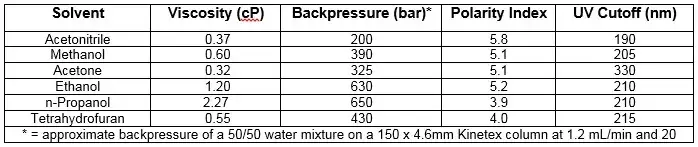
Mobile-phase viscosity in HPLC directly controls system backpressure and depends on the nature of the solvents and their composition in the mobile phase. For example, isopropanol is a typically high-viscosity solvent. Even when initial conditions are within pressure limits, changes in solvent ratios during a run can increase overall viscosity and raise backpressure as the separation progresses, a behavior commonly observed in gradient LC methods. This is particularly relevant for the two most commonly used organic modifiers, ACN and MeOH, both of which show viscosity changes at varying ratios.
To maintain high separation efficiency while managing pressure, larger core-shell particles can be used, as they provide higher efficiency than fully porous particles of the same size. Pairing them with lower-viscosity solvents such as acetonitrile further helps maintain stable flow and system performance.
UV Cutoff
A solvent’s UV cutoff is the wavelength range in which the solvent absorbs strongly, creating background signal that can interfere with analyte detection. Solvents with higher UV cutoffs (e.g., acetone, tetrahydrofuran) absorb at longer wavelengths, which limits sensitivity and makes low-wavelength UV detection impractical. By contrast, low-absorbance solvents such as ACN and MeOH support more reliable detection across a broader UV range.
Polarity Index
The polarity index of an HPLC solvent describes how strongly it interacts with polar versus nonpolar compounds, directly influencing elution strength, retention, and selectivity. In reversed-phase liquid chromatography, lower-polarity organic solvents increase elution strength and promote faster elution of hydrophobic analytes, while higher-polarity solvents increase retention. Understanding solvent polarity is essential for optimizing separation selectivity and controlling retention behavior during method development.
Together, these characteristics determine backpressure, sensitivity, and overall method robustness.
Organic Solvents Used in LC
Organic solvents do not behave the same way across every LC technique. The same solvent can drive fast elution in one mode and lock analytes to the column in another. There is no single “best” solvent for LC overall; there is only the right solvent for your specific technique, analyte class, and detection method. With that in mind, here’s how the most commonly used organic solvents actually perform across LC techniques.
Acetonitrile
ACN is one of the most widely used organic solvents in HPLC, but its role shifts considerably depending on the technique. And in some cases, its role reverses entirely. Its low viscosity keeps backpressure minimal, which is a real advantage when working with small-particle or UHPLC columns. ACN’s very low UV cutoff (~190 nm) also supports sensitive detection across a wide wavelength range.
Reversed-Phase (RP)-HPLC
ACN is the go-to organic modifier because it is fully miscible with water and provides strong elution in reversed-phase systems. In RP mode, the stationary phase is nonpolar, and ACN functions as a strong organic solvent. Increasing its concentration in the mobile phase raises elution strength, moving analytes through the column faster.
Normal-phase (NP)-HPLC
Normal-phase uses a polar stationary phase and a nonpolar mobile phase. ACN, despite being organic, is strongly polar and thus acts as a polar modifier in a largely nonpolar mobile phase (e.g., hexane-based). Adding ACN increases the polarity of the mobile phase, which increases elution strength for polar analytes.
Hydrophilic Interaction Liquid Chromatography (HILIC)
ACN is the standard solvent, typically used at very high concentrations (often >80%), but here it acts as the weak solvent, not the strong one. In HILIC, high organic concentration promotes retention of polar analytes on the polar stationary phase. Reducing ACN (i.e., increasing water content) is what drives elution. ACN is preferred over MeOH in HILIC because its aprotic structure helps maintain a more stable aqueous enrichment layer on the stationary phase surface, which is central to the HILIC retention mechanism.
Ion Chromatography (IC)
ACN appears at low concentrations (typically 1–10%) as a selectivity modifier rather than a primary elution driver. Small additions can improve peak shape for hydrophobic anions by reducing secondary hydrophobic interactions. Always verify compatibility with your specific ion-exchange column before use.
Methanol
MeOH is one of the most commonly used organic solvents in LC. It is more affordable than ACN and often produces different selectivity because it can form hydrogen bonds, making it a practical alternative or complement depending on the technique.
RP-HPLC
MeOH is a polar organic solvent that offers different selectivity from ACN in reversed-phase mode and is commonly a weaker organic modifier. This difference can help resolve analyte pairs that co-elute under ACN conditions. The trade-off is higher viscosity in aqueous mixtures, which can push backpressure above system limits, especially on systems with low maximum backpressure.
NP-HPLC
MeOH is polar and acts as a strong elution modifier in normal-phase systems. Even small additions to a nonpolar base solvent like hexane can significantly shift selectivity and retention. It is used less frequently than in RP-HPLC and typically at low concentrations.
HILIC
MeOH can serve as the organic component, but because it is both a hydrogen-bond donor and acceptor, it disrupts retention more readily than ACN by interacting more like water with the stationary phase. This is generally undesirable, so ACN remains the preferred starting solvent for HILIC method development, while MeOH is used mainly when specific selectivity adjustments are required.
IC
Similar to ACN, MeOH can be added in small amounts as a selectivity modifier to improve peak shape or manage hydrophobic interference. Its use is situational, and column compatibility must be confirmed before use.
Tetrahydrofuran (THF)
THF is a specialized solvent in LC. It is not routinely used as a first-choice mobile-phase component, but it offers distinct selectivity and strong solvent power that can be useful in specific chromatographic situations. Its limitations include particularly strong UV absorbance, compatibility concerns with some system materials, and peroxide formation during storage. This means it must be used with more care than ACN or MeOH.
Reversed-Phase (RP)-HPLC
In RP-HPLC, THF can act as a relatively strong organic modifier and may provide selectivity that differs from both ACN and MeOH. This can be helpful when standard solvent systems do not adequately resolve difficult analytes. However, THF absorbs strongly in the UV region and is less suitable for low-wavelength UV detection, which limits its routine use in analytical RP methods.
Normal-Phase (NP)-HPLC
In NP-HPLC, THF functions as a polar organic modifier and can significantly alter solvent strength and selectivity. Because it is more polar than the typical hydrocarbon base solvents used in NP methods, even modest additions can change retention behavior substantially. This makes THF potentially useful for tuning separations but also means method changes must be made carefully.
HILIC
THF is not commonly used in HILIC because it does not support the retention mechanism as effectively as ACN. In addition, its solvent properties and UV absorbance make it a poor general substitute for the high-organic mobile phases typically required in HILIC.
Ion Chromatography (IC)
THF is rarely used in IC and generally is not considered a standard modifier for ion-exchange methods. Any use would need to be highly application-specific and carefully validated for compatibility with both the stationary phase and the detection system.
Solvents That Work for Specific Applications
Ethanol
Ethanol generates very high backpressure in aqueous mixtures across most LC techniques and is not a practical choice for routine analytical RP-HPLC. Its main application is in preparative RP-HPLC of pharmaceutical finished products, where regulatory constraints on residual solvents may rule out ACN or MeOH. Outside of that context, it offers no meaningful advantage over the more commonly used modifiers.
Acetone
Acetone is best treated as a situational solvent rather than a broadly used LC modifier. Its higher UV cutoff limits its usefulness in low-wavelength UV methods, but it can still be cheap and practical when analytes absorb at higher wavelengths or when MS or ELSD is used for detection.
Isopropanol (IPA) and n-Propanol
Both solvents have strong elution strength in RP-HPLC but very high viscosity, making them impractical as routine mobile phase components at standard analytical flow rates. Their most common application is column cleaning and regeneration, where strong elution is actually the point. They are also effective protein solubilizers and are often preferred for intact protein workflows. In all cases, run them at reduced flow rates to protect your column and system from overpressure.
Column Care Consideration
The high-viscosity or high-UV-absorbance solvents should be used at reduced flow rates during cleaning procedures to prevent system overpressure and protect column integrity. Review our HPLC Column Care article to ensure safe use.
FAQs
What is an organic solvent in HPLC?
An organic solvent in HPLC is a carbon-based liquid, such as acetonitrile or methanol, used as part of the mobile phase to control analyte retention, elution strength, and separation efficiency.
What does the term “organic solvent polarity” mean in liquid chromatography?
Polarity describes how strongly a solvent interacts with polar or nonpolar analytes. In LC, solvent polarity affects retention, selectivity, and how quickly compounds elute.
Which organic solvents are commonly used in HPLC mobile phases?
The most common solvents are acetonitrile and methanol, chosen for their low viscosity, low UV absorbance, and predictable elution behavior.
Which organic solvents are bad for HPLC columns and why?
Ethanol, isopropanol, n-propanol, and THF can cause very high backpressure, compatibility concerns, or detector limitations. They are typically reserved for cleaning or specialized applications.
What is an organic modifier in HPLC?
An organic modifier is an organic solvent added to the mobile phase to adjust polarity, elution strength, and selectivity in LC separations.
Related resources: