
Most Common Solvents Used in HPLC Mobile Phase
High-performance liquid chromatography (HPLC) mobile-phase solvents control how a sample moves through the column, how long each analyte is retained, and how cleanly compounds elute in HPLC. The right solvent system depends on analyte chemistry, stationary phase chemistry, separation mode, and detector choice, so analysts usually build a mobile phase as a mixture rather than relying on a single solvent.
What Is an HPLC Mobile Phase?
The mobile phase is the liquid phase that carries the sample through the column, while the stationary phase is the packed material that creates the separation environment. In HPLC, analytes partition between these two phases, and that balance determines retention, selectivity, and elution order, elution being the process by which the mobile phase carries retained analytes off the column and past the detector.
Solvent strength is defined by its affinity for the stationary phase relative to the analyte: a strong solvent competes effectively for stationary-phase interactions and elutes the analyte faster, whereas a weak solvent has lower affinity and allows the analyte to remain retained. In reversed-phase HPLC, the aqueous component usually acts as the weak phase, while the organic modifier drives elution. Normal-phase HPLC follows the opposite pattern, with a polar modifier increasing elution strength on a polar stationary phase.
Depending on whether the mobile phase composition stays fixed or changes during the run, HPLC separations fall into one of two elution formats: isocratic and gradient:
- Isocratic elution keeps mobile phase composition constant through the run.
- Gradient elution changes the phase composition over time, which often improves separation of a complex mixture and broad impurity profile.
Properties That Define a Good HPLC Mobile Phase Solvent
A good mobile-phase solvent matches the analytical goal, the detector, and the stationary phase rather than meeting a single universal rule. Miscibility and purity are mandatory, while low viscosity is a practical advantage when pressure becomes a limiting factor. For UV methods, UV cutoff matters directly, but that factor becomes irrelevant for detectors that do not rely on UV absorbance.
Several solvent properties shape solvent choice:
- Miscibility, which determines whether solvents can form a single phase safely.
- Polarity index, which influences elution strength and selectivity.
- Analyte affinity, which reflects interactions such as dipole-dipole forces, hydrogen bonding, pi–pi stacking, and van der Waals forces between the analyte and the mobile phase.
- Detector compatibility, which covers requirements such as UV cutoff for UV detection and volatility or low-salt composition for LC-MS.
- Viscosity, which affects backpressure and flow rate stability.
- Purity, which reduces impurity peaks and background contamination.
The above table gives a fast reference for solvent selection during method development. UV cutoff matters only for UV detection, while miscibility remains essential for any HPLC mobile phase.
Acetonitrile combines low viscosity, a UV cutoff around 190 nm, and full water miscibility, which explains why it remains a standard organic solvent in reversed-phase HPLC and LC-MS methods. Methanol is also fully water-miscible but carries a higher viscosity and a higher UV cutoff, so it often changes pressure and selectivity relative to acetonitrile.
Common Solvents Used in HPLC Mobile Phases
Most methods rely on a short list of workhorse solvents, and each one shifts selectivity, pressure, and detector response differently. For a closer look at how these trade-offs play out across full method development, see this breakdown of the best and worst organic solvents to use in LC.
Water
Water is the core mobile phase solvent for most of the chromatography methods. It functions as the weakest solvent in RP and as a strong solvent in NP. Water has a relatively high viscosity compared to organic modifiers like acetonitrile or methanol. Water buffers and pure water promote bacterial and algal growth; solutions must be freshly prepared or filtered through 0.22 µm membranes.
Acetonitrile
Acetonitrile is one of the most common solvents used in HPLC mobile phase work, especially when low UV absorbance and low viscosity are valuable. It often gives lower backpressure than methanol and can sharpen peak shape in fast analytical methods. Acetonitrile is also widely preferred in LC-MS mobile phase design due to volatility and strong spray behavior.
Methanol
Methanol remains a workhorse solvent in HPLC, particularly when analysts want a different selectivity profile from acetonitrile (similarly polar, but an H-bond donor rather than an acceptor). It can improve resolution for some analyte classes and is widely used in routine analytical and quality control methods. Its higher viscosity can increase pressure, especially in highly aqueous mixtures or at higher flow rate settings.
Tetrahydrofuran (THF)
THF offers distinct selectivity and stronger elution behavior for some hydrophobic compounds due to unique dipole–dipole and proton-acceptor interactions, so it still has a role in difficult separations. Analysts generally treat THF carefully, since it can form peroxides during storage and can shift UV background relative to acetonitrile or methanol.
Reversed-Phase vs. Normal-Phase Mobile Phase Solvents
Reversed-phase HPLC is widely used across pharmaceutical and other analytical workflows because aqueous–organic mobile phases and nonpolar stationary phases provide broad organic analyte coverage. Normal-phase HPLC remains useful when polar analytes are not retained enough due to their high polarity.
For many routine methods, analysts start with HPLC columns designed for reversed-phase work, then match the phase composition to analyte polarity and detector response.
Buffers, Additives, and pH Modifiers in HPLC Mobile Phases
Buffers and additives matter most when the analyte is ionizable, or pH has a strong influence on the chromatographic outcome. A buffer controls pH drift and can reduce variable interaction between the analyte and residual active sites on the stationary phase.
Common options include:
- Phosphate buffer, effective near pH 2.1, 7.2, and 12.3, offering broad coverage for UV-based methods, but nonvolatile and unsuitable for LC-MS.
- Acetate buffer (acetic acid/acetate, pKa approximately 4.76), effective near pH 3.8–5.8 and commonly used with sodium or potassium counterions in UV methods.
- Formate buffer (formic acid/formate, pKa approximately 3.75), effective near pH 2.75–4.75, generally paired with volatile counterions for LC-MS use.
LC-MS methods require volatile buffers and additives because nonvolatile components accumulate in the ion source and interfere with ionization efficiency. Phosphate buffers are unsuitable for this reason, as their low volatility leads to source contamination and signal loss. Ammonium acetate and formate are commnly use in LC-MS due to the volatility of the ammonium counter ion.
Trifluoroacetic acid presents a different problem: it improves peak shape and chromatographic behavior for many analytes, but it causes ion suppression in electrospray ionization, which reduces MS sensitivity even though the buffer itself is volatile.
Fresh buffer preparation, filtration, and degassing all support reproducibility and lower the risk of particulate or microbial contamination.
How to Select and Mix HPLC Mobile Phase Solvents
Solvent selection should follow a practical checklist rather than a habit-based recipe. Analysts need to verify that the mobile phase solvent supports the analyte, detector, column chemistry, and pressure window of the HPLC system.
Key checks include:
- Miscibility, since immiscible mixtures can separate into layers and damage the method or column.
- Detector compatibility, since requirements shift by detection method: UV cutoff must sit below the detection wavelength for UV detection, refractive index (RI) should differ from the sample for RI detection, and volatile, low-salt composition is needed for MS detection.
- Viscosity, which matters when backpressure is already high.
- Purity, since HPLC-grade solvent minimizes impurity background.
- Temperature matching before mixing, which improves consistency.
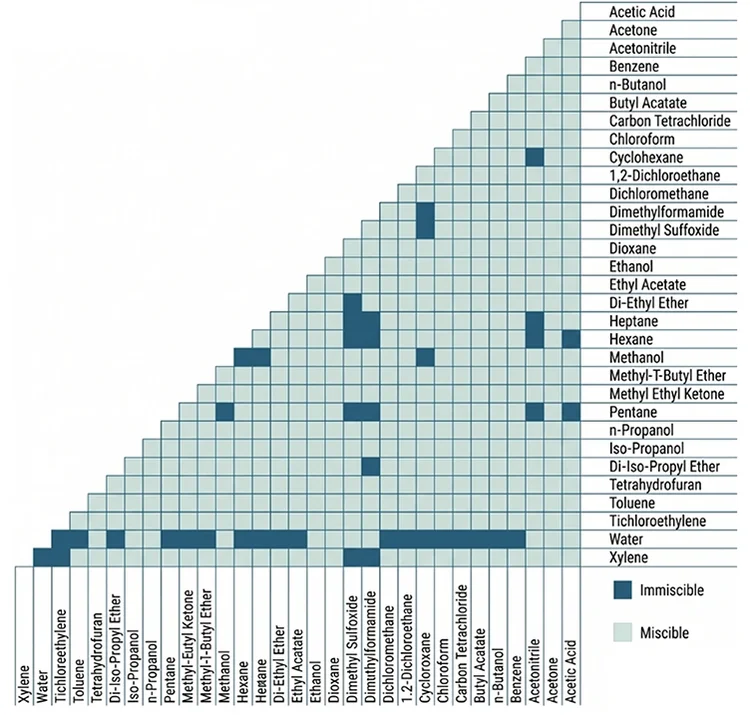
Miscibility Table for Common HPLC Solvent Pairs
Figure 1: Miscibility matrix for common laboratory and HPLC solvents. Shaded cells indicate immiscible solvent pairs; unshaded cells indicate miscible pairs. Solvent pairing can be checked against this table before combining or blending mobile phases to avoid phase separation during method development.
Miscibility is mandatory, while low viscosity becomes most important when system pressure is already close to the system limit.
Best Practices for Mobile Phase Preparation and Storage
Preparation and storage habits affect baseline quality, retention stability, and column life as much as solvent selection does. Analysts should filter mobile phase through a 0.2 µm or equivalent membrane, degas fresh solvent, and prepare aqueous or buffered phase components on an appropriate schedule to limit microbial growth.
Bottle labeling and date tracking support quality control and method traceability. THF needs tighter storage discipline due to peroxide formation risk, and buffered mobile phase should be flushed from the HPLC system before storage or shutdown. Phenomenex’s SecurityCAP mobile-phase safety products are also relevant here because they help prevent solvent vapor release and reduce airborne particulates or contaminants entering the reservoir.
FAQs on HPLC Mobile Phase Solvents
What are the most common solvents used in normal-phase HPLC mobile phases?
In normal-phase HPLC, hexane is the most commonly used nonpolar solvent, typically paired with a more polar solvent such as ethyl acetate, isopropanol, or THF to fine-tune elution strength. Unlike reversed-phase HPLC, where water and acetonitrile dominate, normal-phase separations rely on a nonpolar mobile phase working against a polar stationary phase, so the solvent pairing is chosen to match the analyte’s polarity and the desired separation strength. As with all HPLC methods, exact solvent choice remains method-dependent, varying with column chemistry and analyte properties.
What is the difference between a weak solvent and a strong solvent?
A weak solvent is a solvent that promotes retention of the analytes and has low affinity with the analyte (low elution strength), whereas a strong solvent promotes elution and has high affinity with the analyte (high elution strength). The higher the percentage of strong solvent, the quicker the elution of the analyte will be. Often in practice, “mobile phase A” is assigned to the weak solvent and “mobile phase B” to the stronger modifier, though these labels are a naming convention rather than a fixed rule and can vary. In RP, the strong solvent is the organic solvent (e.g., acetonitrile) and the weak solvent is the polar solvent (e.g., water). In NP, the polar solvent (e.g., water) is the strong one, whereas the weak one is the organic solvent (e.g., hexane).
What solvents are used in normal-phase HPLC?
Normal-phase HPLC often uses hexane or heptane as the weak solvent, then adds water, ethyl acetate, or another polar solvent to increase elution strength.
Can you mix water and acetonitrile in an HPLC mobile phase?
Yes. Water and acetonitrile are fully miscible, and that pair is one of the most common choices for reversed-phase HPLC and LC-MS methods.
Which buffers are used in HPLC mobile phases?
Common buffer options include phosphate, acetate, and formate, with the choice depending on the desired pH. LC-MS methods require a volatile buffer so that the mobile phase evaporates completely in the ionization source, preventing hardware clogs, severe signal suppression, and high background noise.