HILIC vs. Reversed Phase: Key Differences and When to Switch
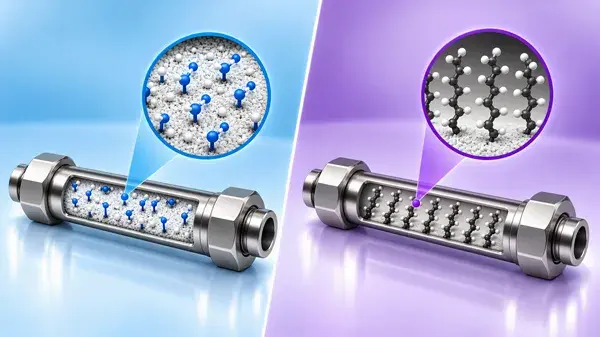
Hydrophilic interaction liquid chromatography (HILIC) vs. reversed-phase chromatography is a choice between two complementary modes, not a contest with one winner. Reversed phase is the most widespread choice in analytical separation, but polar and ionic compounds are poorly retained and often elute near the void.
HILIC adds a complementary, orthogonal selectivity for those analytes without replacing reversed phase. It is most useful when analyte polarity, ionization, or sample matrix leaves reversed-phase retention insufficient. It also demands careful control of diluent, mobile phase composition, equilibration, and buffer conditions.
This guide compares the two modes and shows when a switch pays off.
What Is Reversed-Phase Chromatography?
Reversed-phase chromatography pairs a non-polar stationary phase with a polar aqueous-organic mobile phase. Typical phases are silica bonded with alkyl or aromatic groups(ie. C18or phenyl-hexyl phases), which suit non-polar to moderately polar compounds in reversed-phase HPLC. Retention comes from adsorption and partitioning, where the non-polar parts of each analyte are attracted to the hydrophobic ligands.
Organic solvents such as acetonitrile and methanol have greater elution strength than water, so organic ones are the strong solvents. Raising the water content increases retention, because non-polar analytes have a higher affinity for the bonded groups. Analytes elute in order of decreasing polarity, which means the most polar compounds leave first.
What Is HILIC?
HILIC pairs a polar stationary phase with a high-organic mobile phase in which water is the strong solvent. It retains polar and hydrophilic analytes, and the elution order is roughly the reverse of reversed phase, following increasing hydrophilicity. The mechanism is mixed and phase-dependent. Retention is usually described as partitioning into a water-enriched layer on the polar surface, plus hydrogen bonding, dipole-dipole, and ion-exchange (electrostatic) interactions.
The balance shifts with the stationary phase, the buffer conditions, and the analyte, which is why method development matters. Treating HILIC as simple partitioning can mislead you during that work.
HILIC vs. Reversed-Phase: Side-by-Side Comparison
The difference between HILIC and reversed phase shows up in solvent strength, retained analytes, and elution order. This table sets out HILIC vs. reversed-phase chromatography across 15 attributes.
When to Switch from Reversed-Phase to HILIC?
Knowing when to use HILIC vs. reversed-phase chromatography comes down to analyte polarity, retention, and workflow. The checklist below shows when to use HILIC, and the cases where reversed phase remains the better call.
Consider Switching to HILIC When:
- Highly polar basic, acidic, or neutral compounds, and polar metabolites, elute at or near the void in reversed phase, which makes them low-k analytes. One Arctic soil extract showed that about 80% of the most abundant ions eluted in under 2 minutes on a reversed-phase column.
- Polar impurities or early-eluting degradants are not resolved from the void, and HILIC has been applied to polar pharmaceuticals and impurities.
- Peak shape stays poor, or hydrophilic analytes need more retention. One study found sharper peaks on a HILIC column than on a reversed-phase column for polar soil-water compounds.
- Orthogonal selectivity is needed, for example for confirmation or two-dimensional LC. One natural-product study confirmed the purity of a target peak above 95% on both a C18 and a HILIC column.
- High-organic extracts, including solid-phase extraction (SPE) eluents, or PPT extracts (protein-precipitation) can be injected directly, without evaporation and reconstitution, which removes a time-consuming sample-prep step. A validated plasma method injected a supported liquid extraction eluate straight into HILIC-MS/MS. A Phenomenex technical note shows the same for protein-precipitated plasma, saving up to 50% of sample preparation time. The note explains that high-organic elution solvents are weak solvents in HILIC and so add no band broadening.
Stay With (or return to) Reversed Phase When:
- Analytes are non-polar to moderately polar and retain well.
- Reproducible retention across large batches is the priority. Reversed phase is the established choice here.
Validation Considerations When Switching
Validate the switched method against the International Council for Harmonisation (ICH) Q2(R2) characteristics, because a mode change alters selectivity and can affect robustness. ICH Q2(R2) identifies specificity/selectivity, range, accuracy, precision, and robustness, and states that validation demonstrates a procedure is fit for its intended purpose. It adds that partial or full revalidation may be needed after a change, depending on the characteristics affected. The guideline covers release and stability testing of commercial products, and it can be applied to other procedures with a risk-based approach.
- Specificity/selectivity: Confirm the analyte is resolved from matrix, impurities, and degradants under the new HILIC selectivity.
- Range, accuracy, and precision: Establish them across the working range, and control diluent and equilibration, because studies tie HILIC results to both. ICH asks for at least nine determinations across the range, or six at 100%, for repeatability.
- Detection and quantitation limits (LOD and LOQ): ICH accepts signal-to-noise ratios of 3:1 for detection and 10:1 for quantitation. The high-organic eluent may improve LC-MS sensitivity and lower achievable limits, so validate the lower limits where relevant, such as trace impurities or bioanalysis.
- Robustness: Vary mobile phase composition, buffer concentration, and pH on purpose. ICH examples also list column temperature and column lot. Add diluent composition and equilibration time as HILIC-specific variables, because retention responded to both in the studies reviewed.
What Changes When You Switch to HILIC?
The practical difference between HILIC and reversed phase goes beyond the column. Seven areas shift in practice, so a HILIC vs. reversed phase decision is also a method-development decision.
Mobile Phase Design
Build the mobile phase around a high-organic start, with water as the strong component. Gradients therefore ramp the aqueous fraction, the reverse of a reversed-phase gradient. Application examples begin near 90% acetonitrile, such as a vitamin separation run at 90:10 acetonitrile to 100 mM ammonium formate at pH 3.2.
Acetonitrile is the usual organic solvent, and the guide to common HPLC mobile phase solvents covers the alternatives. Alcohols need a higher concentration for the same retention, and methanol changed selectivity in one glycan study.
Sample Diluent & Injection Conditions
Sample solvent composition has a crucial effect, so match the injection solvent to the starting mobile phase, which is usually 80% organic or higher. A mismatch can cause breakthrough, where part of the analyte skips focusing at the column head and elutes with the unmixed plug near t0. Volume interacts with the diluent: one oligonucleotide study found that 100% water injections above 2 µL caused severe distortion and breakthrough. A 30% water diluent tolerated 20 µL, which was 5.7% of the column volume. Those limits belong to that column, gradient, and analyte set. A separate UHPLC study saw no solvent effect from 1 µL of a water-based sample, so tolerance depends on the method.
Too little organic solvent also weakens binding to the stationary phase and distorts peaks. Earlier work cited in one study found that dropping acetonitrile from 80% to 70% shifted glycopeptide retention (9). Too much can precipitate analytes: glycopeptides precipitated above 70% acetonitrile, with sialylated species most affected, and some metabolites dissolve poorly in high-organic solvent.
Buffer Selection & pH Control
Use volatile buffers: ammonium formate and ammonium acetate are typically used to control pH and ionic strength. Published methods used concentrations from 5 mM to 100 mM. Higher buffer concentration lowers retention when ion exchange controls it, and can raise retention through solvation effects when ion exchange is absent. A labeled-dextran study found that 10–100 mM ammonium formate shortened retention without changing selectivity much.
The pH sets analyte charge, and charge sets retention, so mobile phase pH was the most critical parameter in a plasma metabolomics study. High acetonitrile shifts pKa values, with strong deviations above 60% acetonitrile. Studies therefore quote an apparent pH. One study measured pH 6.7 for a pH 5.0 ammonium acetate buffer at 70% acetonitrile.
Equilibration & Retention Stability
HILIC methods need longer equilibration than reversed-phase methods to give stable retention between runs. A new column also needs extra pre-conditioning. One soil-extract study reported longer pre-conditioning and re-equilibration, and a plasma study conditioned each column with 20 plasma injections before the batch. One method used a 10-minute re-equilibration after the gradient, and another limited column washes to 60% aqueous so the water layer stayed intact.
Water uptake into the stationary phase can distort the effective gradient during a run. Without enough equilibration, retention times drift between runs. Determine the time during development, for example by comparing repeatability after a long re-equilibration with shorter times, as a reversed-phase study did. Document the conditioning steps and the equilibration time you settle on, so the method can be run the same way every time.
Temperature Effects
Temperature usually matters less in HILIC than in reversed phase. A review reports that retention is almost independent of temperature across the HILIC range, though the effect depends on the analyte. Temperature still matters for the sample: glycopeptides were less soluble in high-organic solvent at 4 °C, a common autosampler setting, so precipitation rose during storage.
Liquid Chromatography-Mass Spectrometry (LC-MS) Compatibility
High-organic eluents suit electrospray ionization because the solvent evaporates rapidly, and HILIC can improve MS sensitivity for polar compounds. The high organic content also prolongs retention and improves ionization of polar metabolites. Avoid non-volatile salts and keep to the volatile buffers above, since perchlorate is poorly suited to MS detection.
Matrix effects deserve attention: reversed phase usually sends salts to the void, but HILIC retains them. Retained sodium and chloride in plasma caused adducts and suppression, and 73% of 51 metabolites on one column showed a matrix effect. A supported liquid extraction method reported matrix effects of 3.9% for erlotinib and 6.3% for its internal standard.
Choosing a Column for Each Mode
Start from analyte chemistry and the selectivity you need, then map to a phase type. Some phases offer mixed-mode or dual retention depending on the mobile phase, so one column can sometimes cover mixed samples.
Common starting points follow the analyte. Aromatic analytes suit phenyl phases, structural isomers suit pentafluorophenyl (PFP) phases, carbohydrates suit amino phases, and polar bases suit bare silica or PFP phases. Neutral polar analytes suit diol or amide phases, where ionic retention stays low.
Reversed-Phase Options
- C18: Bonded octadecyl groups give strong hydrophobic retention.
- Phenyl: Adds selectivity for aromatic analytes through π-π interactions, and methanol can tune it because acetonitrile competes for those interactions.
- PFP: Adds steric selectivity for structural isomers, and its electronegative fluorine groups can raise retention of polar basic compounds.
- Polar-embedded phases: Polar groups improve retention and peak shape for polar compounds and allow highly aqueous mobile phases, including pure water in published studies.
HILIC Options
- Bare silica: Retention involves silanol hydrogen bonding, with cation exchange at higher pH that mainly affects basic compounds.
- Diol: Polar and hydrogen bonding, with no ionizable groups beyond residual silanols.
- Amino: Historically used for carbohydrates, where acidic compounds bind more strongly and can adsorb irreversibly.
- Amide: A nonionic carbamoyl phase. One study described a hybrid-particle amide column as mainly partitioning with weak ion exchange, per its manufacturer.
- Urea: A neutral ligand with low ionic retention. A 19-column comparison found similar selectivity for urea, amide, and pentahydroxy phases.
Example Phenomenex Columns
Reversed Phase:
- Luna C18(2): Octadecyl silane on ultra-pure silica, with 17.5% carbon load and a pH range of 1.5–9.0 under gradient conditions (1.5–10 isocratic).
- Kinetex C18: A core-shell C18 described as an all-purpose choice for hydrophobic retention.
-
HILIC:
- Luna HILIC: A cross-linked diol silica phase that provides a denser aqueous layer for polar selectivity.
- Luna Omega HILIC: A diol phase on thermally modified fully porous particles, for polar analytes.
- Kinetex HILIC: Core-shell particles with an unbonded silica phase.
- Kinetex Amide: A 2.6 µm core-shell amide (amide polyol) phase for small polar compounds in HILIC mode.
- Luna Polar Pesticides: A phase for underivatized anionic and cationic pesticides in food and environmental matrices, cataloged under hydrophilic interaction mode.
- Luna Omega SUGAR: An amide/amino phase with polar endcapping, described for polyols and sugars in HILIC or reversed-phase mode.
FAQs on HILIC vs. Reversed-Phase
Why is my HILIC retention drifting?
Check equilibration first, because HILIC needs relatively long equilibration for stable retention. Then confirm that the sample diluent matches the starting mobile phase and that buffer concentration and apparent pH are the same from run to run.
Can I inject aqueous samples in HILIC?
Aqueous samples risk poor peak shape and breakthrough, so keep volumes small or dilute with acetonitrile when the analyte stays soluble. Check solubility first, because some analytes precipitate in high-organic diluents.
How long should I equilibrate a HILIC column?
No universal value is supported, so test it on your own method until retention times repeat between runs. Record the time you settle on in the method.
Which buffers are used for LC-MS HILIC?
The typical choices are volatile ammonium salts, mainly formate and acetate. Non-volatile salts such as perchlorate suit MS detection poorly.
Is HILIC more difficult to validate than reversed phase?
HILIC needs tighter control of diluent, equilibration, and buffer conditions during validation, and it is recognized as more challenging in long batches.
What is the difference between HILIC and reversed-phase chromatography?
The main difference between HILIC and reversed phase is stationary-phase polarity and the strong solvent. HILIC uses a polar phase with water as the strong solvent, while reversed phase uses a non-polar phase with organic as the strong solvent. Elution order is roughly reversed.
When should I use HILIC instead of reversed phase?
Consider when to use HILIC if polar analytes elute near the void, if you need orthogonal selectivity, or if high-organic extracts could be injected directly. Stay with reversed phase when your analytes retain well.
Is HILIC better than reversed phase for polar compounds?
Often for retention: HILIC is described as the mode of choice for highly hydrophilic and amphiphilic compounds that reversed phase retains poorly. It is not a universal rule, because HILIC asks for closer control of diluent and equilibration.
Is HILIC compatible with LC-MS?
Yes. The high-organic eluent suits electrospray ionization, and volatile buffers are compatible with MS detection. Watch for retained matrix salts, which can cause adducts and ion suppression.
Can one column perform both HILIC and reversed-phase separations?
Some can. Polar-embedded and mixed-mode phases show retention at both high and low organic content, and Phenomenex describes Luna Omega SUGAR and Kinetex Amide for both modes. Performance depends on the phase and the mobile phase.