Partition Chromatography: Principles, Retention Mechanisms, and Modern Applications
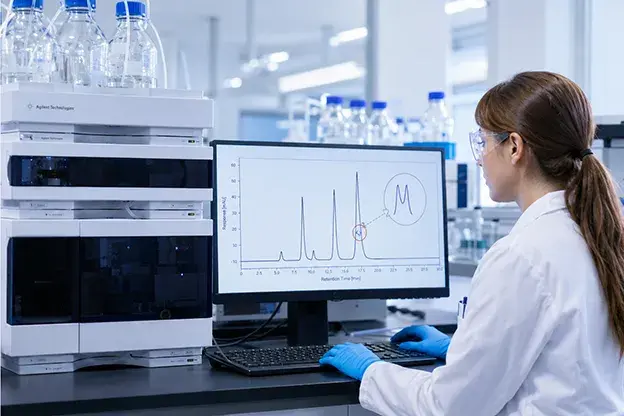
Partition chromatography is best understood today as a separation mechanism rather than a standalone routine technique. It describes how analytes distribute between two phases according to relative solubility. Modern methods often rely on that behavior as one of the forces controlling retention, especially in reversed-phase high-performance liquid chromatography (RP-HPLC), gas–liquid chromatography (GLC), paper chromatography, and hydrophilic interaction liquid chromatography (HILIC) (1–4).
Researchers, analysts, lab managers, and method developers use this concept to predict retention, refine selectivity, and troubleshoot separation problems. That makes it useful as a framework for understanding chromatography, and not as a step-by-step technique guide, across pharmaceutical, biotech, environmental, food, and academic labs (1, 2).
What is Partition Chromatography?
Structurally, partition chromatography comprises a system where separation occurs between two specific phase states. The stationary phase is a liquid or a liquid-like bonded layer, while the mobile phase may be a liquid or a gas. Retention is governed primarily by an analyte’s relative solubility in these two phases, which directly answers the question, “What is partition in chromatography?” at the mechanical level (2, 5).
This structural mechanism clearly distinguishes partition from adsorption. Partitioning relies on a solubility-driven distribution between phase volumes, whereas adsorption requires direct interaction with active sites on a solid surface. Although modern methods often contain both, the physical makeup of the stationary phase determines which mechanism dominates (4, 5).
Classical liquid–liquid chromatography (LLC) and paper chromatography are clear historical examples of this model. Modern bonded-phase systems brought the same idea into stable, high-performance workflows used every day in analytical labs (1, 3, 5, 6).
Principle of Partition Chromatography
The principle of partition chromatography relies strictly on dynamic equilibrium and repeated distribution. Rather than a single extraction event, the separation is driven by continuous thermodynamic exchange as the sample travels the chromatographic path (2, 6).
Dynamic Equilibrium
To understand the principle underlying partition chromatography, consider the analyte’s state: it reaches a dynamic balance between the two phases rather than undergoing a static, one-time transfer. The continuous rate at which molecules enter and leave the stationary phase dictates their overall velocity through the system (2, 6).
Repeated Partitioning Along the Chromatographic Path
Repeated partitioning is what gives chromatography its resolving power. A single distribution event would not separate complex mixtures well, but many successive equilibria magnify small differences in affinity. That cumulative effect creates measurable spacing between analytes that started together in the same sample band. The rate at which analytes establish equilibrium between phases also drives mass-transfer effects that influence chromatographic efficiency(5, 6).
Band Formation and Separation
As the sample zone moves through the column or support, the more strongly retained compounds spend more time in the stationary phase and lag behind. Less strongly retained compounds stay more in the mobile phase and travel sooner. This difference produces distinct bands or detector peaks rather than one unresolved signal (1, 2, 6).
What is Partition Coefficient in Chromatography?
The partition coefficient (K) helps explain retention in chromatography by describing how a solute distributes at equilibrium between the stationary phase and the mobile phase. It is often expressed as [Equation], with [Equation] representing the concentration in the stationary phase and [Equation] representing the concentration in the mobile phase (6).
While partition coefficient K is useful for understanding retention mechanisms, chromatographers more commonly use the retention factor (k') to describe chromatographic behavior experimentally.
The Relationship Between K and Retention
Higher K means the analyte spends more time in the stationary phase, which directly translates to a larger retention factor and a longer retention time. Lower K means the analyte remains more in the mobile phase, so it migrates faster through the system. That qualitative relationship is one reason partition theory remains useful for predicting chromatographic selectivity during method development (2, 6).
Partition Coefficient vs. Distribution Coefficient
The phrase “partition coefficient in HPLC” is often used broadly, but K and D are not identical. K generally refers to the equilibrium of a neutral species, while D reflects the total of ionized and non-ionized forms at a given pH. That distinction matters for ionizable pharmaceutical compounds because pH can shift observed retention even when the
Physical Implementation of Partition Systems
So how does partition chromatography work in the lab? Implementing partition chromatography requires specific hardware: a column or support to house the stationary phase, a pump or gas supply to drive the mobile phase, and a detector to record the output. The physical configuration of these components determines how efficiently the separation can be carried out and scaled (2, 3).
Stationary Phase Formats
In classical systems, the stationary phase is a liquid film supported on an inert material. In modern formats, it is often a bonded layer that behaves like a liquid environment at the surface. That bonded design brings much better stability and reproducibility than older liquid–liquid systems that were prone to stationary-phase loss during use (1, 2, 5).
Column and System Configurations
In liquid chromatography, the mobile phase is a liquid that flows through a packed column. In GLC, the mobile phase is a carrier gas and the stationary phase is a liquid film associated with the support or column surface. The hardware changes, but the core mechanism remains the same because analytes still distribute between phases according to relative affinity (2, 3).
Mobile Phase Transport
The mobile phase does more than push the sample forward. It continuously resets the partitioning environment along the chromatographic path. Changes in solvent composition, polarity, temperature, or pH can shift that balance and change retention markedly, which is why these variables matter so much in method refinement (3, 4, 6).
Detection and Chromatographic Output
The detector records the outcome of the separation rather than causing it. As compounds exit the column at different times, the detector converts those differences into a chromatogram with peaks whose position and area support identification and quantitation. Better partition-based control usually leads to cleaner peak spacing and more interpretable output (1, 3).
Types of Partition Chromatography
The section below is meant to show where partition behavior appears, not to present a list of standalone routine techniques. Some examples are classical methods, but in modern practice, the same mechanism often appears inside broader chromatographic systems, especially RP-HPLC and mixed-mode separations (1, 2, 4, 5).
Liquid–Liquid Chromatography
LLC uses a liquid stationary phase and a liquid mobile phase. It is a direct expression of partition-based separation and helped define the concept historically. Support-free all-liquid systems remain useful in selected preparative applications where liquid–liquid selectivity is especially valuable (5, 7).
Paper Chromatography
Paper chromatography is a classic partition method in which analytes distribute between a moving solvent and a stationary water-rich phase associated with the paper matrix. It remains one of the clearest ways to visualize how repeated partitioning creates separation, even though it is much simpler than modern instrumental methods (2, 5).
Bonded-Phase Partition Chromatography
Bonded-phase systems brought partition principles into stable, reproducible HPLC workflows. RP-HPLC is the most widely used example because analytes distribute between a polar mobile phase and a nonpolar stationary phase layer attached to the support. That is one reason partition theory still matters in routine pharmaceutical and analytical method development (1, 2).
Gas–Liquid Chromatography
GLC is a traditional system in which analytes distribute between a gaseous mobile phase and a liquid stationary phase. Separation occurs because each component has a different tendency to remain in the gas phase or dissolve into the liquid film. Consequently, GLC is best read here as a classic example of distribution-based retention, rather than the primary way this mechanism is applied in routine modern method development. Modern GLC is predominantly performed using capillary columns coated with thin stationary-phase films (3).
Hydrophilic Interaction Liquid Chromatography
The relative contributions of partitioning, adsorption, and electrostatic interactions depend strongly on stationary-phase chemistry and mobile-phase composition. (4). This mixed behavior helps HILIC retain highly polar compounds that can be difficult to analyze by reversed-phase methods alone (4).
- Partitioning: Polar analytes distribute into the water-rich layer associated with the stationary phase, and this partitioning helps control retention.
- Adsorption: Some analytes interact directly with the stationary-phase surface, which can strengthen or modify retention.
- Electrostatic Interactions: Charged analytes can interact with ionized sites or counterions in the system, which can shift retention and selectivity.
Partition vs. Adsorption Chromatography
As established earlier, partition and adsorption describe two fundamentally different dominant retention models. Partition relies on relative solubility and volume distribution, whereas adsorption is strictly a surface-level binding event. The table below highlights these core structural and thermodynamic distinctions. Note that many modern chromatographic systems exhibit mixed retention mechanisms rather than purely partition- or adsorption-based behavior (4, 5).
Do Modern Chromatographic Systems Use Only One Mechanism?
Most modern chromatographic systems do not use only one mechanism. RP-HPLC can show both partition and surface interaction effects. HILIC often combines partitioning with adsorption and electrostatic contributions. Mixed-mode columns are built around that reality, so partition and adsorption are better understood as dominant tendencies rather than mutually exclusive categories (4, 5).
A practical way to explain this is to compare chromatography with liquid–liquid extraction. Both depend on analyte distribution between environments, but chromatography repeats that distribution many times across a support or column, which creates much finer analytical separation (2, 6).
Factors Affecting Partition Chromatography
The factors affecting partition chromatography include the polarity of the stationary and mobile phases, the nature and thickness of the stationary phase, phase stability, temperature, pH, ionic strength, flow rate, and the quality of the support or column. Each factor can shift the partition coefficient and alter selectivity, retention, or peak shape, especially when analytes are ionizable or strongly polar (3, 4, 6).
Temperature is especially important in gas chromatography, while solvent composition often exerts a stronger effect in liquid chromatography. pH and ionic strength matter when analytes can ionize, and support quality matters because poor materials can distort equilibrium behavior. Modern bonded-phase columns also reduced the older issue of stationary-phase loss that limited classical liquid–liquid formats, which helped make partition-based methods more reproducible for routine laboratory work (1, 2, 5).
FAQs on Partition Chromatography
What is the partition coefficient in chromatography?
Partition coefficient in chromatography is the equilibrium ratio that describes how a solute distributes between the stationary and mobile phases. Higher values usually mean stronger retention in the stationary phase.
What is the difference between partition and adsorption chromatography?
Partition chromatography depends on distribution between phases, and adsorption chromatography depends on binding to a solid surface. Many real systems show both, but one usually dominates the observed retention pattern.
Is reversed-phase HPLC a type of partition chromatography?
Reversed-phase HPLC is commonly described using partition theory because analytes distribute between the mobile phase and the bonded stationary phase environment. Adsorption, hydrogen bonding, and silanol interactions can also contribute to retention.
Is HILIC purely a partition chromatography technique?
No. HILIC is generally considered a mixed-mode technique that includes partitioning, adsorption, and electrostatic contributions depending on the analyte and conditions.
Why is partition chromatography considered a retention mechanism rather than a standalone technique today?
Partition chromatography is considered a retention mechanism rather than a standalone technique today because many current chromatographic methods combine more than one interaction model in the same separation. Partitioning still explains much of the retention behavior, but it often works alongside adsorption or other secondary mechanisms in modern systems.
References
- Karageorgou, E. G., Kalogiouri, N. P., & Samanidou, V. F. (2025). Green Approaches in High-Performance Liquid Chromatography. Molecules. https://pmc.ncbi.nlm.nih.gov/articles/PMC12430196/
- Harvey, D. (2022). 28.04: Partition Chromatography. In Instrumental Analysis (LibreTexts). https://chem.libretexts.org/Bookshelves/Analytical_Chemistry/Instrumental_Analysis_(LibreTexts)/28%3A_High-Performance_Liquid_Chromatography/28.04%3A_Partition_Chromatography
- Note on Gas Liquid Chromatography (GLC). (2022). Walsh Medical Media. https://www.walshmedicalmedia.com/open-access/note-on-gas-liquid-chromatography-glc-110139.html
- Hemström, P., & Irgum, K. (2006). Hydrophilic interaction liquid chromatography. Journal of Separation Science, 29(12), 1784–1821. https://pmc.ncbi.nlm.nih.gov/articles/PMC3249561/
- Synge, R. L. M. (n.d.). Applications of partition chromatography. Nobel Prize. https://www.nobelprize.org/uploads/2018/06/synge-lecture.pdf
- Wasik, S. P., Tewari, Y. B., Miller, M. M., & Purnell, J. H. (1982). Measurements of the Octanol/Water Partition Coefficient by a New Experimental Method. Molecules, 24(17), 3173. https://pmc.ncbi.nlm.nih.gov/articles/PMC6768191/
- Elie, N., Fougère, L., Noorizadeh, S., Jamin, E., Clément, S., Ahond, A., Ausseil, F., & Poupon, E. (2022). Online hyphenation of centrifugal partition chromatography and mass spectrometry, an application to Santalum austrocaledonicum heartwood extract analysis. Journal of Mass Spectrometry, 57(6), e4877. https://pmc.ncbi.nlm.nih.gov/articles/PMC9234026/