Silica vs. Polymer Monolithic Columns: A Selection Guide
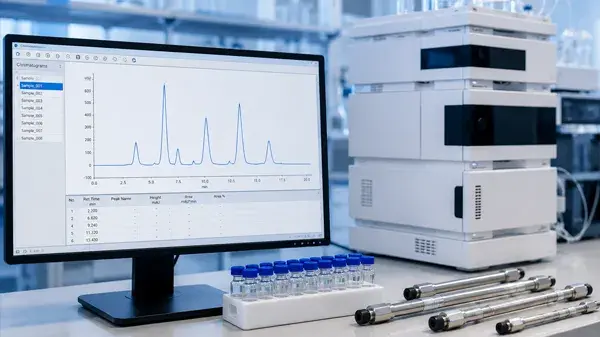
Choosing between a silica and a polymer monolithic column means picking between two chemistries: silica-based and organic polymer-based. The right choice depends mainly on mobile phase pH, the efficiency you need, and the size of your analytes.
Both types are single, continuous porous rods rather than packed beds. This guide assumes you already plan to use a monolith, so it covers only which chemistry to pick. The parent monolithic vs packed columnscomparison page covers backpressure against efficiency. Read on for a side-by-side table, the reasoning behind each trade-off, and a simple rule of thumb. Every figure is approximate and tied to the cited literature.
The Two Monolith Chemistries at a Glance
A silica monolithic column is a rigid, continuous rod of porous silica made by a sol-gel process. For analytical use, the rod is sealed in a PEEK tube. Its macropores carry the flow, and its mesopores supply the surface for separation.
A polymer monolithic column is a porous organic polymer rod prepared from acrylamide, acrylate or methacrylate, or styrene monomers. Typical polymer monoliths have few or no mesopores, so they separate small molecules poorly and therefore suit large biomolecules.
That gives the headline trade-off. Polymer monoliths have better pH stability, and silica monoliths have better separation efficiency. As a practical rule of thumb, silica monoliths are usually preferred for small-molecule separations, whereas polymer monoliths excel with large biomolecules and applications requiring extreme pH conditions.
Silica vs. Polymer Monoliths: Side-by-Side Comparison
This table compares the two main monolithic column types on six attributes. Use it as a quick silica vs. polymer monolithic column reference.
Availability differs too. Only a few manufacturers produce polymer monoliths commercially, and most published reports use home-made columns. Because synthesis conditions can differ between laboratories, reproducibility is difficult to obtain for those columns.
pH Stability: The Polymer Advantage
Polymer monoliths tolerate a wider range, roughly pH 1–12. Confirm the limits for your specific column. Stability also depends on the monomer family. One review rates styrene-based monoliths as having stable properties and acrylamide- and acrylate-based monoliths as poorly stable. A C18 methacrylate capillary monolith ran with highly acidic and basic buffers for 30 hours without prominent degradation in one study. Sodium hydroxide sanitization has also been reported for a methacrylate monolith in virus purification.
Bare silica monoliths work within narrower limits. For example, Phenomenex Onyx monolith columns are specified for pH 2–7.5. Low pH hydrolyzes the bonded phase, and high pH dissolves the silica.
A wider pH window can be particularly valuable for basic compounds. High pH suppresses protonation of many basic analytes, often improving peak shape, reducing secondary interactions with residual silanols, and increasing retention in reversed-phase separations.
Define your target pH early, because it sets your options for the mobile phase and your choice of HPLC mobile phase solvents.
Hybrid organic-silica monoliths are a more specialized middle option. One hybrid capillary column held its performance from pH 1.1 to 11 in a reported test, but its monolith failed at pH 12.
Efficiency and Small Molecules: The Silica Advantage
Silica monoliths resolve small molecules well, and efficiency rises with each generation. One report found about 80,000 N/m for a first-generation rod. A second-generation rod with smaller macropores reached about 140,000 N/m under reversed-phase HPLC conditions.
Pore structure explains much of this advantage. Macropores measure about 2 µm in first-generation rods and about 1.1 µm in second-generation rods, and mesopores measure roughly 12–17 nm. Sol-gel silica monoliths reach a surface area of about 300 m²/g.
Polymer monoliths behave differently. Typical polymer monoliths consist of aggregated nonporous microglobules, completely lack mesopores, and show surface areas of only tens of m²/g. Small molecules find few interaction sites in isocratic mode. Some chemistries also swell. Acrylamide-based monoliths swell excessively in aqueous mobile phases, and even highly crosslinked styrenic monoliths can swell in good solvents.
Hypercrosslinked capillary columns exceeded 60,000 plates per meter in one study, but they remain specialized. Some research polymer and hybrid capillary monoliths also report high plate counts. Treat the silica advantage as a general trend and not a ceiling.
Applications: Where Each Chemistry Wins
The applications below follow the published literature. Conditions differ between studies, so use them as directional guidance.
Silica monoliths:
- Small-molecule HPLC for drugs and metabolites in plasma, urine, whole blood, and milk.
- Fast, low-backpressure separations, with flow rates of up to about 6 mL/min reported for plant extracts without loss of separation efficacy.
- Polar small molecules that need HILIC selectivity fall outside this comparison, and Luna HILIC is one place to start.
Polymer monoliths:
- Proteins, peptides, and oligonucleotides, including isoform and peptide digest separations coupled to mass spectrometry.
- Bioprocess purification of monoclonal antibodies, viruses, and nucleic acids.
- Capillary and nano-LC formats, where the polymer forms directly inside a fused-silica capillary.
- Capillary electrochromatography (CEC), solid-phase extraction, and sample enrichment.
Hybrid monoliths bridge mixed-mode needs. One hybrid capillary column separated alkylbenzenes, PAHs, and proteins, and its protein digest coverage matched a packed column.
How to Choose: Silica or Polymer
Use this silica monolith vs. polymer monolith checklist as a first filter for any HPLC Column shortlist.
Choose a silica monolith when:
- You are separating small molecules and want high efficiency.
- Your method runs within the usual silica pH range.
- You need a conventional analytical format and fast, low-pressure runs.
If these signals match your method, explore monolithic silica columns and Onyx monolithic HPLC columns from Phenomenex.
Choose a polymer monolith when:
- You are separating large biomolecules such as proteins, peptides, nucleic acids, and antibodies.
- Your method needs very high or very low pH.
- You are working in capillary, nano-LC, or CEC formats.
A quick example shows the logic. A small-molecule drug in plasma at mid-range pH points to silica. A tryptic peptide separation in a capillary points to polymer.
Remember: Go silica for small molecules and efficiency, and polymer for large biomolecules or extreme pH.
FAQs on Silica vs. Polymer Monoliths
Which monolithic column type is best for proteins and other biomoleculesbetter for proteins?
Polymer monoliths are generally better for proteins and other large biomolecules. Typical polymer monoliths have few or no mesopores, which can suits fast gradient separations of large proteins. Reviews also report better performance than silica for large molecules, citing biocompatibility and large domain size.
Why do polymer monoliths have wider pH stability?
Reviews report a wider pH range for polymer monoliths than for silica. For silica, low pH hydrolyzes the bonded phase and high pH dissolves the silica. Phenomenex guidance describes packed polymeric columns as resistant to hydrolysis under extreme pH. That guidance does not address monoliths directly, so confirm the limits for your specific column.
Can polymer monolithic columns be used for small- molecule separations?
Generally, no. Typical polymer monoliths have few or no mesopores and separate small molecules poorly. Hypercrosslinked capillary monoliths are a specialized exception.
What is a hybrid monolithic column?
A hybrid monolithic column is an organic-silica monolith, a third category beside silica and polymer monoliths. It combines the pH tolerance and biocompatibility of organic polymers with the permeability and mechanical strength of silica.