UHPLC Columns
Phenomenex UHPLC columns deliver exceptional performance on any UHPLC system—boosting throughput and reducing solvent consumption without compromising sensitivity. Whether you need quantitative bioanalysis, complex small-molecule separations, or large biomolecule characterization, our solutions provide consistent, accurate results for every application.
As a leader in UHPLC, Phenomenex offers ultra-high-performing columns with unique fully porous and core-shell particle technologies, achieving extraordinary resolution and efficiency across all systems.
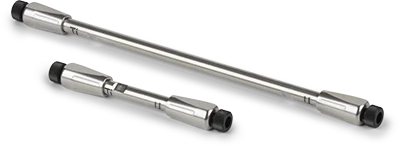

Why Choose Phenomenex UHPLC Columns?
Phenomenex UHPLC columns combine advanced particle engineering with precisely controlled surface chemistries to deliver high-resolution, reproducible separations across a wide range of analytes. The portfolio includes both fully porous particles (1.6 µm) and core-shell particles (1.3 µm, 1.7 µm and 2.6 µm), providing analytical scientists with optimal flexibility for method development, transfer, and optimization.
Key advantages include:
- Industry-Leading Efficiency: Core-shell technology minimizes band broadening, delivering exceptional peak resolution and sensitivity even for challenging separations.
- Exceptional Reproducibility: Rigorous manufacturing processes ensure batch-to-batch consistency for reliable, transferable methods.
- Broad Application Versatility: Eleven diverse stationary phase chemistries address reversed-phase, HILIC, ion-exchange, and biocompatible separations.
- Enhanced Inertness: Advanced surface modification and hardware technologies reduce unwanted analyte interactions, critical for basic compounds and biomolecules.
- Cost-Effective Performance: Extended column lifetimes and compatibility with protective accessoriesmaximize return on investment.
- Comprehensive Support: Expert technical assistance, method development resources, and compatible UHPLC
accessories enhance your analytical workflow.
Whether you are conducting peptide mapping, small molecule pharmaceutical analysis, or metabolomics studies, Phenomenex UHPLC columns provide the performance and reliability essential for demanding analytical work.
How to Select the Right UHPLC Column
Selecting the optimal UHPLC column requires matching column specifications to your specific analytical requirements. Consider these critical factors:
-
Stationary Phase Chemistry: Determines selectivity and retention.
- C18/C8 phases: Broadly applicable for reversed-phase separations.
- Aromatic phases (phenyl-hexyl, biphenyl, PFP): Enhance π–π interactions and resolve positional isomers.
- HILIC phases: Ideal for highly polar analytes.
- Ion-exchange phases: Effective for ionic compounds.
- Biocompatible phases: Designed for biomolecules.
-
Particle Size and Morphology: Sub-2 µm particles improve efficiency but increase backpressure. Core-shell particles (1.3–1.7-2.6 µm) deliver UHPLC-level performance with lower backpressure, allowing use on both UHPLC and modern HPLC systems.
-
Column Dimensions:
- Length: Affects efficiency and run time (50–100 mm for rapid analyses; 150 mm for maximum resolution).
- Internal Diameter: 2.1 mm is standard for balancing efficiency, sensitivity, and solvent use. 3mm ID can be used to increase column loadability .
-
Hardware Compatibility: Ensure your UHPLC system can operate at required pressure levels. 2.6 µm columns often operate efficiently at ≤400 bar, while sub-2 µm columns may require UHPLC systems rated to 1,200–1,500 bar.
-
Pore Size: Choose based on analyte size:
- 60–120 Å: Small molecules (<10,000>
- 150–300 Å: Peptides
- ≥300 Å: Intact proteins or antibodies
-
pH Range and Temperature Stability: Match column pH tolerance to your mobile phase requirements. Hybrid silica columns offer extended pH stability (1.5–12), while silica based columns have more limited range (1.5-8.5).
Systematically evaluating these parameters creates a framework for selecting UHPLC columns that optimize separation performance, analysis speed, and method robustness for your specific application.
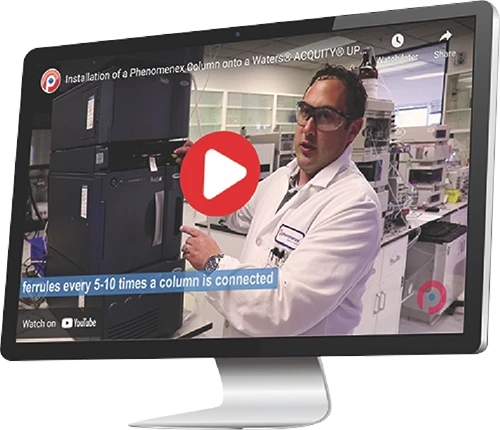
Phenomenex LC columns are universally compatible with all HPLC and UHPLC systems. Installing Phenomenex UHPLC columns on Waters® ACQUITY® UPLC® Systems is quick and easy—watch the demo to see how it’s done.
For more information about high-performance liquid chromatography techniques and column technologies, visit our comprehensive HPLC Column resource center.
FAQs
What is the size of a UHPLC column?
UHPLC columns are smaller than conventional HPLC columns, with internal diameters ≤2.1 mm and lengths of 50–150 mm. They use sub-2 µm particles (typically 1.3–1.7 µm), enabling faster, more efficient separations at lower flow rates (0.2–0.7 mL/min).
What accessories are recommended to protect UHPLC columns?
Use SecurityGuard ULTRA cartridges to block particulates and contaminants, protecting against frit blockage and media damage. They extend column life, improve performance consistency, and reduce replacement costs. Inline filters and proper sample prep also help.
How do I extend the lifetime of my UHPLC columns?
Use guard cartridges, filter and degas solvents, prepare samples properly, flush regularly, store in the correct solvent, stay within pH limits, and equilibrate to room temperature before use.
Can I use UHPLC columns on a conventional HPLC system?
Yes. Core-shell columns like Kinetex 2.6 µm work on HPLC systems (≤400 bar) with lower backpressure. However, full UHPLC performance requires systems rated up to 1,200–1,500 bar. Always ensure pressure stays within system limits.
Can I use a guard on my UHPLC column?
Yes. SecurityGuard ULTRA cartridges are designed for UHPLC columns with matched phases and low dead volume. They prevent frit blockage and degradation, extending column life and maintaining consistent results.