

Posted on Apr 24, 2026
Written By Mark Colbassi, MSc, Senior Global Marketing Content Specialist
Estimated reading time: 5 minutes
From Dispersive Carbon to Stacked SPE: Improving PFAS Sample Preparation for LC-MS/MS Analysis
In PFAS LC–MS/MS workflows, sample preparation largely defines method sensitivity, robustness, and reproducibility. The mixed ionic and hydrophobic character of PFAS, combined with their environmental ubiquity, complicates extraction and places strict demands on contamination control. As methods extend beyond drinking water into non‑potable waters and solids, additional cleanup is often required to mitigate ionization suppression and MS/MS interferences at low‑ppt concentrations.
Weak anion‑exchange (WAX) SPE remains a primary extraction tool for anionic PFAS, but in more complex matrices, it is commonly paired with a cleanup using graphitized carbon black (GCB) to remove co‑extracted organic acids, including cholic acids known to co‑elute with PFOS and introduce positive bias or spectral interference.
History of PFAS sample preparation:
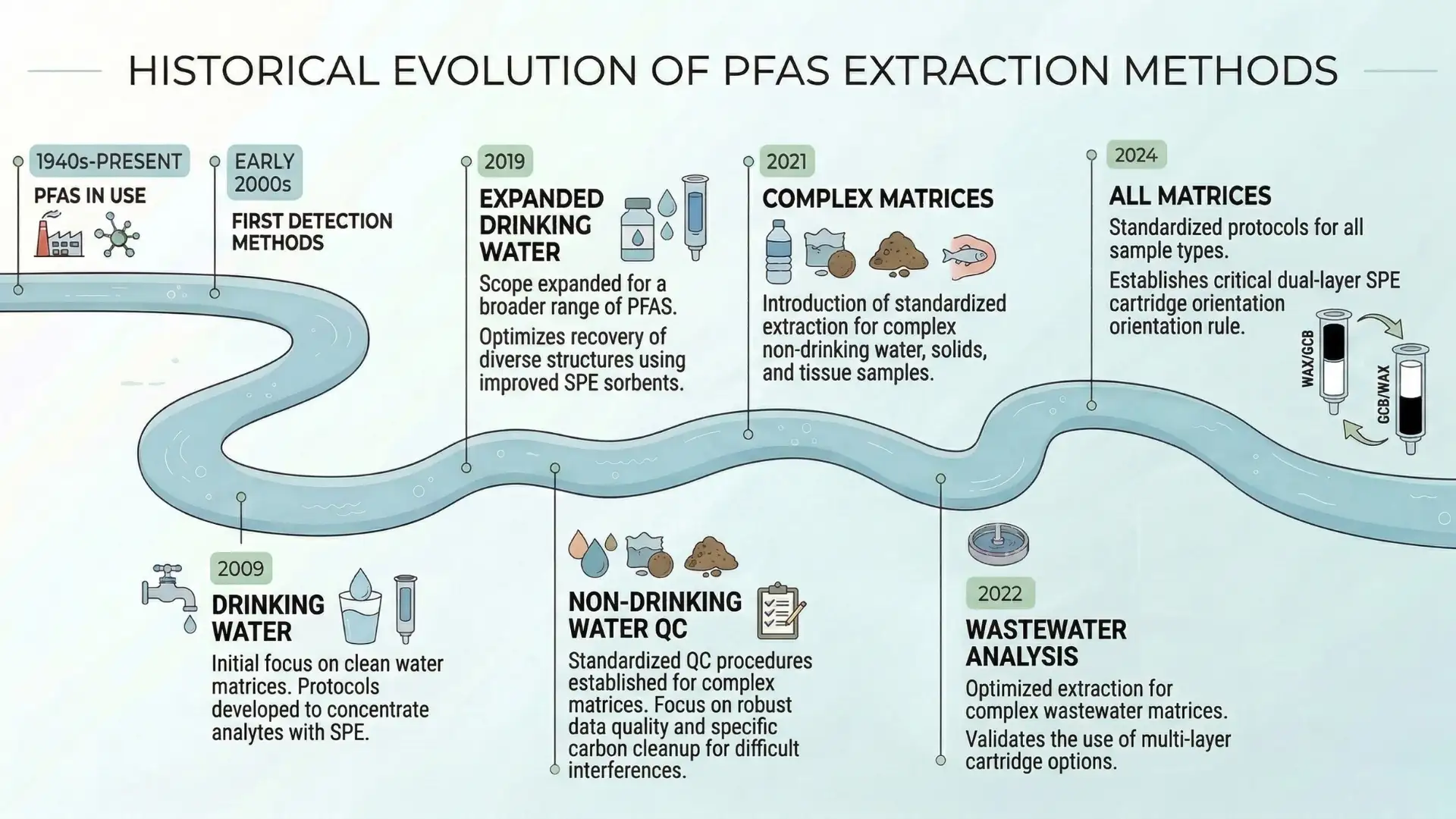
PFAS sample‑preparation strategies have evolved in parallel with expanding regulatory scope, lower reporting limits, and increased matrix complexity:
· Drinking water (early
workflows):
WAX SPE was used primarily to concentrate PFAS and reduce background, generally
providing sufficient cleanup for relatively clean matrices.
· Drinking water
(expanded analyte scope):
As analyte lists grew to include short‑chain compounds and precursors,
workflows incorporated isotope dilution and optimized WAX selectivity to
maintain accuracy at lower levels.
· Non‑drinking water
aqueous matrices (wastewater, surface water, groundwater):
Carbon cleanup was increasingly added after WAX SPE to remove organic acids and
other co‑extracted interferences contributing to ionization suppression and
spectral bias.
· Solid matrices (soil, biosolids,
tissue):
Carbon cleanup was often applied prior to WAX SPE to reduce matrix load before
selective extraction, leading to matrix‑dependent sequencing of cleanup
relative to SPE.
Across these workflows, dispersive GCB cleanup proved chemically effective but operationally complex, adding manual steps and increasing variability and contamination risk.
Limitations of Sequential WAX SPE + Dispersive GCB Cleanup
Dispersive GCB cleanup following WAX SPE is effective at removing interfering organic components but represents the least controlled step of many PFAS workflows. Manual carbon addition, mixing, centrifugation, and frequent filtration increase analyst‑to‑analyst variability, limits throughput, and elevates contamination risk—particularly when handling fine, electrostatic carbon powders in high‑volume laboratories.
Stacked SPE: Integrated Extraction and Cleanup
Phenomenex was the first to offer stacked SPE cartridges that integrate WAX and GCB sorbents into a single cartridge format to consolidate extraction and cleanup into one controlled process. The approach preserves established PFAS retention mechanisms while eliminating loose carbon handling.
Key workflow impacts include:
- Elimination of dispersive carbon addition and handling
- Defined, reproducible carbon exposure within an enclosed format
- Reduced variability across analysts and batches
- Simplified workflows suitable for standardization and automation
Cartridge Orientation and Matrix‑Specific Sequencing
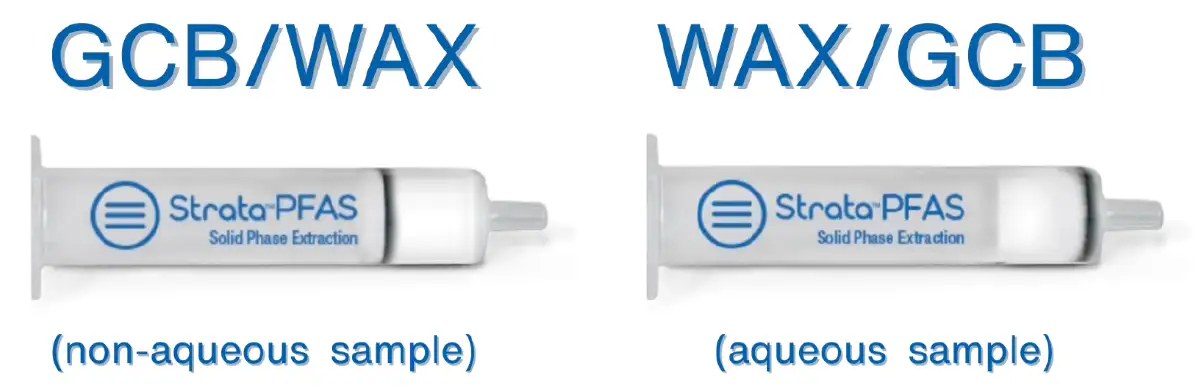
Because carbon placement relative to WAX is matrix‑dependent, stacked SPE cartridges are available in two configurations:
- Standard stack (WAX → GCB) for non‑drinking water aqueous matrices, where carbon cleanup is applied after WAX extraction
- Reverse stack (GCB → WAX) for solid matrices (soil, biosolids, tissue), reflecting common practice of carbon exposure prior to selective extraction
Carbon Mass Optimization
Early stacked formats (e.g., 200–500 mg WAX with 50 mg GCB) reflected common laboratory practice. Subsequent evaluations showed that excessive carbon mass can increase long‑chain PFAS retention risk, particularly in lower‑organic matrices.
Updated stacked formats reduce GCB to 10 mg, which:
- Maintains removal of cholic acids and key organic interferences
- Minimizes long‑chain PFAS recovery risk
- Shortens elution times through the carbon layer
Stacked SPE vs WAX + dSPE
Process Comparison (workflow and touchpoints)
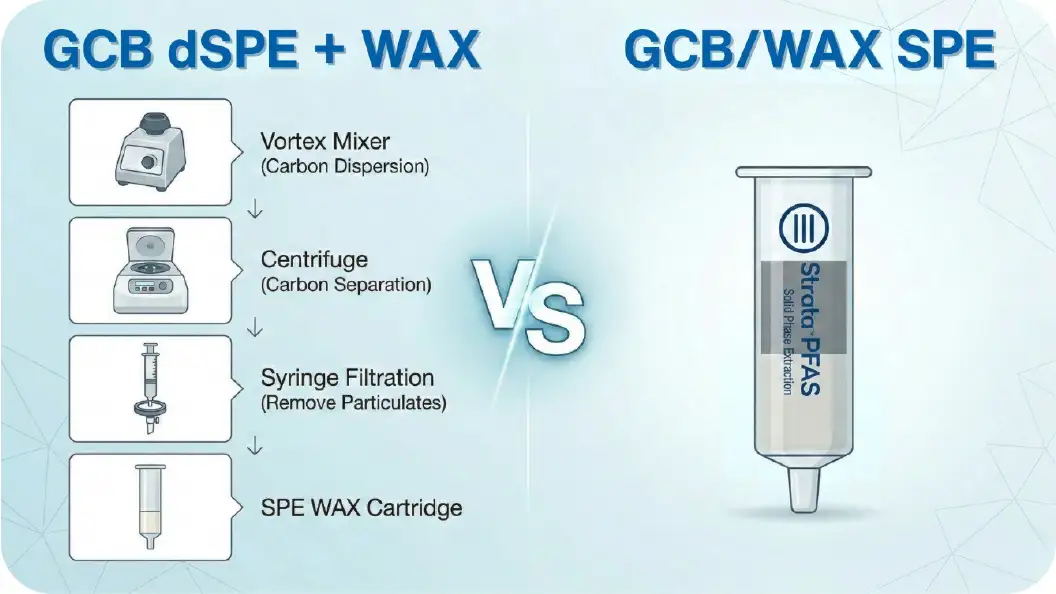
Loose GCB dSPE is, let me use this organic chemistry term, the rate determining step of this procedure, described as labor-intensive and operationally complex, requiring added steps (such as adding carbon, mixing, and centrifugation) and frequently followed by filtration to remove particles that could impact the LC column or MS source.
In contracts, stacked cartridges contain the carbon within the cartridge body, consolidating extraction and cleanup into one step and eliminating the loose-carbon handling step evaluated in the studies.
Performance Evaluation: Non‑drinking water aqueous matrices
A cross‑laboratory equivalency study compared the Phenomenex Strata PFAS stacked WAX/GCB cartridge to sequential WAX SPE plus dispersive GCB cleanup. Native PFAS were spiked at 2 ng/L (N = 7) and isotope‑labeled analytes at 50 ng/L (N = 7).
Under the stated equivalency framework, the stacked cartridge approach was shown to be equivalent, and in some cases more efficient, than the conventional two‑step workflow (1).
Technical Note TN‑0145 — Comparison of PFAS Recoveries Between Cartridge Format WAX/GCB vs. Dispersive GCB for DoD Compliance (1) here.
Performance Evaluation: Solid matrices (EPA Method 1633)
A collaborative study with Alpha Analytical Labs evaluated reverse stacked Phenomenex Strata GCB/WAX cartridges for extraction of soil extracts prepared using EPA Method 1633. For soils spiked at 10 ppt, stacked SPE produced recoveries equivalent to loose‑carbon dSPE followed by WAX SPE, with equivalency demonstrated across multiple soil reference materials.
The stacked approach reduced analyst labor by approximately 30 minutes per 20‑sample batch, with an additional ~30 minutes saved when filtration was eliminated. (2)
Conclusions
Across aqueous non‑potable water and solid matrices, Phenomenex Strata PFAS stacked SPE cartridges provide recoveries equivalent to traditional WAX plus dispersive carbon cleanup while simplifying execution. By integrating carbon cleanup directly into the SPE cartridge, stacked SPE reduces contamination risk, improves reproducibility, and increases throughput — supporting the growing analytical and operational demands of PFAS testing laboratories.
Improve your PFAS extraction: talk with a technical expert!
FAQs
What are stacked SPE cartridges for PFAS extraction?
SPE cartridges layering WAX and GCB so extraction and carbon cleanup occur in one device, evaluated as an alternative to sequential WAX SPE followed by dispersive carbon cleanup in non‑drinking water workflows.
Why is GCB cleanup used in non‑drinking water PFAS LC‑MS/MS?
Because GCB is described as removing cholic acid (caused by the breakdown of organic matter) associated with spectral interference and ionization suppression, and it mitigates PFOS bias risk tied to cholic acids coeluting with PFOS and producing MS/MS fragment interference.
What are the advantages of stacked SPE cartridges for PFAS analysis compared with standard WAX SPE + GCB dSPE workflows?
Stacked WAX/GCB SPE cartridges combine PFAS extraction and carbon cleanup in a single device, instead of running WAX SPE and then adding loose GCB by dSPE. That consolidation cuts hands‑on steps (no separate carbon addition, mixing, centrifugation, and often filtration), eliminates the handling of fine, electrostatic carbon powder that can be messy on the manifold and surrounding surfaces, and supports automation-ready cleanup because the polishing layer is built into the cartridge. In the published comparisons, stacked formats are reported as equivalent to WAX + dSPE for recovery (and evaluated for precision), and in some datasets show equal or higher recoveries than dispersive carbon workflows, depending on analyte/matrix, while also improving workflow consistency through fewer manual touchpoints.
How do I choose a standard stack vs reverse stack for multi-matrix SPE extraction workflows?
The choice of standard stacked cartridges (WAX/GCB) over reverse stacked cartridges (GCB/WAX) for PFAS extraction is matrix-dependent: aqueous matrices follow WAX then carbon (WAX over GCB), while solid matrices follow carbon then WAX (GCB over WAX).
References
(1) Lodge, S. et al. TN-0145 Comparison of PFAS Recoveries Between Cartridge Format WAX/GCB vs. Dispersive GCB for DoD Compliance.
(2) Shimizu, M. et al. TN‑0169. Use of a Simplified Extraction Method Using a Stacked SPE for Soil Extracts for EPA Method 1633.