

Posted on Feb 10, 2026
Author: Mark Colbassi, MSc, Sr. Global Content Marketing Specialist
The everyday struggle in pharma labs
Your HPLC queue is full, the method clocks 40 minutes per injection, and the monograph seems to lock you into 250 × 4.6 mm, 5 µm—forever. Solvent costs rise, throughput lowers, but still, revalidating your method seems daunting. Here’s the good news: you can modernize and speed up pharmacopoeia HPLC methods without revalidating, as long as you follow the recommended allowable adjustments correctly and respect system suitability. Below, we’ll show how two simple levers, the L/dp ratio and particle morphology, let you cut run time dramatically while staying compliant, using side-by-side chromatogram comparisons for Lamivudine related substances (Ph. Eur), Doxepin Hydrochloride stereoisomers (USP), and Irbesartan Related Substances (Ph. Eur).
Why monographs feel like handcuffs (and why they aren’t)
Pharmacopoeia methods do specify, among many other regulated methods, column dimensions, particle size, and phase (e.g., “L1/C18, 250 × 4.6 mm, 5 µm”), so choices are limited. But the harmonized USP <621> [1] and Ph. Eur. 2.2.46 [2] chapters also define what you may change without fundamentally altering the method, and if system suitability is respected, without revalidating anything. These are called allowable adjustments.
A summary of what can and what can’t be adjusted in an isocratic Pharmacopoeia method is listed in Table 1.
Table 1 Allowable Adjustments for Isocratic Methods included in USP <621> [1] and Ph. Eur. 2.2.46 [2] harmonized chapters.
| Method Parameter | Allowable Adjustments Isocratic Methods |
|---|---|
| Stationary Phase | No change of the identity of the substituent (e.g., no replacement of C18 by C8); the other physico-chemical characteristics of the stationary phase (i.e., chromatographic support, surface modification, and extent of chemical modification) must be similar; a change from totally porous particle (TPP) columns to superficially porous particle (SPP) columns is allowed provided the above-mentioned requirements are met. |
| Column Dimension (particle size and length) | Column length (L) to the particle size (dp) ratio within −25% to +50% of the prescribed L/dp ratio. |
| Column Internal Diameter | Can be adjusted as desired. |
| Flow Rate |
±50%. F2 = F1 × (dc22 × dp1) / (dc12 × dp2) F: flow, dc: internal diameter, dp: particle size |
| Column Temperature | ±10 °C |
| Minor Solvent Composition | ±30% relative |
| pH of the Aqueous Content of the Mobile Phase | ±0.2 units |
| Concentration of Salts in the Buffer Component of a Mobile Phase | ±10% |
| Detector Wavelength | No adjustment permitted |
| Injection Volume |
When the column dimensions are changed, the injection volume adjustment
equation may be used to adjust the injection volume. V2 = V1 × (dc22 × L2) / (dc12 × L1) V: injection volume, L: length, dc: internal diameter |
Today, we will focus on two adjustments:
- Column dimensions (L and dp ratio): You may change length and/or particle size as long as L/dp remains constant or within −25 % to +50 % of the monograph value.
- Stationary phase morphology: You must keep the stationary phase chemistry equivalent (e.g., C18 → C18) and similar physico chemical characteristics; switching from fully porous (TPP) to core shell (SPP) is explicitly allowed under those conditions.
Other permitted adjustments exist, but we’re prioritizing L/dp and morphology, since these are the most common and easiest to apply changes, and provide the largest time savings.
The science behind efficiency
So, why do these adjustments matter so much? The answer lies in chromatographic efficiency, the heart of every separation method. When you modernize a method, your goal isn’t just to make it faster; it’s to keep equal (or higher) separation power. That’s where the concept of theoretical plates (N) comes in. N is a measure of how well your column can separate compounds: the higher the number, the sharper and more distinct your peaks.
N = 16 × (Rt / Wb)2
- (Rt) = retention time of solute (where my peak is in the chromatogram)
- (Wb) = peak width at base (how large is my peak)
Here, Rt is the retention time, and Wb is the peak width at its base. A higher N means better resolution and sensitivity, which is crucial for passing system suitability in regulated pharma methods.
How do you boost N?
- Smaller particles: These reduce the diffusion path, minimizing band broadening and increasing efficiency.
- Longer columns: More opportunities for separation, but also more time and solvent.
Unfortunately, a longer column will also slow you down. The real trick is to hold efficiency steady while shortening runtime. That’s exactly what the L/dp ratio allows: by adjusting column length and particle size together, you can maintain high efficiency and get faster results, which would all be within the allowable adjustments, and thus, no revalidations required!
L/dp Adjustment
Pharmacopoeias regulate column dimensions via L/dp
- L = column length (mm)
- dp = particle size (µm)
- Rule: Keep L/dp the same as the monograph or within −25 % to +50 %.
Theoretical example (no compound):
- Monograph column: 250 mm × 5 µm → (L/dp = 250/0.005 = 50,000)
- Allowed alternatives (same chemistry):
- 150 mm × 3 µm → (150/0.003 = 50000) (identical)
- 100 mm × 1.7 µm → (100/0.0017 = 58824) (+17.6 %, inside the +50 % window)
Preserving L/dp preserves efficiency, so you can shorten the column and decrease particles to cut runtime, and remain within USP/Ph. Eur. regulations. Once you have the calculations, you need to test them in real life to see if the system suitability is respected. If you pass that test, you win!
Still need some additional help with the calculation? Use our Allowable Adjustment Calculator to easily update your method
Fully Porous to Core-Shell Adjustment
Fully porous particles have a uniform porous structure throughout, which means analytes diffuse deep into the particle where the functionalization of the particle surface didn’t happen, and thus, the separation does not occur. Core-shell particles, on the other hand, have a solid core and a thin porous shell, reducing the diffusion path, improving mass transfer, and so the performance of the separation.
The Van Deemter equation explains why core-shell particles deliver better performance:
The Van Deemter equation explains the physics:
H = A + (B / μ) + C · μ
- H = plate height (lower is better)
- µ = linear velocity
- A = packing quality (eddy diffusion)
- B = longitudinal diffusion (spreading along the column)
- C = mass transfer (how quickly analytes move between phases)
- Core-shell particles minimize the Cμ term, which dominates at higher flow rates. because analytes don’t need to penetrate deep pores. This results in sharper peaks, higher efficiency at the same particle size and lower backpressure compared to fully porous particles.
The gain in efficiency is highly dependent on the size of the particle, as we are switching from fully porous to core-shell. The highest efficiency gain for analytical columns is for a 5 µm particle, where it can be up to 90% higher (almost doubling efficiency!). This efficiency can be used to improve the resolution, or you can increase the flow to cut the runtime while maintaining the same efficiency.
Now, let's dive into some real-world examples to see how these two allowable adjustments really impact our chromatography separations
Real-world example #1: Lamivudine: Adjust L/dp
Original setup (Ph. Eur. 2217):
- Column: 250 × 4.6 mm, 5 µm
- L/dp = 50,000
- Runtime: 40 min
- System suitability: Passed (Rs ≥ 1.5, symmetry 1.0)
Allowed adjustment:
- Column: 150 × 4.6 mm, 3 µm
- L/dp = 50,000 (compliant)
- Runtime: 25 min
- System suitability: Passed

Figure 1 – APP ID: 27627: System Suitability Test for Lamivudine Related Substances with Pharmacopoeia indicated column Luna™ Omega 5 μm C18, 250 x 4.6 mm.
| Peak No. |
Analyte | Retention Time (min) |
Area | Height | Resolution | Symmetry Factor |
|---|---|---|---|---|---|---|
| 1 | Impurity E | 3.17 | 48970 | 12260 | – | 1.16 |
| 2 | Impurity F | 4.02 | 12416 | 2754 | 3.59 | 1.12 |
| 3 | Impurity A | 4.49 | 87249 | 16330 | 1.06 | |
| 4 | Impurity B | 12.26 | 54297 | 4128 | 2.87 | 1.02 |
| 5 | Lamivudine | 13.29 | 12747943 | 890457 | 0.97 | |
| N=6 Injections | ||||||

Figure 2 - APP ID: 27629: System Suitability Test for Lamivudine Related Substances with optimized column Luna Omega 3 μm, 150 x 4.6 mm, respecting Ph. Eur allowable changes.
| Peak No. | Analyte | Retention Time (min) | Area | Height | Resolution | Symmetry Factor |
|---|---|---|---|---|---|---|
| 1 | Impurity E | 1.16 | 17318 | 8364 | - | 1.18 |
| 2 | Impurity F | 1.48 | 4435 | 2027 | 3.01 | 1.14 |
| 3 | Impurity A | 1.66 | 31017 | 12653 | 1.09 | |
| 4 | Impurity B | 4.91 | 18402 | 3439 | 2.74 | 0.99 |
| 5 | Lamivudine | 5.32 | 4502183 | 755672 | 0.98 | |
| N=6 Injections | ||||||
The result: 15 minutes saved per run without changing chemistry or revalidating.
Why it works: Efficiency (N) is preserved when L/dp is preserved. Because chemistry and mobile phase are unchanged, selectivity remains where you need it; suitability confirms it.
Real world example #2: Doxepin Hydrochloride stereoisomers: fully porous → core shell
Original setup:
- Column: Luna™ 5 µm C8(2), 150 × 4.6 mm (fully porous)
- E-isomer RT: 25.4 min
- Z-isomer RT: 28.5 min
- Resolution: 2.84
Allowed adjustment:

Figure 3 – APP ID: 2639: Separation of Doxepin Hydrochloride Stereoisomers Using a Fully Porous Luna 5 μm C8(2), 150 x 4.6 mm Column.
| Peak No. | Analyte | Retention Time (min) | Area | Height | Resolution | Symmetry Factor |
|---|---|---|---|---|---|---|
| 1 |
Doxepin Hydrochloride (E)-isomer |
25.4 | 1340 | 34 | 2.84 | 1.15 |
| 2 |
Doxepin Hydrochloride (Z)-isomer |
28.5 | 238 | 5.5 | 1.05 |

Figure 4 – APP ID: 26360: Separation of Doxepin Hydrochloride Stereoisomers Using a Core-Shell Kinetex 5 μm C8, 150 x 4.6 mm Column.
| Peak No. | Analyte | Retention Time (min) | Area | Height | Resolution | Symmetry Factor |
|---|---|---|---|---|---|---|
| 1 |
Doxepin Hydrochloride (E)-isomer |
14.6 | 1346 | 72.4 | 3.78 | 1.49 |
| 2 |
Doxepin Hydrochloride (Z)-isomer |
16.5 | 241 | 12.3 | 1.11 |
The result: Same dimensions, same chemistry, but switching to core-shell cuts runtime by 40% and improves resolution, within pharmacopoeia allowable adjustments.
Side note: the USP monograph for Doxepin Hydrochloride actually calls for a 5 µm L7 (C8) column in a 125 x 4.0 mm. So the impact would be slightly less than 40% if the exact USP suggested column had been used.
Real-world example #3: Irbesartan Related Substances: Combine L/dp and morphology
Original setup:
- Column: Luna™ 5 µm C18(2), 250 × 4.0 mm
- Runtime: 40 min
- Resolution: ≥10
Allowed adjustment:
- Column: Kinetex™ 1.7 µm C18, 100 × 2.1 mm
- Runtime: 8 min (≈80% faster)
- Resolution: 12
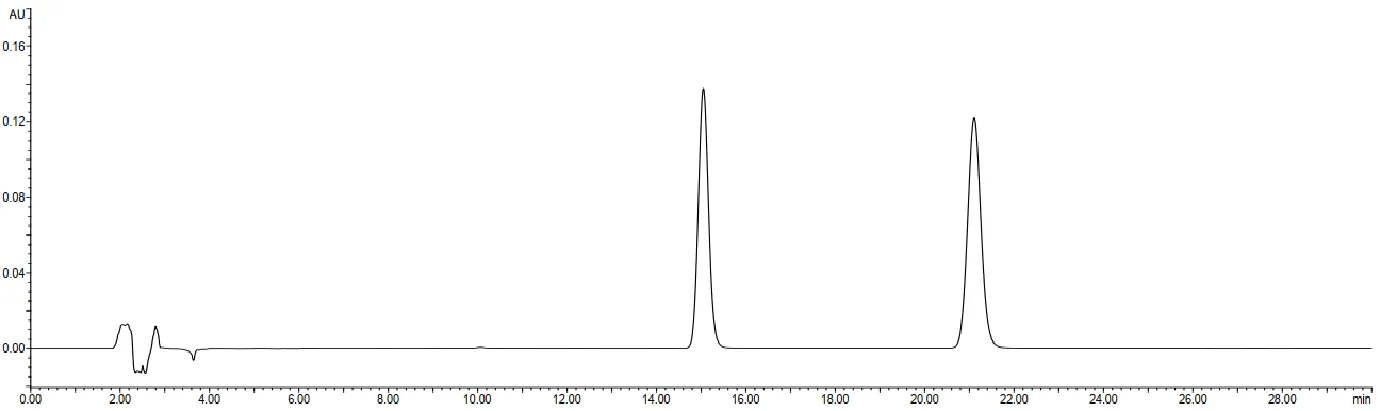
Figure 5 - APP ID: 27333: System Suitability Solution (Reference Solution (b)) for Method 1 on a Luna 5 µm C18(2), 250 x 4.0 mm Column.
| Peak No. | Analyte | Retention Time (min) | Area | Height | Resolution | Symmetry Factor |
|---|---|---|---|---|---|---|
| 1 | Irbesartan Impurity A | 15.05 | 2213344 | 137712 | 12.37 | 1.08 |
| 2 | Irbesartan | 21.11 | 2555501 | 122101 | 1.07 | |
| N=6 Injections | ||||||
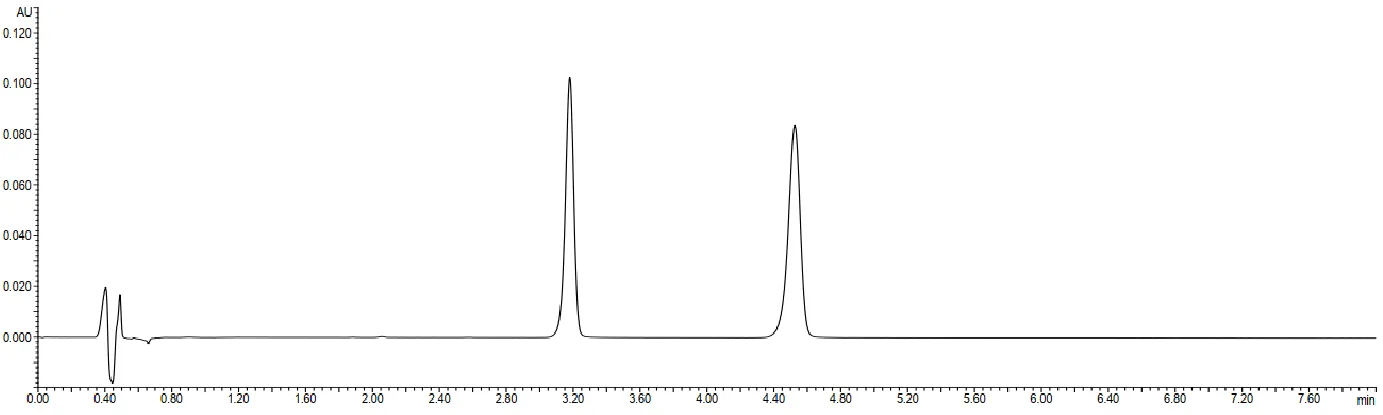
Figure 6 - APP ID: 27335: System Suitability Solution (Reference Solution (b)) for Method 7 on a Kinetex 1.7 µm C18, 100 x 2.1 mm Column.
| Peak No. | Analyte | Retention Time (min) | Area | Height | Resolution | Symmetry Factor |
|---|---|---|---|---|---|---|
| 1 | Irbesartan Impurity A | 3.18 | 368368 | 102700 | 12.00 | 0.90 |
| 2 | Irbesartan | 4.53 | 424730 | 83744 | 0.87 | |
| N=6 Injections | ||||||
The result: Combining both adjustments transforms a 40-minute method into an 8-minute method, while staying compliant and meeting all system suitability criteria.
Key takeaways
- Allowable adjustments enable modernization of your pharmacopoeia method without revalidating. If you maintain L/dp within the allowed window and keep chemistry equivalent, you can cut runtime and solvent consumption while staying within USP <621> / Ph. Eur. 2.2.46. System suitability is your proof.
- Core shell is explicitly allowed (with equivalent phase chemistry). Expect sharper peaks, often lower backpressure, and headroom to increase flow—the Van Deemter advantage.
- Lamivudine shows L/dp in action: same ratio, faster runs, suitability intact.
- Doxepin shows morphology in action: same dimensions, higher Rs, and shorter RTs with core shell.
- Irbesartan shows both levers together: L/dp tuning + core shell + UHPLC → up to 80 % time reduction with resolution well above spec.
Three things you can do after reading this article
- Choose one of your Pharmacopoeia methods and calculate the L/dp and list 1–2 allowed alternatives (e.g., 150 × 4.6 mm, 3 µm; 100 × 2.1 mm, 1.7 µm) based on your instrumentation. Use our online tool to make this step even easier.
- Decide if a core shell equivalent (e.g., C18 → C18) makes sense based on your analysis;
- Run side-by-side suitability (baseline vs. adjusted) and compare chromatograms for runtime, Rs, symmetry, and area %RSD.
If you’d like help confirming allowability, doing the L/dp math, or choosing an equivalent phase, submit a support request to our technical team.
FAQs
Can I change the column length or particle size in a pharmacopoeia method?
Yes. The harmonized chapters USP <621> and Ph. Eur. 2.2.46 allow you to adjust column length (L) and/or particle size (dp) as long as the L/dp ratio remains within −25% to +50% of the value specified in the monograph. System suitability must be checked after the change.
Is it allowed to switch from a fully porous column to a core-shell column?
Yes. If the stationary phase chemistry (e.g., C18) and other physico-chemical characteristics remain equivalent, switching to core-shell particles (e.g. Kinetex columns) is an allowable adjustment under both USP and Ph. Eur. guidelines, as long as system suitability criteria are met.
Will changing L/dp or particle morphology affect selectivity?
No, selectivity is determined by the chemistry of the stationary phase and the mobile phase composition. Adjusting L/dp or switching to core-shell particles affects efficiency and speed, but not selectivity. The improved efficiency turns into a chromatogram with better separation and sharper peaks.
Do I need to revalidate my method after making these adjustments?
No. Revalidation is not required if you stay within the allowable adjustment ranges and system suitability passes. Always check your organization’s SOPs and regulatory expectations, if any.
How do I scale flow rate and injection volume when changing column dimensions?
Flow rate and injection volume should be scaled according to the new column dimensions and particle size. In Table 1, the two equations that can be used to apply these adjustments are reported. A digital tool on the Phenomenex website can be used for the calculation, or the chat support can be used if further assistance is needed.