
Resolution Fundamentals: Review for All Skill-Level Chromatographers

We recently reviewed How Phase Ratio Can Shorten Run-Times While Preserving Resolution, and I would like to elaborate on the relevance of the resolution equation towards the consistency of phase ratios during method development with these resolution fundamentals. This will be a great review for both novice and experienced chromatographers alike.
A shorter column alone will maintain the selectivity and capacity factor (also known as the “retention factor”) of an analysis, but the preservation of phase ratio will maintain the efficiency of the original method by which to preserve the method’s resolution. That’s a mouthful, but hang on for the ride. The resolution equation is viewed as having three terms, which reflect the efficiency, selectivity, and retentiveness of your method. The efficiency is paramount to maintaining the resolution of a method upon migrating to a shorter column, as we will demonstrate.
The negligible impact of a shorter column towards the selectivity and capacity of a column is demonstrated in the following two hypothetical chromatograms, for which the internal diameter (ID) and film thickness remain constant. Table 1 features the variables of which we should be mindful.
Table 1 - Resolution Variables
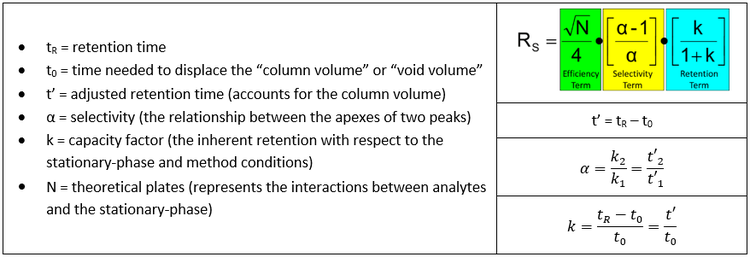
The following two hypothetical chromatograms are important to these resolution fundamentals as they represent the proportional effect on retention time and column volume upon running a method with a new column that is exactly half the length of the original column. The ultimate effect is that the “Selectivity Term” and “Retention Term” of our resolution equation remain constant, for which the math is demonstrated in Table 2.
Table 2 - Determination of Selectivity and Retention

The use of a shorter column alone will actually reduce the number of theoretical plates available, as a result of the analytes having fewer opportunities for interaction with the stationary-phase on a shorter column. This is demonstrated in the second chromatogram, for which the peaks maintain their broad shape despite eluting earlier, ultimately diminishing the resolution between our peaks.
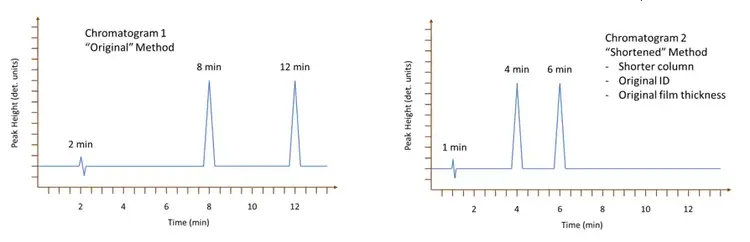
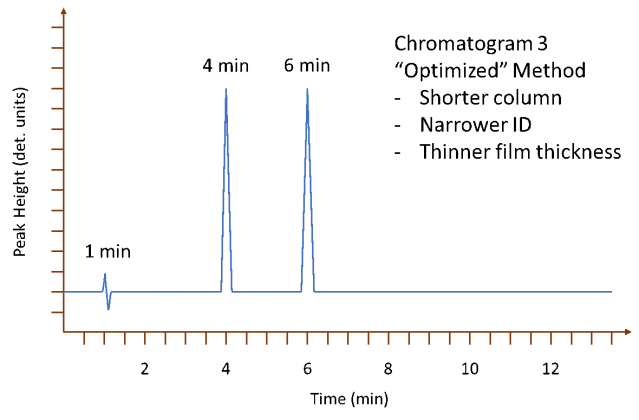
The important consideration will be to then lower the ID and film thickness in a manner commensurate with preserving the phase ration, so as to increase the column efficiency (N) and ultimately return our resolution to the value of the original method. A narrower ID will increase the frequency of interactions between an analyte and the stationary-phase, while a thinner film will increase the rate of mass-transfer as the analyte transitions into and out of the stationary-phase. The ID and film thickness are lowered in the third hypothetical chromatogram, for which the peaks of both analytes are much sharper to provide a higher level of resolution between the two peaks.
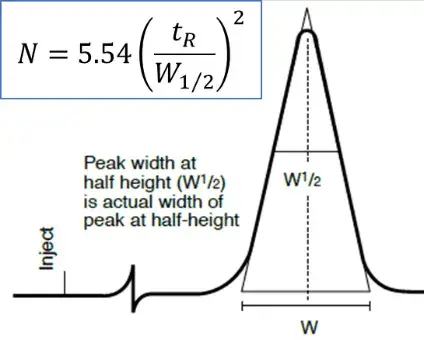
The efficiency (N) represents the sharpness of the peak and the opportunities for interaction of an analyte with the stationary phase. The calculation of efficiency takes into account the width of the peak and the duration of the peak’s retention. A peak that elutes early must have a very narrow width to demonstrate a high level of efficiency and to benefit the resolution of that peak from neighboring analytes
There are tricks in both GC and LC to maintain efficiency while shortening a column. In GC (gas chromatography), you maintain the phase ratio while shrinking both the ID and film thickness, so as to increase the frequency and speed of interactions between analytes and the stationary-phase. During LC (liquid chromatography), smaller particles increase the frequency of interaction, while also increasing the rate at which analytes transfer into and out of the particle and the associated stationary-phase. We will evaluate how this affect LC during the next installment of this column.