Size Exclusion Chromatography (SEC)

Size exclusion chromatography (SEC) is a chromatographic method that separates analytes solely based on their size, where molecules are separated on the basis of their exclusion from pores in the size exclusion chromatography column packing material. Larger analytes will elute first, while the smaller molecules interact more with the stationary phase and will elute later.

Based on the analytes and the mobile phases used, size exclusion chromatography can be broken into two main categories: aqueous size exclusion/gel filtration chromatography (GFC) and non-aqueous size exclusion/gel permeation chromatography (GPC).

Aqueous Size Exclusion/Gel Filtration Chromatography (GFC)
Analyze and/or characterize proteins, peptides, and other biomolecules such as antibodies, immunoglobulins, protein complexes, protein aggregates, and desalting.

Non-Aqueous Size Exclusion/Gel Permeation Chromatography (GPC)
Analyze polymers such as adhesives, oils, plasticizers, plastics, resins, and rubbers/elastomers.

Size Exclusion Chromatography Columns

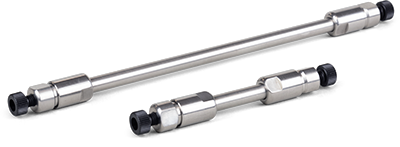
Enhance your analytical capabilities with Phenomenex’s advanced SEC-HPLC columns, designed for precise molecular size analysis and consistent, high-resolution separation. Ideal for both analytical and preparative applications, these columns offer excellent reproducibility and long column lifetimes. Whether you're characterizing monoclonal antibodies, fragments, aggregates, or analyzing biomolecules and polymers in aqueous or organic phases, Phenomenex’s SEC technology delivers the accuracy and reliability your workflows demand.

How does size exclusion chromatography work?
SEC employs porous particles, commonly composed of natural polymeric gels such as cross-linked dextran, agarose, or polyacrylamide, as well as synthetic materials like silica or cross-linked polystyrene, packed into a chromatographic column.. These beads contain pores of specific sizes, creating a molecular "sieve." Large molecules cannot enter the pores and flow around the particles, eluting first in the void volume of the column. Intermediate molecules partially enter the pores, leading to delayed elution based on their size. Small molecules fully penetrate the pores, taking the longest path and eluting last. This results in an elution order from largest to smallest molecular size (or weight).

When is the right time to use analytical size exclusion chromatography?
Analytical size exclusion chromatography is primarily used when separation and characterization of biomolecules or polymers based on size are required, particularly in scenarios demanding high-resolution analysis without chemical interactions. It is also widely used when scientists want to maintain the native state of a molecule, as other techniques may alter its shape or conformation, whereas SEC does not. Analytical SEC is also employed to assess sample quality or study biomolecular properties. Choosing the right column for analytical size exclusion chromatography is crucial for achieving optimal separation and analysis of biomolecules.

FAQs

Yes, the guard columns for Biozen are biocompatible. Though the holder is not titanium, the analyte flow path is biocompatible.
dSEC-7 columns are shipped in 0.1 M Sodium Phosphate Buffer, pH 6.8 with 0.025 % Sodium Azide.
Chromatography is the separation of components in a mixture based on their chemical nature. Chromatography can be performed in either liquid (HPLC) or gas (GC) forms. Liquid chromatography, specifically High Pressure Liquid Chromatography (HPLC), involves a stationary phase (sorbent), a mobile phase (liquid) and the analyte or compounds of interest. Analytes or compounds of interest are injected onto an HPLC column (packed with sorbent that contains a variety of chemistries) in mobile phase. As the mobile phase, which is carrying the analyte or compounds of interest, travels across the stationary phase, the analyte or compounds of interest separate from each other as they interact with the stationary phase, each eluting from the column at various times. Gas chromatography (GC) is similar to HPLC in that is utilized with working analytes or compounds of interest that can be vaporized without decomposing. In GC, gas is used instead of a liquid (like in HPLC). As analytes or compounds of interest travel in the gas mobile phase and interact with the stationary phase, eluting at various times.
1 M is the maximum salt concentration that should be used when operating Biozen dSEC columns. Theoretically, a higher salt concentration should be compatible, however, as salt molarity increases, unwanted secondary impacts such as decreased protein solubility and increased column backpressure will arise.
The void volume corresponds to the amount of mobile phase in an LC system. In most separation modes the void volume would be equivalent to the amount of mobile phase needed to elute a compound that doesn't interact with the stationary phase and is hence unretained. In size exclusion, analytes are not separated based on chemical interactions with the stationary phase but rather their ability, based on size, to enter pores in the stationary phase. Therefore, in size exclusion the terms total permeation and total exclusion volume have greater significance than void volume. The total permeation volume corresponds to the amount of mobile phase in the system, including that in the pores of the stationary phase, whereas the total exclusion volume does not include the mobile phase within the pores of the stationary phase. Consequently, the total permeation volume corresponds to the amount of mobile phase needed to elute a compound that is small enough to completely enter into the stationary phase pores and the total exclusion volume is the amount of mobile phase needed to elute a compound that is entirely excluded from the stationary phase pores.
For short-term storage, it is suggested that mobile phase conditions continue to be run overnight at a low flow rate. For long-term storage, 0.1 M Sodium Phosphate Dibasic / 0.025 % Sodium Azide in water or 20 % Methanol in water can be used. When storing the column for extended periods it is important that buffer, salts, and sample first be removed from the column. Prior to storage, flush column with ~5 column volumes of 100 % water before switching between mobile phase and storage solvent.
The major impact of choice of temperature in GPC is analyte solubility. In general GPC systems will be run at the lowest temperature where analytes are fully soluble in the mobile phase. Increasing temperature increases analyte solubility, whilst also decreasing mobile phase viscosity and hence system back pressure.
The presence of microorganisms in the LC system is the most widely characterized source of unwanted chromatographic artifacts. Symptoms of microbial growth often first emerge through gradual increases in pressure that can signal impending compromised separations and eventual column failure. It is therefore important that the source be identified and addressed swiftly. Mobile phase bottles are often the most common source. It is generally suggested that the mobile phase bottle and solution be replaced entirely, particularly if the mobile phase looks cloudy or a film is apparent on the side of the bottle. Avoid the use of mobile phase sinkers where possible as these are a common source of contamination. If the pressure increase persists after replacing the mobile phase solutions, it is suggested that a system cleaning protocol be implemented (see ‘What are best-practice guidelines for system cleaning’ section).
We recommend 1 M as the maximum salt concentration that should be used in the mobile phase with Biozen SEC columns. Theoretically, a higher salt concentration should be acceptable and would not be incompatible with the columns. However, as salt molarity increases hydrophobic interactions increase, protein solubility decreases and column backpressure increases.
For comprehensive guidance pertaining to system readiness check, mobile phase preparation, column installation, condition/equilibration and recommended flow rate conditions, please review page 2 of the Biozen™ Care & Use Manual (GU54150623_W).
When implementing an LC system cleaning protocol, Water / Isopropanol / Methanol / Acetonitrile (1:1:1:1, v/v/v/v) has been demonstrated as a reliable solution to remove system contaminants. If you prefer to utilize a simple water/alcohol mix, it is recommended that 70 % Isopropanol (IPA) or 70 % Ethanol (EtOH) is used to flush the LC. Higher concentrations of either reagent will not effectively penetrate the bacterial cell wall, rendering them ineffective as bactericides.
For size exclusion, there are two considerations - sample volume and sample concentration. As a general rule no more than 5 % of the column volume should be loaded. Theoretically, a 300 x 4.6 mm column, with a column volume of ~ 5 mL, would limit injection volume to 200 µL. In practice, volumes of 10-30 µL are common. Another important consideration is sample concentration; the higher the concentration of protein, the higher the viscosity of the sample. This difference in viscosity can lead to peak shape distortion. The distortion can occur either through exclusion effects or a solvent front referred to as “viscous fingering”. A good starting concentration is 1 mg/mL, though optimal concentrations must be determined experimentally