Oligonucleotide Purification
What is Oligonucleotide Purification?
Oligonucleotide purification is the process of isolating full-length synthetic DNA or RNA sequences from impurities that arise during chemical synthesis. These impurities may include truncated sequences, incomplete coupling products, residual protecting groups, salts, and organic reagents. Purification ensures that only the desired oligonucleotide having the correct sequence and chemical structure is recovered for use in downstream applications such as PCR, gene synthesis, and therapeutic development. Accurate and efficient oligonucleotide purification is therefore a critical step in ensuring sequence integrity, purity, and reproducibility across research and manufacturing workflows.
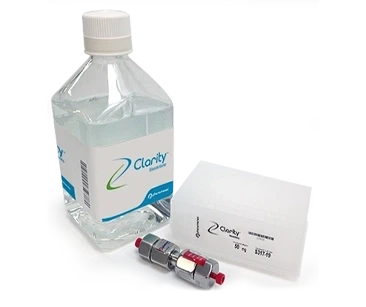
Phenomenex Oligonucleotide Purification Portfolio
Our oligonucleotide portfolio, including columns and sample preparation solutions, is designed to efficiently and effectively purify and characterize synthetic oligonucleotides used in biological research, therapeutic development, and biochemical manufacturing.
Why Purification is Critical in Oligo Synthesis?
While the oligonucleotide synthesis chemistry is very efficient, each cycle generates a number of closely related impurities. The result is a mixture of the desired full-length sequence oligonucleotide and other less abundant forms, including longer and/or shorter sequences, and sequences that can carry unexpected modifications, such as incomplete deprotected groups, deamidation and oxidation. For this reason, oligonucleotide purification is a key process for the efficient recovery of pure full-length sequence oligonucleotides.
Therefore, oligo purification is essential to obtain homogeneous, high-purity sequences suitable for sensitive downstream applications such as qPCR, antisense therapy, or CRISPR guide design. Purification also improves stability and ensures accurate quantitation, which is particularly important for large-scale or therapeutic-grade oligonucleotide production.
Common Oligonucleotide Purification Methods
A range of oligonucleotide purification methods are employed depending on the required purity level and application scale. The most widely used chromatography-based approaches include:
Desalting (Quick Purification)
Desalting refers to a group of rapid purification approaches used to remove small molecule impurities such as salts and residual synthesis reagents following oligonucleotide synthesis. Various technologies can be employed for desalting or buffer exchange, including size exclusion–based spin columns, or ion-pairing reversed-phase chromatography. Desalting provides moderate purity suitable for screening or routine PCR use.
Solid-phase extraction (SPE) purification of oligonucleotides using reversed-phase provides improved purity by removing truncated sequences and hydrophobic by-products. This method can be carried out directly under reversed-phase mode, for oligonucleotides carrying the trityl protective groups, or using ion pairing reagents, for recently synthesised trityl-off oligonucleotides. These approaches are ideal for medium-throughput workflows.
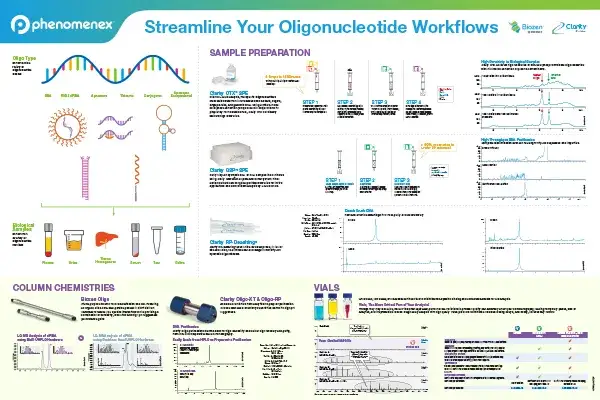
To see how purification fits into the complete process, explore our Oligonucleotide Solution Workflow Infographic, which highlights how Phenomenex supports a streamlined and reliable workflow from purification through final analysis. Discover solutions that enable efficient impurity removal, high recovery of diverse oligo types, robust and selective chromatographic separation, and clean, consistent sample handling.
HPLC Purification of Oligonucleotides
Ion-pair reversed-phase (IP-RP) and anion-exchange (AEX) HPLC methods deliver the highest purity by separating full-length oligos based on hydrophobicity or charge. Preparative and semi-preparative HPLC are preferred for large-scale purification, ensuring reproducibility and scalability for manufacturing. These workflows require method optimization to effectively balance purity, recovery, and throughput to maximize process efficiency.
How Oligonucleotide Purification Works
The working principle of oligonucleotide purification relies on differential interactions between the oligonucleotide, the stationary phase and the mobile phase used. For example:
- Ion-Pair Reversed-phase (RP) purification utilizes a charged, surfactant-like reagent capable of forming ion-pair complexes with ionic analytes - such as oligonucleotides - enhancing their hydrophobicity and enabling separation through hydrophobic interactions with the stationary phase.
- Anion-exchange (AEX) purification exploits differences in net negative charge among oligonucleotide variants.
- Desalting can also be achieved by size exclusion principles, removing low-molecular-weight impurities.
Choosing the Right Oligo Purification Method
Selecting the optimal oligo purification method depends on several key factors:
Application Requirements
Diagnostic, research, or therapeutic applications require different purity levels. Analytical-grade purity may suffice for research, while therapeutic oligos demand >98% purity.
Oligonucleotide Length
Longer sequences (>40 bases) often exhibit stronger hydrophobic interactions in IP-RP and may require gradient optimization for complete separation.
Presence of Modifications
Fluorophores, linkers, or phosphorothioate groups can affect retention behavior, guiding the choice between RP or ion-exchange modes.
Yield Considerations
High-throughput labs and production environments prioritize scalable methods. Semi-preparative or preparative HPLC, using larger particle-size columns, ensures robust yield without compromising purity.
Efficient purification drives better yield, lower costs, and consistent performance. Explore solutions for every scale—from prep columns to bulk media for large-scale separations.
Prep Scale Options
Clarity Oligo-RP columns in 5 µm and 10 µm particle sizes for robust reversed-phase purification.