
Clarity Oligo-RP

Reversed Phase LC for Purification and Characterization

Clarity Oligo-RP has been specifically designed for the reversed phase purification of oligonucleotides with balanced hydrophobicity and polar selectivity. The media is based on composite particle TWIN™ technology. This technology gives improved selectivity and efficiency for oligonucleotides when compared to other hybrid, polymer, and silica particles found in the marketplace. It is available in 3, 5, and 10 µm particle sized beads and in a variety of dimensions.

  • Easily separate N-1 failure sequences from target oligo with > 90% purities
  • Trityl-off purification of DNA, RNA, Thioates, and modified/labeled Oligos
  • Preparative dimensions and particle sizes for loads > 5μmol
  • Purify oligos up to 60 mer in length
  • Excellent column for reversed phase HPLC quality control (QC) testing
Particle Size
3, 5, 10
Recommended Use
Purification of synthetic oligonucleotide mixtures

Order

Select Attributes:

Internal Diameter (mm)

2

4.6

10

21.2

30

50

Length (mm)

30

50

100

150

250

Particle Size (µm)

3

5

10

Pore Size (Å)

110

Showing 1-5 of 29 Results
$795.00 USD (Ea)

Sign In

$929.00 USD (Ea)

Sign In

$929.00 USD (Ea)

Sign In

$2,412.00 USD (Ea)

Sign In

$879.00 USD (Ea)

Sign In

Overview

Analytical LC

Clarity Oligo-RP™

Clarity Oligo-RP columns have been specifically designed for the reversed phase purification of oligonucleotides with balanced hydrophobicity and polar selectivity. Available in 3, 5, and 10 µm particles, Clarity Oligo-RP allows for high capacity analysis and purification of oligos.

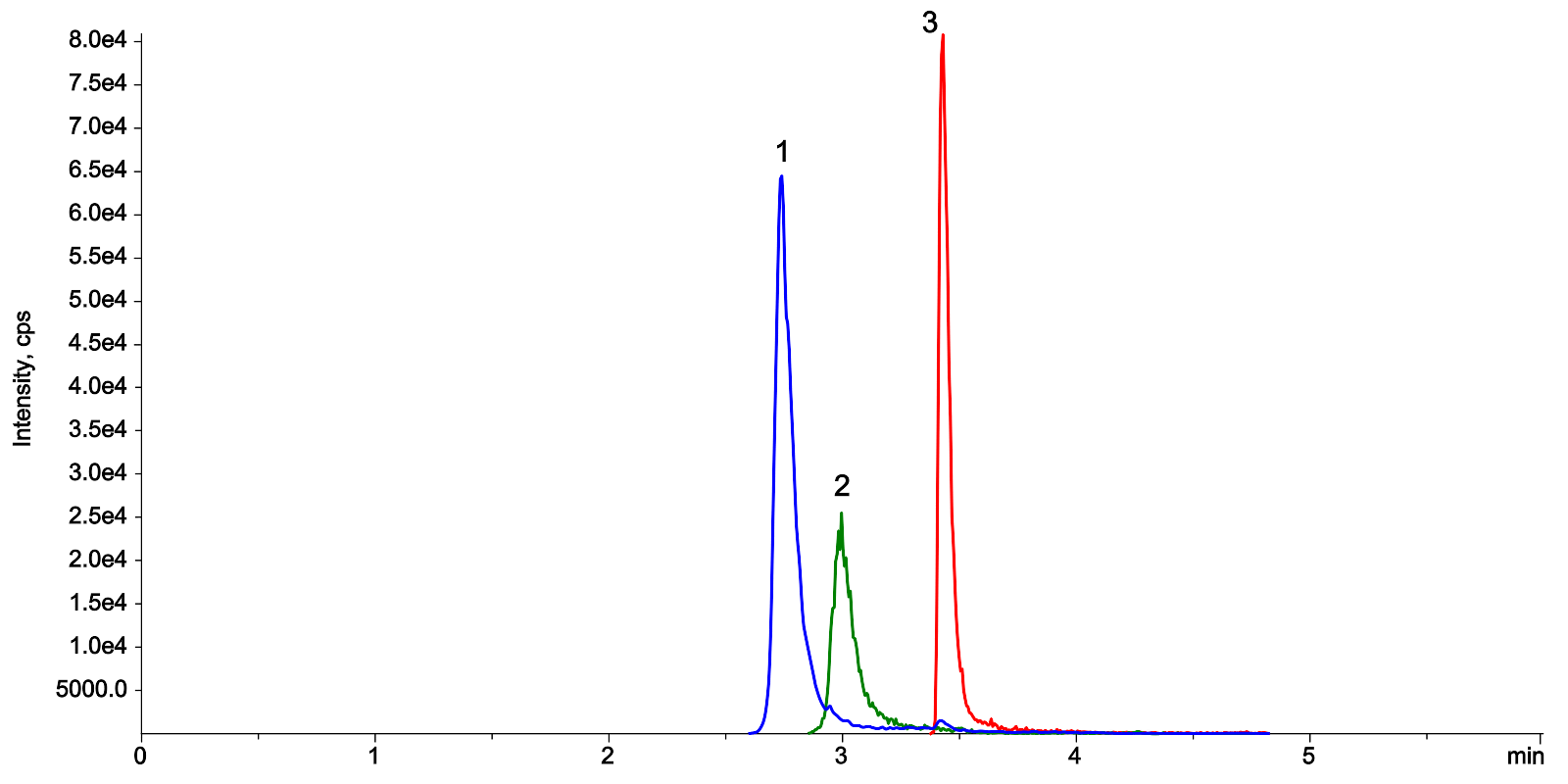
A Highly Selective Analysis

Column:

Clarity 3 µm Oligo-RP C18

Dimension:

50 x 4.6 mm

Flow Rate:

1 mL/min

Detection:

UV @ 260 nm

Mobile Phase:

A: 50 mM TEAA pH 7.5, B: Methanol

Part No.:

00B-4441-E0

Gradient:

10 % to 45 % B in 30 minutes

Sample:

  1. 40nt DNA with sequence CTTCTGAACAGTT- GATCTATG- CACTTCAGACTTATGATCA (2.5 μg)
  2. 39nt DNA with sequence TTCTGAACAGTTGATCTAT- GCACTTCAGACTTATGATCA (2.5 μg)

Clarity Oligo-RP successfully separates a 40mer from a 39mer DNA oligonucleotide due to its excellent efficiency and resolving power.

Purification Clarity™

Clarity Oligo-RP columns allow for high loadability and deliver high recovery and purity, from HPLC to Preparative Purification

Easily Scale from HPLC to Preparative Purification.

DNA Purification

Column:

Clarity 3 µm Oligo-RP C18

Dimension:

(A) 50 x 10.0 mm, (B) 50 x 4.6 mm

Flow Rate:

(A) 4.7 mL/ min, (B) 1.0 mL/ min

Detection:

UV @ 280 nm

Mobile Phase:

A: 50 mM TEAA pH 7.5/ 5 % Acetonitrile, B: Methanol

Gradient:

10 % to 60 % B in 20 minutes

Sample :
20nt DNA

FAQs

The void volume corresponds to the amount of mobile phase in an LC system. In most separation modes the void volume would be equivalent to the amount of mobile phase needed to elute a compound that doesn't interact with the stationary phase and is hence unretained. In size exclusion, analytes are not separated based on chemical interactions with the stationary phase but rather their ability, based on size, to enter pores in the stationary phase. Therefore, in size exclusion the terms total permeation and total exclusion volume have greater significance than void volume. The total permeation volume corresponds to the amount of mobile phase in the system, including that in the pores of the stationary phase, whereas the total exclusion volume does not include the mobile phase within the pores of the stationary phase. Consequently, the total permeation volume corresponds to the amount of mobile phase needed to elute a compound that is small enough to completely enter into the stationary phase pores and the total exclusion volume is the amount of mobile phase needed to elute a compound that is entirely excluded from the stationary phase pores.
The following loading values are consistent with the specified internal diameter for a 20-40mer oligonucleotide: 4.6 mm/250 nanomol 10 mm/1 µmol 21.2 mm/5-10 µmol When considering the mass of the oligonucleotide being loaded onto the column in nanomole values, we can convert from nanomole to milligrams by considering that one deoxyribonucleotide monophosphate is equivalent to approximately 300 Daltons. Therefore, when 250 nmol of a 20mer oligo is loaded onto a 4.6 mm ID column, the loading mass is about 1.5 mg.
Typically ion-pairing reagents are used to increase the retention and resolution of oligo’s separated by reversed-phase HPLC. High molarity amounts (100 mM triethylamine acetate [TEAA]) are typically added when analyzing oligonucleotides, however the high level of TEAA leads to ion suppression that makes MS detection of oligonucleotides difficult at therapeutic and reagent concentrations. With LCMS we recommend hexafluoroisopropanol (HFIP) as a mobile-phase additive which has enabled reasonable sensitivity by MS. Our standard recommendation is 100mM HFIP and 4mM TEA in both A and B of a gradient mixture however more recent studies have shown some oligonucleotides work well even at concentrations as low as 10mM HFIP.
The alkylamine used directly affects retention time, with longer chains leading to increased retention, e.g. hexylamine will show longer retention times than triethylamine. There is also a difference in solubility so generally gradients need to be adjusted to allow for this. Generally, the effect of ion-pair is oligo-specific; for example, Gapmers longer amines offer better resolution whereas for siRNA shorter amines offer an improvement in resolution
Phosphorothioate (PS) can frequently desulfurize in to Phosphodiester (PO) and can result in reduced recoveries during solid phase extraction and sample clean-up step. To abstain PS in oxidizing back to PO we can add anti-oxidants like Cysteine in to the loading buffers. For e.g. in Clarity OTX Loading / Lysis buffer add approx. 1gm Cysteine in 1L bottle of the buffer.