Supercritical Fluid Chromatography (SFC)
Overview
What is Supercritical Fluid Chromatography?
Supercritical fluid chromatography (SFC) is an advanced separation technique that uses carbon dioxide (CO₂) above or near its critical state (temperature >31.1 °C and pressure >73.8 bar) as the primary mobile phase, often combined with a small percentage of organic modifiers such as methanol. Under these conditions, CO₂ exhibits both gas-like diffusivity and liquid-like solvating power, making it ideal for rapid and efficient separations.
This relatively non-polar mobile phase can be used with stationary phases commonly employed in normal-phase HPLC; however, SFC is a highly versatile technique that can also operate under conditions similar to reversed-phase or HILIC mode, depending on the choice of stationary phase, and mobile phase/modifier composition. Compared to conventional solvents, the low viscosity and high diffusivity of supercritical CO₂ enable much faster separations. SFC columns can be used in two main modes highlighting the unique flexibility of SFC in analytical separations:
Although still an emerging technique, supercritical fluid chromatography (SFC) is gaining traction in pharmaceutical, environmental, and food industries. It offers significant economic advantages through faster run times and lower solvent usage, and is recognized as a more sustainable, “green” alternative to traditional normal-phase liquid chromatography. The economic benefits of SFC are especially evident in preparative LC separations, where lower solvent consumption and shorter purification cycles reduce operational costs and enhance throughput.
By shortening analysis times while maintaining high resolution, SFC provides a sustainable and cost-effective alternative to traditional HPLC methods.
Explore Phenomenex Solutions for SFC
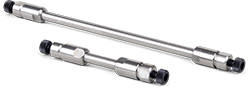
Phenomenex offers a comprehensive range of column technologies optimized for supercritical fluid chromatography.
What Can SFC Separate?
SFC is a highly versatile technique capable of separating a wide variety of analytes. It is particularly effective for compounds that are difficult to separate using traditional normal or reversed-phase HPLC. For example, chiral compounds, lipids, fatty acids, and other structurally similar molecules can be efficiently resolved using SFC columns. The ability to tune selectivity through changes in pressure, mobile phase additives, temperature, and modifier composition makes SFC highly adaptable for complex mixtures.
Pharmaceutical applications often rely on SFC columns to achieve high-resolution separations of chiral drug candidates, while environmental and food testing laboratories use the technique to analyze bioactive compounds, pesticides, and natural products. Compared to conventional methods, SFC offers reduced run times, lower solvent usage, and excellent peak shapes, making it a preferred choice for both preparative and analytical separations. In addition, its minimal use of organic solvents contributes to a lower environmental impact compared with conventional LC techniques. Whether using a single SFC column or advanced systems with multiple columns, the flexibility of this method supports diverse research and industrial needs.
Procedure of Supercritical Fluid Chromatography
SFC follows concepts like liquid and gas chromatography but with distinct advantages due to the use of a supercritical mobile phase.
-
Mobile phase: Supercritical CO₂ serves as the mobile phase, modified with small amounts of organic solvents (e.g., methanol, IPA or ethanol) to enhance solubility and selectivity.
-
Sample introduction: The mixture to be separated is introduced into the flow of the supercritical fluid.
-
Stationary phase: The mobile phase, carrying the analytes, passes over the stationary phase—commonly silica gel packed in SFC columns.
-
Separation mechanism:
- Constituents partition differently between the mobile and stationary phases based on their physical and chemical properties.
- Analytes with greater affinity for the mobile phase move faster, while those favoring the stationary phase travel slower.
- This difference in partitioning leads to effective separation according to partition coefficients.
-
Control parameters: Pressure, temperature, mobile phase additives and modifier percentage are carefully optimized to achieve the desired resolution.
-
Detection methods: Commonly coupled with UV, mass spectrometry (MS), or flame ionization detectors (FID) for precise qualitative and quantitative analysis.
-
Sample recovery: Following SFC preparative separations, the carbon dioxide is vaporized into gas form allowing for easy collection of purified compounds.