
What Is HILIC Separation? Understanding the Principle and Applications

HILIC separation, short for hydrophilic interaction liquid chromatography, pairs a polar stationary phase with a mostly organic, water-rich mobile phase to retain highly polar compounds that reversed-phase columns struggle to hold. Because that same organic-rich mobile phase sprays well under electrospray ionization, HILIC also pairs naturally with liquid chromatography coupled with mass spectrometry (LC-MS), often improving sensitivity for trace-level work for polar analytes.
This guide walks through the underlying principle, where the approach fits best, and the practical steps that make a method reproducible in a working lab.
Watch: https://youtu.be/bLO-GQM68fM: a quick Phenomenex video walkthrough of the HILIC mechanism and method essentials.
What Is HILIC Separation?
Researchers developed HILIC to close a gap that neither older mode could fill. Reversed-phase columns have poor retention on strongly polar or ionizable compounds, which elute near the void volume with little separation between them. Normal-phase (NP) chromatography addresses the issue, but biomolecules analysis is commonly incompatible with NP mobile phases, and NP does not always couple easily with mass spectrometry. HILIC offers polar selectivity analogous to NP, an aqueous-compatible mobile phase (suitability with biomolecules’ native states), and convenient MS coupling.
Compared with reversed phase, HILIC separation flips that elution order, so the most hydrophilic compounds come off the column last instead of first, which makes it a strong match for polar drugs, sugars, small metabolites, amino acids, and other molecules carrying multiple hydroxyl, amine, or carboxyl groups.
What Is the HILIC Principle?
The HILIC principle rests on a layered mechanism. Like normal-phase liquid chromatography, HILIC uses a polar stationary phase, but it runs that surface with an organic-rich mobile phase containing some water, which builds a water-enriched layer on the stationary phase surface. The analytes then distribute between this layer and the bulk eluent, so hydrophilic molecules are pulled out of the organic layer and retained in the water-enriched layer where they interact with the stationary phase.
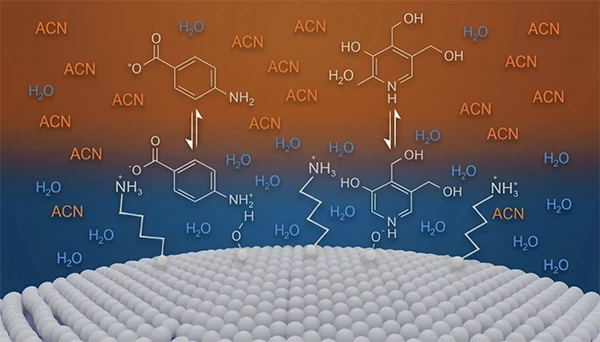
The Water-Enriched Layer
A thin, water-rich layer forms on the surface of the polar stationary phase whenever the mobile phase contains some water. The surface holds this layer partially in place while the organic-rich mobile phase keeps flowing past it, so analytes constantly exchange between the two. Increasing the water content in the mobile phase disrupts the water-enriched layer and favours the elution of highly retained analytes.
Partitioning Mechanism
Retention here largely follows a partitioning behavior, where a molecule shifts back and forth between the organic-rich eluent and the water-enriched layer described above. A compound with strong polarity settles into that layer more readily, so it takes longer to reach the detector.
Analyte–Stationary Phase Interactions
Beyond partitioning, interactions between the analyte and the stationary phase shape selectivity and elution order. Several types of interactions (chemical and physical) take place, and the three main ones are described below.
Hydrogen Bonding
Hydrogen bonds form when a partially positive hydrogen atom, covalently bound to an electronegative atom, is electrostatically attracted to the lone pair of another electronegative atom. This happens commonly when analytes or the stationary phase carry N–H or O–H covalent bonds.
Dipole–Dipole Interactions
Dipole–dipole forces occur when permanent molecular dipoles align so that the positive end of one molecule attracts the negative end of another. These forces can help HILIC separate neutral polar isomers based on their geometry and charge distribution.
Electrostatic Interactions
Electrostatic forces occur when fully charged ions attract or repel each other, causing HILIC columns to drastically increase or decrease retention for ionized analytes. This happens with ionizable molecules such as carboxylic acids and amines, and buffer concentration and pH can tune the interaction.
How Does HILIC Separation Work?
A working method depends on three main elements lining up correctly: the packing chemistry, the composition of the mobile phase, and the way the sample gets introduced onto the column.
Stationary Phase
The HILIC stationary phases available are multiple and differentiate based on the phase bonded onto the silica particles as well as the particle composition. The Luna Omega HILIC columns, Phenomenex last development in HILIC HPLC columns, for example, combine thermally modified fully porous particles with a diol stationary phase. Other HILIC columns across the industry use chemistries such as bare silica, amide, or zwitterionic ligands. Each chemistry shifts the balance between hydrogen bonding, dipole attraction, and charge-based pull, so the stationary phase deserves attention alongside the solvent system when you match a column to an analyte class.
Mobile Phase Composition
A HILIC eluent runs opposite to reversed-phase logic; the weak eluent is the organic one, whereas the hydrophilic eluent favors the elution. For gradient modes, the mobile phase starts with a high organic content and moves toward more water to release retained molecules (for gradient methods). This organic solvent needs to be water-miscible to support the partitioning behavior described earlier, and acetonitrile is the most common choice because it mixes cleanly with water while still promoting that partition. reversed-phasets like methanol compete for polar sites and disrupt the water-enriched layer, which reduces retention of polar compounds.
Sample Injection Considerations
Sample solvent strength has an outsized effect in HILIC mode, and injecting a sample dissolved in a solvent with a water content too high compared with the mobile phase leads to peak splitting or fronting. Matching the injection solvent to the starting eluent keeps peak shape sharp and results reproducible.
When Should You Use HILIC Separation?
Choosing HILIC separation over other methods comes down to a handful of practical signals in the sample and the assay goals. The sections below break down the two core reasons to reach for this technique, then show where labs put it to work across different industries.
Two Core Strengths
Two practical reasons drive most decisions to run this technique instead of reaching for a reversed-phase high-performance liquid chromatography (HPLC). The first is retention of polar compounds that the conventional reversed-phase modes cannot hold long enough to separate from matrix interferences.
The second is compatibility with mass spec detection, since the elution solvent (i.e. ACN + water) sprays efficiently in an electrospray source. This is especially an advantage compared to methods using salt-rich mobile phases like IEX or using poorly ionizable solvents (e.g., hexane) like NP. Mass spectrometry is the detection technique this mode pairs with most often, and that pairing is a large part of why bioanalytical and pesticide residue labs adopted HILIC as a go-to technique.
Industry Examples
Pharmaceutical and bioanalytical labs use this technique to isolate polar drugs, metabolites, and biomarkers from plasma or urine matrices. One example is the use of the Biozen Glycan column to check correct glycosylation of biologics after recombinant synthesis.
Food analysis teams rely on this separation mode to isolate polar additives, sugars, and contaminants that reversed-phase columns leave poorly resolved, and columns like Luna Omega Sugar target this exact need.
Environmental chemists apply the technique to polar pesticides and small pollutants, and dedicated phases such as Luna Polar Pesticides address this gap directly.
Challenges and Limitations of HILIC Separation
HILIC separation delivers strong retention for polar compounds, but that strength comes with some tradeoffs in day-to-day method work. The sections below walk through the most common technical hurdles, from equilibration and injection solvent mismatch to ion suppression and buffer preparation, so that you can plan around them early.
Method Robustness
This separation mode depends on a delicate balance of partitioning and charge-based attraction, so small shifts in buffer concentration, pH, or column temperature can move retention more than they would on a conventional column. This results in methods that require much attention to be built robustly or to have proper replication of the results.
Equilibration
Columns need longer equilibration between injections to rebuild the water-enriched layer, and skipping this step produces drifting retention across a batch. This translates in an increase of time between runs and solvent consumption.
Injection Solvent Effects
The injection solvent must match the mobile phase composition as closely as possible. Therefore, organic-rich injection solvents are close to mandatory here, because a sample solvent with more water than the eluent causes solvent breakthrough and peak fronting headaches over time. This might limit the application for insoluble analytes.
Ionic Interactions
HILIC is heavily influenced by mobile phase pH because pH simultaneously alters the ionization state of both analytes and stationary phase surfaces, such as residual silanols. This dual effect directly shifts hydrophilic partitioning and electrostatic interactions, making HILIC significantly more sensitive to pH fluctuations than reversed-phase chromatography (RPLC), though less strictly governed by pH than ion-exchange chromatography (IEX).
Matrix Effects and Ion Suppression in LC-MS
HILIC can still cause severe ion suppression at the void volume owing to unretained hydrophobic interferents. Suppression can also occur mid-gradient because retained polar matrix components can co-elute with the target compound.
Mobile Phase Preparation
Mixing acetonitrile and buffer produces a highly endothermic effect that cools the mixture rapidly. This temperature drop creates temporary thermal and density gradients that can cause microbubble formation. Consequently, premixed solutions must reach room temperature and be thoroughly homogenized to avoid inconsistencies.
Best Practices for Successful HILIC Method Development
Start with a high organic condition, typically 90–95% acetonitrile, to establish strong initial hold for polar compounds, and match the injection solvent to that starting eluent, since a mismatch is one of the most common causes of poor peak shape.
Allow enough equilibration time between runs, generally 10–15 column volumes, so the water-enriched layer stabilizes before the next injection.
Adjust pH and buffer concentration deliberately because both variables can move retention for charged compounds by several minutes, and track reproducibility across a full validation batch to catch drift early. The commonly used buffers are ammonium acetate (pH 5.8) and ammonium formate (pH 3.2).
Validate detector compatibility for the detection system in use (e.g., solvent UV cutoff for UV detection, along with eluent and buffer volatility for mass spectrometry).
Reviewing established HPLC mobile phase solvents also helps when selecting buffers that stay compatible with mass spectrometry detection.
You can refer to the HILIC method development guide for further details.
FAQs
Is HILIC better than reverse-phase chromatography?
Neither mode wins across the board. HILIC suits polar and hydrophilic analytes, while the conventional RP mode remains the stronger choice for non-polar and moderately polar compounds. The best fit depends on the analyte and the matrix.
Which compounds are best separated by HILIC?
Polar compounds like sugars, polar drugs, amino acids, nucleotides, and small metabolites separate well under HILIC conditions.
What are the limitations of HILIC?
Buffer pH, method robustness, and column equilibration time all need careful control. Injection solvent mismatch and ion suppression in unexpected gradient regions remain the main practical drawbacks compared with reversed-phase.