Monolithic vs. Packed HPLC Columns: Performance and Selection
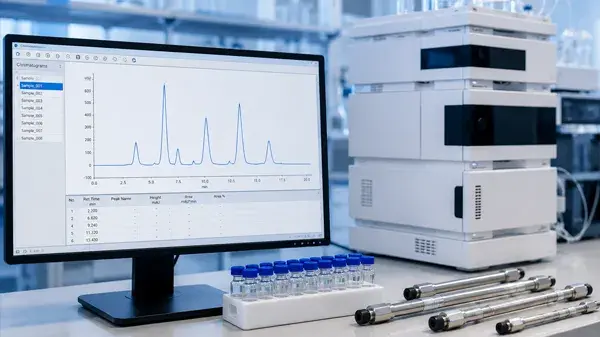
A monolithic vs. packed column decision starts with structure. Packed columns are beds of distinct particles, and they remain the long-standing standard in high-performance liquid chromatography (HPLC). A monolithic column is a single continuous permeable rod. That structural difference changes backpressure, speed, efficiency, and robustness. Each format has a clear place, and neither wins in every case. This guide compares them side by side and gives practical signals for choosing between them. Phenomenex offers both formats, including Onyx monolithic silica columns and packed columns. This guide keeps the comparison balanced and relies on published evidence. Where numbers appear, they come from specific studies and conditions, so read them as examples rather than universal rules. Use the guide to choose an HPLC column format that fits your throughput, pressure, and sample needs.
What Are Monolithic and Packed Columns?
Packed columns are filled with discrete porous particles, while monolithic columns contain one continuous porous structure. Most liquid chromatography separations still use a packed bed of fully porous or superficially porous particles, including sub-2 µm and core-shell types. A typical analytical example is a 100 × 4.6 mm column packed with 5 µm spherical particles. The sample travels by convective flow through the packed bed, and analytes then reach the internal particle surface by diffusion.
A monolith behaves like one large particle with no interparticular voids. A first-generation commercial silica monolith had a bimodal structure, with through-pores (macropores) of about 2 µm in diameter and mesopores averaging about 13 nm in diameter. The continuous rod does not require particle-retaining frits. This pore network is the core difference between monolithic and packed columns.
Material matters too. Silica monoliths suit small molecules. Polymer monoliths work well for large molecules but have generally not matched silica monoliths for small-molecule efficiency. They often have only a minor share of small pores. Some mesoporous polymer monoliths with high surface area have also been reported for small-molecule separations.
How the Structure Drives Performance
Structure controls how easily mobile phase flows through the column, and that sets backpressure. A randomly packed bed has an external porosity of about 36–40%, whereas values of up to 86% have been reported for monoliths. Total porosity follows a similar pattern, with silica monoliths above 80% and particulate beds at 40–60%.
A reversed-phase isocratic comparison found monolithic backpressure 3–5 times lower than that of a 5 µm packed column. Plate height stayed nearly constant as linear velocity rose to 7 mm/s, giving a flat van Deemter curve. At that speed, the packed column could not be operated because of pressure. High permeability and many theoretical plates per unit pressure drop make faster separations possible on current instrumentation.
Packed particles trade pressure for efficiency. Smaller particles shorten diffusion paths and raise plate count, but any reduction in particle size increases the pressure drop. Modern core-shell columns ease this trade-off. Moving from fully porous to superficially porous particles typically lowers minimum reduced plate height by 20–30%. That gain corresponds to roughly a 2-fold reduction in analysis time in an optimized-kinetic framework.
Low flow resistance also allows series coupling. A study coupled four monolithic columns to obtain chromatographic fingerprints of four Artemisia species. Silica monoliths can run in long coupled columns that give very high efficiencie.
Kinetic plot comparisons put the permeability advantage in context. One comparison used benzophenone at a retention factor of 8.7. It evaluated monoliths at 200 bar, a 2.7 µm superficially porous particle column at 600 bar, and sub-2 µm columns at 1000–1500 bar. The superficially porous particle column outperformed both generations of commercial monoliths across the practically relevant range of plate counts. A similar conclusion held for the sub-2 µm columns. These results compare format plus pressure capability, not equal-pressure performance.
For plate counts above 50,000, first-generation monoliths could perform better because their permeability allows longer columns. Second-generation monoliths have also performed comparably to modern particle columns in some applications. So permeability is the clearest monolith advantage, and the packed-bed lead applies to these optimized comparisons.
Monolithic vs. Packed Columns: Side-by-Side Comparison
This monolithic column vs. packed column table summarizes the reported trends.
Read the table as a map of trade-offs rather than a ranking. Match the column to the constraint that matters most in your method, whether that is pressure, flow, sample matrix, or peak capacity.
Advantages and Limitations of Each Format
The main monolithic column advantages come from permeability, while packed columns offer higher efficiency and a broader range of chemistries.
Monolithic Columns
Advantages:
- Low backpressure and high permeability, which support faster runs.
- Frit-free design, which the literature links to high robustness and easier maintenance than packed columns with frits.
- Low susceptibility to clogging with rich matrices such as plant material and human-derived samples.
- Series coupling to reach very high efficiencies on standard instruments.
- Capillary, nano-liquid chromatography (nano-LC), and chip formats, because in situ synthesis adapts to small channels.
Limitations:
- Lower peak efficiency than sub-2 µm and core-shell columns in optimized kinetic comparisons.
- Silica products in the cited 2010 commercial survey were mostly C8 or C18 phases for rapid reversed-phase HPLC, although polymer monoliths are available in more chemistries.
- High flow needs fast detector response and small flow cells, and it increases mobile phase consumption per unit time, since extra-column band broadening can grow.
Packed Columns
Advantages:
- Sub-2 µm particles deliver higher efficiency, short analysis time, and high sensitivity.
- Broad range of particle sizes and stationary phase chemistries.
- Packed C18 columns are expected to remain the benchmark for routine pharmaceutical analysis.
Limitations:
- Pressure drop rises as particle size falls, and sub-2 µm beds need hardware built for ultra-high-performance liquid chromatography (UHPLC).
- Inlet frits can become clogged, and frit preparation in capillary columns was noted as an unresolved issue in the 2008 review.
When to Choose Monolithic vs. Packed
Knowing when to use a monolithic column starts with your instrument, sample, and goal. Use these signals alongside your own HPLC method development data and the HPLC column selection guide. The decision usually comes down to a trade-off between permeability and peak capacity.
Choose a monolithic column when:
- You need faster runs on a conventional HPLC system without new hardware.
- Samples are plant extracts, biological fluids, or other rich matrices where clogging is a concern, although sample cleanup may still be needed.
- Your separation is a small-molecule reversed-phase method that suits C8 or C18 chemistry.
- Long coupled columns could raise efficiency without UHPLC hardware.
Choose a packed column when:
- You need high peak capacity, where sub-2 µm and core-shell beds led in optimized kinetic comparisons.
- Your lab runs UHPLC, and you want high peak efficiency from sub-2 µm or core-shell beds.
- Your method needs other selectivities, such as hydrophilic interaction liquid chromatography (HILIC), since selectivity largely governs critical pair resolution.
- You work in regulated pharmaceutical quality assurance and quality control (QA/QC), where packed C18 columns remain the benchmark.
- You want packed options such as Phenomenex Luna and Kinetex columns.
Consider a lab that screens crude plant extracts on a conventional HPLC system. The monolith’s low clogging tendency and fast runs fit that job. Phenomenex offers the Onyx monolithic silica HPLC column line for fast, dilute-and-shoot analysis of dirty or viscous samples. The same lab might turn to a packed column for a critical isomer pair, because stationary phase selectivity often drives that resolution.
Remember: Monoliths complement packed beds rather than replace them (1).
FAQs on Monolithic vs. Packed Columns
Are monolithic columns better than packed columns?
Not in general. Packed columns remain the first choice in liquid chromatography, and monoliths serve niche applications. Monoliths are stronger in permeability and clogging tolerance with rich matrices, while packed beds led in optimized efficiency comparisons. The better choice depends on your sample, instrument, and resolution needs.
Why do monolithic columns have lower backpressure?
Their continuous structure has large through-pores and a higher external porosity than a random packing of spheres. The reported values are up to 86% for monoliths vs. 36–40% for packed beds. Total porosity shows a similar trend: >80% for silica monoliths vs. 40–60% for particulate beds. More open flow paths mean less resistance to flow.
Do monolithic columns have higher efficiency than sub-2 micron columns?
Not in the optimized kinetic comparisons. Sub-2 µm and core-shell columns outperformed commercial silica monoliths there, at higher pressure ceilings (600–1500 bar vs. 200 bar). First-generation silica monoliths showed efficiency comparable to 5 µm packed columns, and second-generation monoliths to 3–3.5 µm. Second-generation monoliths have matched modern particle columns in some applications.
What is the difference between silica and polymer monoliths?
Silica monoliths contain mesopores and work well for small molecules. Polymer monoliths excel for large molecules and have generally not matched silica monoliths for small-molecule efficiency. Some mesoporous polymer monoliths with high surface area have also been reported for small molecules.