
HPLC Conditions for LC-MS: Mobile Phase, Flow, and Column Selection
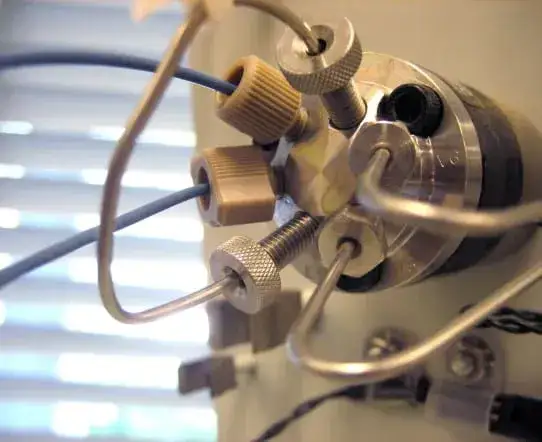
Setting high-performance liquid chromatography (HPLC) conditions for liquid chromatography–mass spectrometry (LC-MS) starts with one tension. HPLC can improve and simplify mass spectral detection, but the best chromatographic conditions can sometimes be less than ideal for the mass spectrometer, and the reverse also holds. The guiding principle for LC-MS is to develop the initial chromatographic method with the ideal mass spectrometer parameters in mind, which helps immensely with the best overall method development. This page is for analytical chemists and method developers coupling HPLC to a mass spectrometer or converting an ultraviolet (UV) method, and it covers mobile phase and buffers, flow and column, separation and ion suppression, and polar analytes.
What Makes an LC Method Compatible with an MS Detector
In LC-MS, compatibility is a relationship between the mobile phase (its flow, its components) and the ion source that converts the liquid eluent, and everything it carries, into gas-phase ions. The sources most commonly used in directly coupled LC-MS systems are atmospheric-pressure ionization, such as electrospray ionization (ESI), and throughout this guide "LC-MS compatible" refers to compatibility with these kinds of atmospheric-pressure sources. The sections that follow explain each compatibility parameter in detail, but for a quick look, you can refer to the next table.
What Makes a Mobile Phase LC-MS Compatible?
A compatible mobile phase must use volatile components, since the system needs to remove them through desolvation or evaporation. Equally important, the mobile phase must avoid ion suppression, which happens when co-eluting species compete to form ions and lower the analyte of interest signal. A UV method with volatile mobile-phase components often transfers directly, while a method built on non-volatile components needs changes.
Buffers and Additives: What to Use and What to Avoid
For mobile phases delivered directly into an atmospheric-pressure ion source, modifiers should generally be volatile and used at the lowest concentration that provides adequate chromatographic control.
Non-volatile buffers (such as phosphate, Tris, and HEPES) and non-volatile ion-pair reagents (such as alkylsulfonates) often give ideal chromatography, particularly for ionizable compounds that would otherwise retain poorly in reversed phase or give poor peak shapes. Because these components do not evaporate with the mobile phase, they can leave source deposits and contribute to ion suppression; they should generally be avoided in mobile phases introduced directly into the mass spectrometer.
TEA can be used in LC-MS, but it is a specialized additive and not a routine choice, since it may contribute to ion suppression and source contamination. Develop the initial method with these buffer choices in mind, since chromatographic selectivity can potentially change when you switch buffers. Typical practice, which depends on the method, is to use the least buffer that still buffers and to set the pH relative to the analyte pKa for reliable retention.
Rule of thumb on buffer concentration: keep volatile buffers at or below ~10 mM (typical); a target of ~5 mM is often used for mass spectrometry (MS), compared with 10–20 mM typical for ultraviolet (UV) detection. For robust control of analyte ionization and retention, a starting point is to set the mobile-phase pH at least about 2 pH units from the analyte pKa when the method permits, while selecting a buffer whose pKa is within approximately 1 pH unit of the target pH.
Ionization Mode and Mobile-Phase Selection
Select ionization polarity from the analyte's acid-base behavior and the ions that provide suitable response. Basic analytes are often measured in positive mode as protonated molecules or cation adducts, whereas acidic analytes are often measured in negative mode as deprotonated molecules. Mobile-phase pH and additives should support the desired solution-phase species and gas-phase ion while preserving chromatographic retention; empirical evaluation is still required because many compounds can respond in both polarities and adduct formation depends on the analyte and mobile-phase composition.
See our guides on HPLC mobile-phase solvents and mobile-phase preparation for solvent selection and handling.
Flow Rate and Column Selection
The flow rate and total solvent load for an LC-MS method should remain within the operating range specified for the installed ion source and source configuration. Typical analytical LC-electrospray ionization (ESI) methods use 2.1–3.0 mm internal diameter (ID) columns, and approximately 0.2–0.6 mL/min provides a practical starting range. Lower flow rates are used for microflow and nanoflow ESI, while appropriately configured heated ESI, APCI, and APPI sources may accommodate conventional analytical LC flow rates of 1 mL/min or higher.
In LC-ESI, columns with an ID of approximately 2.1–3.0 mm are commonly used because they reduce solvent consumption and can provide favorable concentration sensitivity. The final flow rate should nevertheless be optimized for the column dimensions, particle characteristics, mobile-phase viscosity, system pressure, and required separation efficiency.
Conventional 4.6 mm ID columns provide greater loading capacity and are comparatively tolerant of system dispersion, but they normally require higher solvent flow. When transferring these methods to LC–MS, confirm that the flow and solvent load are compatible with the installed source. If they are not, then scale the flow to a narrower column, modify the method, or use a suitable post-column split.
These ranges are representative starting points rather than universal operating limits. Terminology and format boundaries vary among manufacturers, and the allowable flow ultimately depends on the column characteristics, mobile phase, LC system, and installed ion source.
If you need support with method development, you can connect with a real chromatography expert through the customer support portal.
Separation, Void Volume, and Ion Suppression
Chromatographic separation can improve analyte response and identification confidence by resolving the analyte from matrix components. Early elution near the void volume often coincides with substantial matrix elution, but the ion-suppression region is method- and matrix-dependent and is not synonymous with the void volume. Ion suppression is especially associated with ESI because co-eluting matrix components can compete for droplet surface charge, alter droplet properties, impair desolvation, or otherwise reduce the formation of gas-phase analyte ions. The compounds that elute around the void volume and contribute to ion suppression depend on the chosen HPLC separation modality. Highly polar analytes may elute with weak retention in reversed-phase LC-MS and therefore overlap with early-eluting matrix components that cause ion suppression. Good separation is part of the overall method quality and not only a chromatography concern.
Retaining Polar Analytes for LC-MS
Polar analytes are a common challenge in RPLC-MS because weak retention can place them near the void volume, where they may co-elute with matrix components and experience ion suppression. HILIC has become increasingly important for LC-MS analysis of polar analytes because its polar stationary phases provide greater retention than conventional reversed-phase columns, while the high proportion of organic solvent in the mobile phase can support efficient electrospray desolvation and, in many cases, greater MS sensitivity. See the HILIC page for the retention mechanism.
Need help choosing HPLC conditions for your LC-MS workflow? Contact our technical team.
Related resources:
- Normal Phase ChromatographyHydrophilic Interaction Chromatography
- Ion Exchange Chromatography
- Ion Exclusion Chromatography
- Chiral HPLC
- HPLC and Pharmaceutical Industry
- HPLC for the Food and Beverage Industry
FAQs on HPLC Conditions for LC-MS
What is an LC-MS compatible mobile phase?
An LC-MS compatible mobile phase uses volatile solvents, buffers, and additives that support chromatographic separation and ionization without leaving non-volatile residues in the ion source. Examples include water, methanol, or acetonitrile combined with formic acid, acetic acid, ammonium formate, or ammonium acetate.
Why should TFA be minimized in LC-MS?
TFA is volatile, but it can strongly suppress ESI response, particularly in positive-ion mode. Formic acid and acetic acid are commonly preferred volatile alternatives when they provide acceptable chromatographic selectivity and peak shape.
What flow rate is best for LC-MS?
Conventional LC-ESI methods often start at 0.2–0.6 mL/min, a practical starting range, particularly with 2.1–3.0 mm ID columns. Lower flow rates are used for microflow and nanoflow ESI, while heated ESI, APCI, and APPI sources may accommodate 1 mL/min or more.
Which volatile buffers are used in LC-MS?
Common volatile LC-MS buffer systems include ammonium formate/formic acid, ammonium acetate/acetic acid, and ammonium bicarbonate. Formic acid, acetic acid, and aqueous ammonia can also be used as volatile pH-adjusting additives. Non-volatile buffers such as phosphate, Tris, and HEPES should generally be avoided in mobile phases delivered directly to the mass spectrometer because they can cause source deposits and ion suppression.