The Role of Polarity in Chromatographic Separation
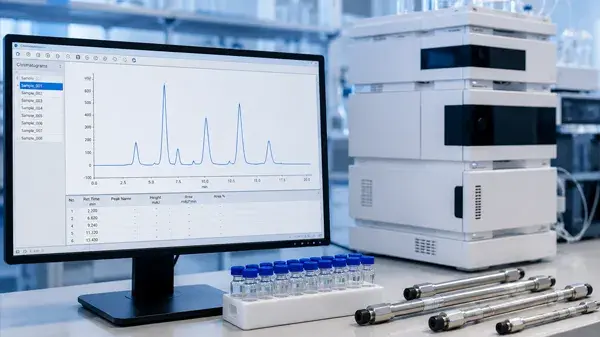
Molecules behave differently inside a chromatography column, and the reason often comes down to polarity. Liquid chromatography, paper chromatography, and thin-layer chromatography (TLC) lean on polarity to drive separation, while gas chromatography (GC) and size-exclusion chromatography (SEC) instead depend mainly on volatility and molecular size.
This guide covers the science behind polarity in chromatography, from molecular definitions to practical column and solvent selection.
What is Polarity?
Polarity starts at the bond level, where a difference in electronegativity between two atoms creates an uneven share of electrons. Overall molecular polarity depends on more than individual bonds, since geometry matters too: a molecule with several polar bonds can still behave as non-polar if those bonds cancel out symmetrically.
This property decides how tightly an analyte clings to a stationary phase, how fast it moves with a mobile phase, and whether a mixture resolves into clean peaks. The net molecular polarity dictates how an analyte engages with the stationary and mobile phases through dipole–dipole interactions and hydrogen bonding (1, 2), a mechanism that underlies everything from Rf values in paper chromatography to retention order in reversed-phase high-performance liquid chromatography (RP-HPLC).
Polar vs. Non-polar Molecules: The Foundation
Before exploring how polarity plays out across chromatographic modes, it helps to define the basics: what separates a polar molecule from a non-polar one, and how chemists quantify that difference.
Polar Molecules
Polar molecules carry regions of partial positive and negative charge, usually from electronegative atoms such as oxygen or nitrogen arranged asymmetrically across the structure. Water, methanol, and acetonitrile are familiar examples, and they readily form hydrogen bonds with other polar species.
Non-polar Molecules
Non-polar molecules distribute their electrons evenly, so they carry no significant charge separation. Hydrocarbons like methane and hexane fall into this category, interacting mainly through weak dispersion forces rather than dipole attractions.
The “Like Dissolves Like” Principle
This contrast underpins one of the oldest rules in separation science: like dissolves like. A solute’s polarity must roughly match its solvent’s polarity for dissolution to occur efficiently, which is why water pulls in polar or ionic compounds, whereas hexane favors non-polar ones (3).
How Polarity Is Measured
Because “more polar” and “less polar” are relative terms, chemists quantify the difference using polarity indices: numerical values based on solubility behavior and dielectric properties. These indices let method developers compare compounds objectively, a tool put to practical use later in the method development section.
How Does Polarity Affect Chromatography?
Polarity affects chromatography by determining how strongly each analyte interacts with the stationary phase versus the mobile phase, which governs its retention time and elution order.
Partitioning Between Stationary and Mobile Phases
Every analyte spends part of its time bound to the stationary phase and part moving with the mobile phase, a balance that depends on relative polarity through competitive polar and hydrogen-bonding interactions (1).
Effect on Retention Time
This competition directly shapes retention. In normal-phase separations, a more polar solute retains longer because it binds more tightly to the polar stationary phase (2), a binding strength built from dispersion, dipole, and hydrogen-bonding forces that chemists collectively call the compound’s polarity (2). Reversed-phase systems flip this relationship, so a more polar analyte elutes faster due to weaker affinity for the non-polar stationary phase.
Effect on Elution Order Within a Given Mode
Because retention scales with polarity, elution order becomes predictable once you know both the mode and the relative polarity of stationary phase and analytes. Testing across several stationary phases with different polar characteristics in normal-phase-type systems showed a clear retention sequence, with the most polar phase retaining solutes longest (1). This ranking direction reverses under reversed-phase conditions, so any elution order prediction must specify which mode is in use before it becomes meaningful.
Effect on Resolution and Peak Shape
Resolution depends on how far apart two analytes sit on the polarity scale. Analytes with meaningfully different polarities separate cleanly into sharp peaks, since sufficient polarity difference drives differential partitioning between phases, while similar polarities cause overlap and force analysts to adjust mobile phase composition or reconsider the column.
Polarity in Normal-Phase vs. Reversed-Phase Chromatography
These retention and elution principles play out most clearly in the two dominant LC modes, each pairing stationary and mobile phase polarity in opposite ways.
Normal-Phase Chromatography (NPC)
In NPC, the stationary phase carries more polarity than the mobile phase, and retention increases as mobile-phase polarity decreases (4). Polar analytes retain more strongly than non-polar ones, suiting compounds with distinct polar functional groups.
Reversed-Phase Chromatography (RPC)
RPC inverts this arrangement, pairing a non-polar stationary phase with a more polar mobile phase (4), so the most polar compounds elute first rather than last.
Where Hydrophilic Interaction Liquid Chromatography (HILIC) Fits Between These Modes
HILIC uses polar stationary phases similar to NPC, but its separation mechanism is more complex than classical normal-phase partitioning (4). Retention in HILIC arises from analytes distributing between an organic-rich mobile phase and a water-enriched layer adsorbed onto the polar stationary phase, a hybrid partitioning-adsorption process rather than pure normal-phase behavior (4). This distinction matters in practice, since HILIC selectivity depends on buffer composition and ionic strength in ways that classical NPC does not.
Why Reversed-Phase Chromatography Is Widely Used in Small-Molecule LC
RPC handles a broad range of compound polarities using aqueous-organic mobile phases compatible with mass spectrometry, which is why it sees wide use across small-molecule pharmaceutical and bioanalytical workflows. Highly polar, ionic, or chiral analytes, however, often perform better under HILIC, normal-phase, or ion-exchange conditions. Method developers exploring HPLC typically start with reversed-phase conditions for general small-molecule work, since it accommodates a wide polarity range in one framework.
Polarity in Paper Chromatography
Long before HPLC columns existed, chemists exploited polarity differences on a far simpler platform: a strip of paper.
Why Paper Is a Polar Stationary Phase
Paper chromatography uses a sheet of cellulose as its stationary phase, but the true retaining surface is the thin water layer adsorbed onto that cellulose (5), which holds back polar analytes relative to less polar compounds moving more freely with the solvent front.
How Polarity Determines Rf Value
That retention shows up as the Rf value: the distance a solute travels divided by the distance the solvent travels, producing a figure between 0 and 1 (5). Stationary-phase type, solvent polarity, and temperature all influence this figure, so a polar compound on a polar stationary phase typically produces a lower Rf value.
Choosing the Solvent in Paper Chromatography
Because Rf depends heavily on solvent polarity, solvent choice becomes the main lever for controlling separation. A more polar solvent competes with analytes for the water layer’s polar sites, pushing compounds farther up the paper and raising Rf values, while a less polar solvent leaves compounds closer to the origin.
Working Example: Interpreting Rf in Paper Chromatography
Picture a plant-pigment mixture on paper with a moderately polar solvent. Chlorophyll b, a comparatively polar pigment, produces a lower Rf value than a less polar carotenoid, which travels farther because it interacts more weakly with the cellulose–water surface.
Polarity in TLC and Column Chromatography
The same logic scales up onto silica-based platforms, giving analysts more control over resolution and reproducibility.
Silica as a Polar Stationary Phase
TLC plates typically use silica gel or alumina as the stationary phase, and both materials are inherently polar, interacting strongly with polar functional groups on the analyte (6), which is what makes silica effective at separating compounds by functional group rather than size or volatility.
Adjusting Mobile Phase Polarity to Tune Separation
Stationary-phase polarity stays fixed, which is why mobile-phase polarity becomes the main tuning knob. In normal-phase TLC, less polar compounds travel farther up the plate, while more polar compounds move more slowly (6). Increasing mobile-phase polarity pushes every spot higher, often the fastest fix when nothing has moved during development.
Reading TLC Spots by Polarity
Spot position on a developed plate becomes a visual readout of relative polarity, with less polar compounds near the solvent front and polar compounds closer to the origin, letting developers estimate polarity before committing to a full HPLC method.
How to Use Polarity to Choose a Column and Solvent
This theory becomes useful only when it informs real method development, so here is a practical sequence for turning polarity into a working separation.
Step 1: Estimate Analyte Polarity
Start by scanning the analyte’s structure for polar groups like hydroxyls, amines, or carboxylic acids, weighed against non-polar hydrocarbon segments, as a starting point before running a fast TLC screen.
Step 2: Match the Stationary Phase
With a rough polarity estimate in hand, match it to a stationary phase. Highly polar analytes pair well with normal-phase or HILIC phases, and non-polar to moderately polar compounds suit reversed-phase columns. This guide: choosing the Right HPLC Column narrows these options based on chemistry rather than trial and error.
Step 3: Choose the Mobile Phase
Once the stationary phase is set, select a mobile phase with contrasting polarity. An HPLC Mobile Phase resource or an HPLC Solvent Selection Guide can map compatible solvent combinations for your analyte class.
Step 4: Refine with the Polarity Index
Refine the separation by adjusting solvent ratios according to their polarity index values until resolution improves. Choosing between an Isocratic vs. Gradient Elution approach depends on how many polarity extremes exist in your sample.
Polar vs. Non-polar in Chromatography: Quick Comparison
This table compares five common modes, with a note on HILIC’s mixed mechanism.
*HILIC retention involves a hybrid partitioning-adsorption mechanism distinct from classical NPC, not a simple mirror of normal-phase behavior (4).
Common Misconceptions About Polarity in Chromatography
Even experienced analysts carry forward polarity assumptions that only remain valid in specific systems.
High Polarity Always Means Longer Retention
This holds true in normal-phase and HILIC systems, but reverses in reversed-phase chromatography, where polar compounds elute faster instead.
Rf and Polarity Mean the Same Thing
An Rf value reflects a compound’s polarity relative to a specific stationary phase and solvent system, but it is not an intrinsic property and changes whenever conditions change.
Adding a More Polar Solvent Always Speeds Up Elution
This assumption only holds in normal-phase, paper, and TLC setups, where a polar mobile phase competes for polar stationary phase sites. In RPC, a more polar solvent slows elution instead.
Polarity and Hydrophilicity are Interchangeable
These two terms overlap conceptually but are not interchangeable.
HILIC retention depends primarily on hydrophilicity-driven partitioning into a water-enriched stationary phase layer, while RPC retention depends primarily on hydrophobic interaction with a non-polar stationary phase, so the two properties drive separation through different mechanisms even though both matter (4).
FAQs on Polarity in Chromatography
How does polarity affect retention time?
Polarity controls how strongly an analyte binds to the stationary phase versus the mobile phase. In normal-phase and HILIC systems, polar analytes stay bound longer, while in reversed-phase systems they elute faster due to weaker affinity for the non-polar stationary phase.
Is the stationary phase in paper chromatography polar or non-polar?
The stationary phase in paper chromatography is polar, with water adsorbed onto cellulose fibers acting as the retaining surface, which slows polar analytes relative to less polar compounds.
Why do polar compounds have low Rf values?
Polar compounds produce low Rf values on polar stationary phases like paper or silica because they interact strongly with that surface and move slowly relative to the solvent front. Less polar compounds spend more time in the mobile phase, producing higher Rf values.
Which travels faster in chromatography, polar or non-polar substances?
The answer depends on the separation mode. In normal-phase, paper, and TLC setups, non-polar substances travel faster since they interact weakly with the polar stationary phase, while in reversed-phase chromatography, polar substances travel faster instead.
References
- National Center for Biotechnology Information. (2022). Investigating the effect of polarity of stationary and mobile phases on separation of phytocannabinoids. PubMed Central. https://pmc.ncbi.nlm.nih.gov/articles/PMC9242945/
- University of North Texas, Department of Chemistry. (2020). Chemistry 4631, Lecture 17: HPLC. https://sites.chemistry.unt.edu/~tgolden/courses/Lecture%2017%20HPLC2%202020.pdf
- Carleton College SERC. (2009). Spotting chromatography. https://serc.carleton.edu/sp/mnstep/activities/34811.html
- National Center for Biotechnology Information. (2011). Hydrophilic interaction liquid chromatography (HILIC). PubMed Central. https://pmc.ncbi.nlm.nih.gov/articles/PMC3249561/
- National Center for Biotechnology Information. (2024). Chromatography. StatPearls, PubMed. https://pubmed.ncbi.nlm.nih.gov/38261673/