HPLC Columns
High-Performance Liquid Chromatography Column
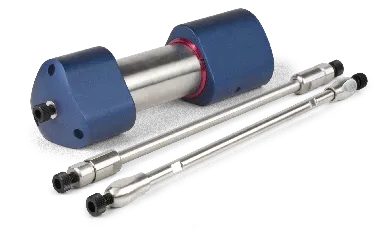
HPLC columns are critical components in the HPLC system, responsible for the actual separation of the sample components. These columns are typically made of stainless steel and packed with tiny, uniform particles known as the stationary phase. The choice of stationary phase material and the column's dimensions (length, diameter, and particle size) significantly influence the separation process and the efficiency of the analysis.
Coupled with sensitive detector systems, HPLC has become a widely employed method for confirming drug identity, providing quantitative results, and monitoring therapeutic progress in disease management.
Know what you need? Fast-track your checkout.
Overview
Phenomenex HPLC Column Portfolio
Looking for high-performance columns tailored to your application? Phenomenex offers a comprehensive portfolio of HPLC columns designed to deliver exceptional resolution, reproducibility, and efficiency across diverse analytical techniques. Explore our featured HPLC columns and find the ideal solution for your chromatography needs.
How to Choose the Correct HPLC Column?
- Sample Properties: Understand the properties of the sample being analyzed, such as polarity, size, and chemical nature. Match these characteristics with the appropriate stationery phase chemistry and column type.
- Analyte Stability: Consider the stability of the analytes during the separation process. Choose column and mobile phase conditions that minimize degradation or internation with the stationary phase.
- Separation Objective: Determine the specific compounds or classes of compounds you need to separate and analyze. Select a column type that provides the required selectivity, resolution, and efficiency for your application.
- Column Dimensions: Consider the dimensions of the column, including length, diameter, and particle size. Longer columns with smaller particle size typically offer higher resolution, but may require longer analysis times.
- Mobile Phase Compatibility: Ensure compatibility between the mobile phase and stationary phase chemistry to prevent interactions that could affect separtion efficiency and column performance.
- Sample Matrix: Consider the composition of the sample matrix and potential interferences. Choose a column that can effectively separate the target analytes from matrix components.
- Budget and Resources: Consider practical factors such as budget constraints, availability of columns, and equipment compatibility.
HPLC Column Types
Ion exchange liquid chromatography columns separate analytes based on their ionic charge. They contain charged stationary phases that attract and retain analytes with opposite charges.
Cation Exchange HPLC Columns
Cation exchange columns retain positively charged ions. They are used for separating cations based on their charge and size.
Anion Exchange HPLC Columns
Anion exchange columns retain negatively charged ions. They are employed for separating anions based on their charge and size.
Particle Types
Core-Shell Particles (Superficially Porous Particles)
Superficially porous particles, also known as core-shell particles, consist of a solid, non-porous core surrounded by a thin, porous layer. This unique design reduces the diffusion path of analytes, leading to faster separations with high efficiency, often comparable to sub-2 micron particles but with the advantage of lower back pressure. These particles are ideal for applications requiring rapid analysis without compromising the resolution.
Fully Porous Particles
Fully porous particles are the traditional particles used in HPLC columns. These particles have pores that allow the mobile phase and analytes to diffuse throughout the entire particle. This leads to a high surface area, enabling good separation efficiency. Fully porous particles are versatile and are often applied in a wide range of analytical applications, particularly when high resolution is required.
Monolithic Particles
Monolithic particles are made from a continuous porous rod rather than packed particles. This structure offers high permeability, which allows for faster flow rates with lower back pressure. Monolithic columns are known for their robustness and are particularly effective in handling complex matrices. They are well-suited for high-speed separations and are often used in bioanalytical applications, such as the analysis of proteins and peptides.
Polymer-Based
Made from materials like polymethacrylate or polystyrene-divinylbenzene, offer excellent chemical stability across a wide pH range. They tolerate extreme acidic or basic conditions, making them ideal for analyzing organic acids, sugars, and non-water-soluble polymers. These columns are widely used in pharmaceutical, environmental, and food testing for reliable, high-efficiency separations.
Sub-2 Micron Particles
Sub-2-micron particles are extremely small, providing a very high surface area that results in high efficiency during separations. These particles are commonly used in Ultra-High Performance Liquid Chromatography (UHPLC), a technique that operates at higher pressures to achieve faster and more efficient separations. Sub-2-micron particles are ideal when the highest possible resolution and speed are required, particularly in complex separations involving closely related compounds.
What is HPLC?
High-Performance Liquid Chromatography (HPLC) is an analytical technique used to separate, identify, and quantify components in complex mixtures. Operating typically at pressures below 6,000 psi, HPLC systems pump a liquid mobile phase through a column packed with fine stationary-phase particles, usually 3–10 µm in diameter. These particles create extensive surface area for interaction between analytes and the stationary phase, enabling efficient and reproducible separations. By precisely controlling mobile-phase composition, flow rate, and temperature—and coupling the system with sensitive detectors—HPLC provides high-resolution and quantitative results across diverse applications, including drug identity confirmation, purity testing, and therapeutic monitoring.
Benefits of HPLC
- Robustness & Reliability – HPLC systems are extremely durable, less sensitive to minor pressure fluctuations, and can handle “dirtier” samples (like food, environmental, or plant extracts) without clogging as easily.
- Method Transferability – Most regulatory and compendial methods (USP, EP, JP) are written for HPLC, making it the default platform in QC and regulated environments.
- Cost Efficiency – HPLC instruments, columns, and maintenance are generally less expensive. UHPLC columns and hardware can be more costly and can wear faster under high pressure.
- Sample Load Capacity – Because HPLC columns typically use larger particle sizes (3–5 µm), they often tolerate higher injection volumes, which can be useful for preparative work or when analytes are at low concentrations.
- Ease of Use – HPLC has broader accessibility; analysts may prefer it for routine, high-throughput work where speed isn’t the primary concern.
How Do High-Performance Liquid Chromatography (HPLC) Columns Work?
Columns for HPLC are key components that facilitate the separation of analytes in chromatographic analysis. These analytical columns in HPLC contain a stationary phase, which interacts with the sample components as they pass through the column under high pressure. Choosing the column type and conditions is crucial for achieving efficient and selective separation of analytes in HPLC analysis.
Phases of HPLC
Mobile Phase
- The HPLC mobile phase, typically a liquid solvent or a mixture of solvents, carries the analyte through the column.
- It plays a crucial role in the separation process by interacting with the stationary phase and the analytes.
- The choice of mobile phase composition, including solvent type, pH, and buffer concentration, influences the selectivity, resolution, and efficiency of the separation.
- Common mobile phase solvents include water, acetonitrile, methanol, and various buffers, depending on the analyte's properties and separation requirements.
- Optimization of the mobile phase column chromatography is essential for achieving optimal chromatographic performance in HPLC analysis.
Stationary Phase
- The stationary phase is a solid or liquid material packed inside the HPLC column, where the analytes are separated.
- It interacts with the analytes based on differences in polarity, size, charge, and other chemical properties.
- The choice of stationary phase chemistry, such as reversed-phase, normal-phase, ion exchange, or affinity chromatography, determines the selectivity of the separation.
- Stationary phases can be made of silica-based materials, polymers, or other specialty materials, depending on the application.
- Tailoring the stationary phase to match the analyte properties and separation objectives is critical for achieving accurate and reliable results in HPLC analysis.
Phenomenex offers a comprehensive range of high-performance HPLC columns—including Biologics, Oligonucleotide, Core-Shell, Chiral, and Omega Robust High-Performance options—to meet diverse application needs. Not sure which column is right for you? Our live chat team is ready to help you find the perfect fit.