Kinetex Core-Shell Technology delivers dramatic improvements in efficiency over conventional fully porous media, which can be leveraged to increase resolution, significantly improve productivity, reduce solvent consumption, and decrease costs. Whether you are running high-performance liquid chromatography (HPLC) or ultra-high performance liquid chromatography (UHPLC) methods, the Kinetex core-shell family can deliver shockingly improved performance over the current column you are using. Phenomenex designs, manufactures, and sells its very own silica and organo-silica core-shell particles. Advantages of Kinetex HPLC columns:
Performance gains on ANY liquid chromatography system
System-to-system and lab-to-lab method portability
Improve the productivity of older, established methods
Core-shell technology in chromatography is a revolutionary approach that enhances the efficiency of HPLC systems while minimizing costs. Core-shell particles are designed with a solid, non-porous silica core surrounded by a porous outer layer. This unique structure allows for faster analyte mass transfer between the mobile and stationary phases, as diffusion occurs only through the thin, porous shell rather than the entire particle. This minimizes band broadening, leading to higher separation efficiency and sharper peaks.
The consistency in size and shape of core-shell particles further enhances separation efficiency by reducing variability in analyte movement. As a result, core-shell HPLC columns provide high efficiency and resolution at lower backpressures, making them an ideal choice for labs looking to improve their existing HPLC systems without the need for costly UHPLC equipment.
Core-shell technology thus offers a cost-effective alternative to upgrading to UHPLC systems, enabling labs to maximize the efficiency of their current HPLC setups. The formation of these particles through advanced sol-gel processing techniques ensures uniformity and reliability, making them a valuable tool in modern chromatography. By using the Kinetex HPLC column, laboratories can achieve faster analysis times and higher productivity while maintaining excellent separation performance.
Kinetex Core-Shell Performance on Any LC System
The 5 versatile particle sizes allow you to select the best fit for your instrument.
UHPLC
UHPLC
UHPLC/HPLC
HPLC
HPLC/PREP
Particle Chemistry
Using sol-gel processing techniques that incorporate nano-structuring technology, a durable, homogeneous porous shell is grown on a solid silica core to create a Kinetex Core-Shell particle. This particle morphology results in less band broadening for all four sources of UHPLC band broadening compared to fully porous particles and thus delivers extremely high efficiencies.
Optimized for Ultra-High Performance
Superior Core-Shell Quality
Core-Shell Scalability and Portability
Kinetex particles are characterized by an exceptionally consistent size distribution, with particles being nearly monodispersed, meaning they are uniform in size. This precise uniformity plays a crucial role in minimizing variability within the column, leading to enhanced separation efficiency and sharper peaks.
The nearly monodispersed nature of these particles ensures that the flow of the mobile phase remains consistent, reducing the likelihood of irregularities that can impact results. As a result, Kinetex columns deliver highly reliable and reproducible performance, making them ideal for achieving consistent analytical outcomes across various applications.
Kinetex Polar C18
Minimized Band Broadening
Fully Porous
Increased Band Broadening
Expand Your Core-Shell Selectivity Toolbox
Kinetex core-shell particle LC columns deliver exceptional performance enhancements across any LC system, offering unmatched efficiency and resolution. With a choice of 12 diverse stationary phases, these columns cater to a wide range of chromatographic applications, ensuring optimal separation for various analytes.
Additionally, the availability of five versatile particle sizes allows for precise method tailoring, enabling both high-speed and high-resolution separations. Whether you're using HPLC or UHPLC systems, Kinetex columns provide the flexibility and performance needed to achieve superior analytical results.
† Shipping conditions may vary slightly in terms of organic to aqueous ratio, depending on column dimensions. * pH stability under gradient conditions. pH stability is 1.5-10 under isocratic conditions.
**** Y=Yes N=No
Core-shell vs Fully Porous
High-Efficiency‚ High-Density Particle
The combination of a consistent, solid, high-density core along with proprietary column packing technologies in the Kinetex HPLC column ensures optimum bed structure and high column performance. This carefully designed core structure promotes uniform packing of the particles, which is essential for minimizing band-broadening effects that can arise from Eddy Diffusion.
The manufacturing process of Kinetex columns is tightly controlled, focusing on factors such as particle size distribution, surface and bonding homogeneity, and packing quality. This meticulous engineering leads to uniform packing and minimized band-broadening, resulting in superior separation efficiency.
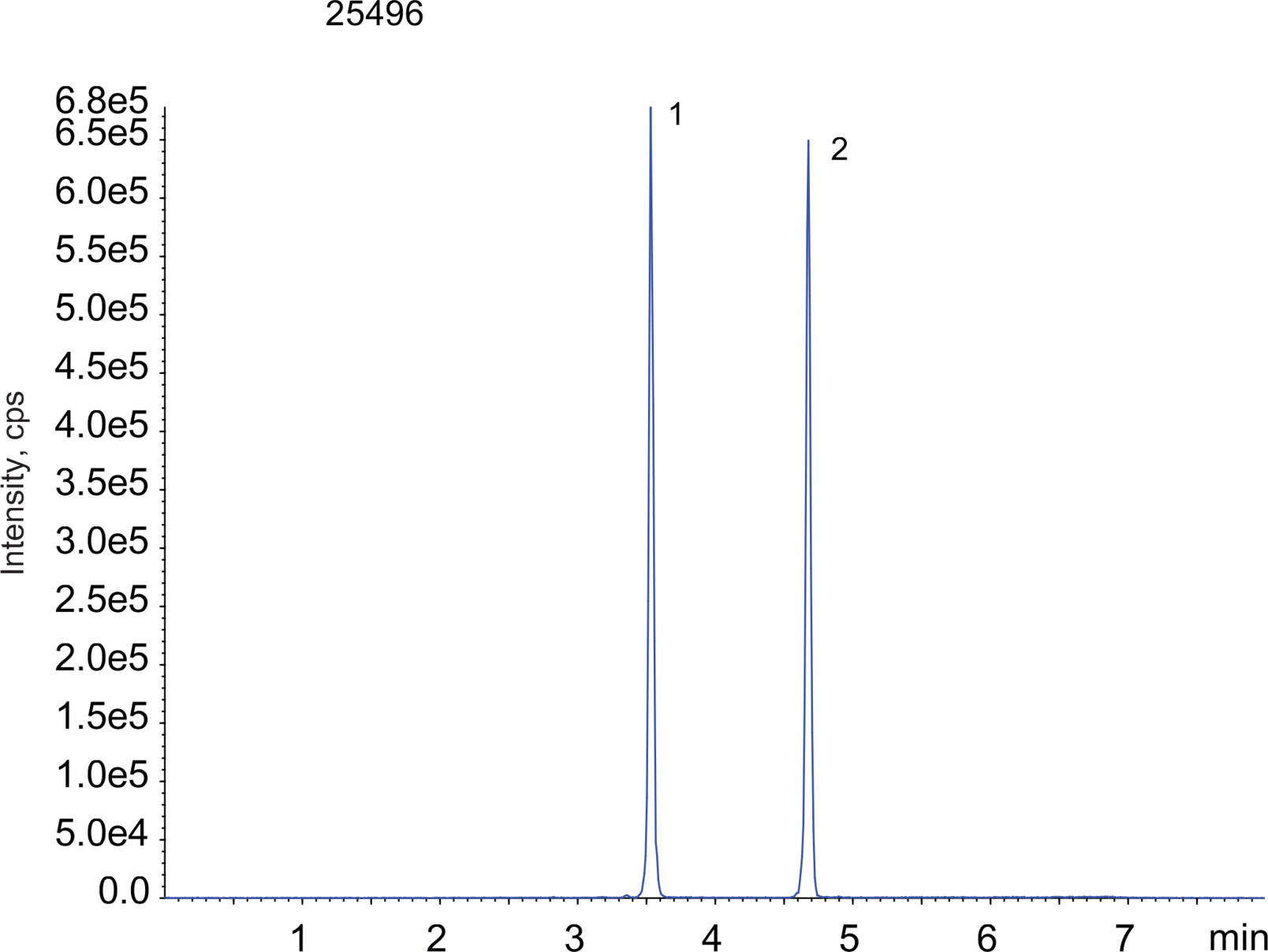
Achieve Sub-2 μm Performance within HPLC Backpressure Limitations
Columns:
Kinetex 2.6 µm C18 Traditional 1.7 µm C18
Dimension:
50 x 2.1 mm
Detection:
UV @ 254 nm
Temperature:
25 °C
Flow Rate:
0.6 mL/min
Mobile Phase:
Acetonitrile / Water (50:50)
Sample:
0.5 µL test mixture
Acetophenone
Benzene
Toluene
Naphthalene
Uniform Particle Size Distribution
Every step in the manufacturing process of Kinetex Core-Shell columns is tightly controlled for:
Comparative separations may not be representative of all applications.
Top 5 Pros of Kinetex Core-Shell Technology
Productivity: Kinetex Core-Shell Technology significantly enhances method productivity with minimal effort. By simply replacing traditional, fully porous columns with Kinetex HPLC columns, users can achieve better resolution, sensitivity, and overall productivity without extensive method redevelopment. This easy switch allows for immediate improvements in chromatographic performance, making it a cost-effective upgrade to existing methods.
PortabilityThe Kinetex Core-Shell columns are available in a range of particle sizes (1.3 µm to 5 µm), which ensures method portability across different HPLC and UHPLC systems. This scalability allows for consistent retention and selectivity across various particle sizes while accommodating different backpressure levels, making it easier to transfer methods between instruments.
Performance Kinetex Core-Shell Technology delivers superior chromatographic efficiency compared to fully porous particles. This efficiency boost enables chromatographers to maximize the performance of their HPLC/UHPLC systems, ensuring optimal results with higher resolution and sharper peaks, even under similar method conditions.
Phases With 11 unique phase selectivities available, Kinetex Core-Shell Technology offers unmatched versatility for method development. This wide selection of phase chemistries allows for tailored separations and simplified optimization, ensuring the best possible results for a wide range of applications.
Pressure Kinetex Core-Shell columns provide higher efficiency at lower system backpressures compared to fully porous columns. This allows users to achieve superior chromatographic performance on conventional LC instruments without the need for ultra-high-pressure systems, making it a practical choice for routine analyses.
Chromatography is the separation of components in a mixture based on their chemical nature. Chromatography can be performed in either liquid (HPLC) or gas (GC) forms. Liquid chromatography, specifically High Pressure Liquid Chromatography (HPLC), involves a stationary phase (sorbent), a mobile phase (liquid) and the analyte or compounds of interest. Analytes or compounds of interest are injected onto an HPLC column (packed with sorbent that contains a variety of chemistries) in mobile phase. As the mobile phase, which is carrying the analyte or compounds of interest, travels across the stationary phase, the analyte or compounds of interest separate from each other as they interact with the stationary phase, each eluting from the column at various times. Gas chromatography (GC) is similar to HPLC in that is utilized with working analytes or compounds of interest that can be vaporized without decomposing. In GC, gas is used instead of a liquid (like in HPLC). As analytes or compounds of interest travel in the gas mobile phase and interact with the stationary phase, eluting at various times.
Does high pH mobile phase reduce the sensitivity of basic analytes in LC-MS?Asked Mar 01, 2022
Using high pH mobile phase, the retention of polar bases will be increased. Signal response does depend upon ionization state, so if we use high pH, we are actually de-ionizing our bases and should lose sensitivity. But this doesn’t happen actually. When we increase the retention of the polar base analytes using high pH, it elutes later in the gradient run and in a high percentage of organic (acetonitrile or methanol). For example, when using formic acid, the polar base analyte peak is eluting in about 5-10% acetonitrile, but when we switch to pH 10, the polar base analyte peak is coming off in about 30-40% acetonitrile. The increased % of acetonitrile in the source is what allows the ions to be ionized thoroughly, thereby giving you a better response in ESI-MS.
I have switched from a 5 µm fully porous column to a 2.6 µm Kinetex core-shell column but am seeing a loss of sensitivity, how can I overcome this?Asked Feb 23, 2022
When switching to a higher efficiency material such as Kinetex, you must take steps to ensure your detector scan rate has been adjust appropriately to accommodate the narrower peak widths that the Kinetex column will generate. A detector scan rate of 1Hz will generate 1 data point per second so for a 20s wide peak is sufficient to ensure you do not see flattening of your peak at the apex. When you move to a more efficient media with narrower peaks you must turn up the detector scan rate to accommodate the narrower peak width and prevent loss of the apex of the peak which can appears as a loss of peak efficiency.
Do phenyl columns suffer from "hydrophobic phase collapse"?Asked Mar 23, 2022
Due to the polar nature of phenyl phases they can be used under 100% aqueous mobile phases without the user being concerned about phase collapse.
How does HILIC chromatography compare to Normal Phase, Reversed Phase, and Ion Chromatography?Asked Mar 22, 2022
Like normal phase HPLC, HILIC employs traditional polar stationary phases such as bare silica, cross-linked diol, amino or cyano, but the mobile phase used is similar to those used in the reversed phase HPLC mode. The components in a HILIC mobile phase are the same as reversed phase, however acetonitrile is the major component and water is the minor component. So, HILIC is also known as an aqueous normal phase. HILIC also allows for the analysis of charged substances, similar to ion chromatography.
When conducting cannabis analysis, how can you prevent the acetonitrile used in potency analysis from contaminating laboratory air and interfering with residual solvent analysis?Asked May 27, 2022
There are many potential sources and solutions: Put caps with filters or sorbent traps on your HPLC mobile phase bottles and solvent waste receptacles; don’t leave residual acetonitrile in pipette barrels; do all your potency extractions and standard preparations in a fume hood; and if you are using a triple quad MS for pesticide analysis, don’t discharge the vacuum exhaust from the ionization source into the lab.
Which C18 columns are most appropriate for preparative separations?Asked May 09, 2017
Phenomenex has a variety of preparative C18 columns to choose from. If the you are looking for a material that can handle large sample volumes then Luna C18(2) would be the best option. Gemini NX-C18 offers extended pH stability for high pH analyses and a different selectivity to Luna C18(2). Kinetex core-shell columns are best suited for those who are looking for high efficiency preparative applications often where closely eluting impurities pose a problem. Kinetex C18 is also fully scalable from UHPLC to Prep so it is perfect for labs that require the same selectivity across multiple particle sizes. Luna Omega Polar C18 and PS C18 offer a different selectivity to more traditional C18 phases and would be ideal for analysts who need a different selectivity or greater retention of polar compounds.
What are the solvents that can be used in HILIC chromatography?Asked Mar 23, 2022
In any form of chromatography, the mobile phase is composed of a weaker and stronger component. In HILIC chromatography, acetonitrile is the weaker component while water is the stronger component. The relative strength of solvents in HILIC mode is as follows: Acetone < Isopropyl alcohol < Acetonitrile < Ethanol < Dioxane < Dimethylformamide = Methanol < Water
What should I consider when chosing between Kinetex phenylhexyl, biphenyl and F5?Asked Jul 21, 2020
Kinetex phenylhexyl is best suited to the separation of aromatic compounds which are relatively hydrophobic. It can also be used as an alternate selectivity to a C8 or C18, retaining compounds to a similar extend compared to a C8, but with the additional pi-pi interations allowing for aromatic positional isomers to be separated. Kinetex biphenyl is more applicable to polar aromatic compounds, and will also offer a good degree of shape selectivity. Kinetex F5 is the most polar phenyl phase, due to it's highly polar nature and the interactions it can undergo with analytes it is the best option for analyzing highly polar analytes, and those compounds which differ in terms of pi electron structure.
What changes are allowed to USP / EP gradient HPLC methods?Asked Feb 16, 2022
When using a gradient method, no change may be made to particle size or column dimensions. They must be the same as those directed in the monograph.
What is the typical operating backpressure for Kinetex 5 µm columns?Asked Mar 01, 2022
The expected back pressures generated by a Kinetex core-shell column should be approximately what is observed with a column packed with fully porous particles of the same diameter. The observed backpresure for a given method will depend on column dimension, flow-rate and solvent composition. That said, backpressures are typically less than 250 bar. Kinetex 5 µm columns are rated to withstand pressures up to 600 bar.
What is the approximate loading capacity of Kinetex 1.3 µm C18?Asked Mar 01, 2022
As with any column, loading capacity of Kinetex 1.3 µm C18 depends on a number of variables: the chemical nature of the analyte (acid, base, or neutral) the running conditions (mobile phase and flow rate, temperature) the dead-volume system of the system the method limitations for the specific method (one customer may find that a 10% increase in peak width is unacceptable, while another may not mind a 40% increase in tailing as a function of overload). That said, in general, loading capacities for the same media is independent of particle size (i.e. a 3 µm media should have the same loading capacity as a 5 µm media of identical base media and surface chemistry). So, in general, one would predict that the loading capacity of Kinetex 1.3 µm would be identical to that of similar core-shell C18 columns.
We and our partners use cookies and other tracking technologies and some of the data you directly provide to us such as your contact details to improve your experience of using our website, provide you with personalized ads and content based on your interactions with these and other websites, allow you to share content on social media, to perform analytics and measure the effectiveness of our advertising campaigns. By clicking “Accept All Cookies”, you consent to this and to the sharing of this data with our partners (find the link below). You can change your consent preferences at any time in the “Cookie Settings” section at the bottom of our website. Review our Cookie Notice to learn more about our practicesCookie Notice