Solid Phase Extraction (SPE) Columns & Cartridges

What Is Solid Phase Extraction (SPE)?

Solid Phase Extraction (SPE) is a sample preparation extractive technique used in laboratories to clean-up, solvent switch, and concentrate samples prior to analysis, particularly with methods like high-performance liquid chromatography (HPLC) or gas chromatography (GC). Solid phase extraction is essential for getting specific separations in complex mixtures by isolating target analytes while removing unwanted contaminants, which helps achieve more accurate and precise analytical results.

Phenomenex offers advanced sample preparation with its wide selection of SPE products, engineered for exceptional reliability and precision in analytical testing.

Phenomenex’s SPE products, with their targeted selectivity and robust capabilities, are crucial in producing cleaner samples to reduce interferences and premature column failure. This, in turn, significantly improves the accuracy and precision of HPLC and GC analyses, making them indispensable tools for achieving high-quality analytical results.

Overview

How Does Solid Phase Extraction Work?

Solid phase extraction is a highly effective method utilized in chromatography for preparing samples for further analysis. It involves multiple steps designed to isolate specific analytes from complex or dirty mixtures, resulting in cleaner, more concentrated samples, and suitable for accurate analysis. The process is straightforward, following a sequence of steps: condition, equilibrate, load, wash, and elute. Each step is essential in ensuring targeted selectivity, versatility, and can be used in conjunction with automation to ensure further optimization, but some types of sorbents may require additional steps or even fewer steps for a clean sample.

Standard SPE Protocol:

  • Condition

    The first step in SPE is conditioning the sorbent within the extraction cartridge, well or column. This step activates the sorbent, typically using a weak organic solvent, ensuring it is ready to interact with the sample analytes.

  • Equilibrate

    After conditioning, the sorbent is equilibrated using a solvent that matches the polarity of the sample matrix. This step stabilizes the sorbent environment, preparing it for the sample mixture.

  • Load

    The dirty sample is loaded onto the conditioned and equilibrated sorbent. As the sample passes through, the analytes of interest are selectively retained on the sorbent based on chemical interactions, while unwanted components either pass through or are weakly retained. Selecting the correct sorbent is crucial for ensuring the analytes are tightly retained on the sorbent in this step.

  • Wash

    In this step, the sorbent is washed with a stronger solvent than the loading mixture to remove weakly bound impurities or matrix interferences. The washing solvent is chosen that retains the target analytes on the sorbent while flushing out contaminants. There can be multiple wash steps to ensure cleanliness.

  • Elute

    Finally, the retained analytes are eluted from the sorbent using a solvent that disrupts their interaction with the sorbent, usually a strong organic solvent. This solvent is stronger than the wash step, so the analytes bound to the sorbent are released and eluted into the collection vial or 96-well plate. The eluted analytes are now purified, ready for analysis by techniques like HPLC or GC. Depending on the elution solvent volume, the final mixture can be more concentrated. If the final eluent is not compatible with the LC or GC conditions, then additional solvent switching and concentration can occur through evaporation and reconstitution in suitable sorbent.

Benefits of Using Solid Phase Extraction

The principles of solid phase extraction, a fundamental technique in sample preparation, revolve around selectively isolating specific analytes, making SPE a crucial step in many laboratory workflows. Here are the key benefits of using SPE:

  1. Targeted Selectivity: The principles of solid phase extraction emphasize the ability to retain and isolate specific analytes from complex mixtures selectively. By using a solid phase extraction cartridge, SPE ensures that the compounds of interest are captured while impurities and unwanted substances are effectively removed. This targeted selectivity leads to cleaner samples, which is essential for accurate and reliable analytical results.
  2. Versatility: SPE is highly versatile and can be applied to various sample types, viscosities, and volumes. Solid phase extraction cartridges are available in multiple tube or 96-well plate sizes with variable sorbent volumes to accommodate different needs, whether working with small biological samples or large environmental matrices. This versatility allows SPE to be used across various industries, including pharmaceuticals, environmental testing, food safety, and many others.
  3. Easy Automation: SPE is well-suited for automation, allowing for the streamlined processing of numerous samples with minimal manual intervention. Automated SPE systems use solid phase extraction cartridges or 96-well plates to handle large sample batches quickly and consistently, making SPE an ideal choice for high-throughput laboratories where speed and accuracy are essential. Automation includes the use of additional equipment or robots that are programmed for specific product measurements and protocols.

Phenomenex SPE Cartridges

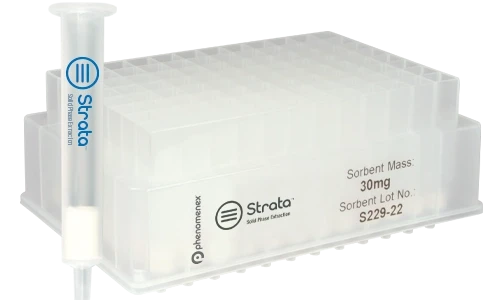
Cartridges, often referred to as tubes, are small, cylindrical containers filled with a specific type of SPE sorbent material used to capture, retain, and isolate target analytes from a sample. Phenomenex SPE cartridges stand out for their high performance and consistency in delivering clean, concentrated samples ready for analysis. They come in a variety of volumes, even going up to 150 mL Giga Tubes for large volume formats.

Smaller tubes are often used for limited sample volumes typically seen in clinical and pharmaceutical applications. On the other hand, larger cartridges and Giga tubes are commonly used in environmental and food applications, where higher sample volumes need to be processed.

For different sample sizes, Phenomenex offers several types of solid phase extraction cartridges, each tailored to specific sample preparation needs. Here’s an overview of some of the most popular options:

  • Strata

    Strata™ SPE is a silica-based sorbent platform engineered for reliable clean-up and concentration across a wide range of analytes. The line includes normal-phase, reversed-phase, ion-exchange, and specialty chemistries, giving users flexible options for diverse sample preparation needs.

    Strata solid phase extraction cartridges are available in multiple formats including 1, 3, and 6 mL tubes and large-volume Giga Tubes (12–150 mL)—making them suitable for workflows ranging from small biological samples to large environmental extractions.

    Designed for consistent retention and strong recoveries, Strata is a dependable choice for routine purification, method development, and application-specific workflows.

  • Strata-X

    The Strata-X line features polymeric-based sorbents designed for targeted selectivity of analytes in complex matrices such as biological fluids, food samples, and environmental materials. The polymeric structure of Strata-X cartridges enhances their durability and allows for more efficient retention and elution of analytes with stronger solvents being used due to a wide pH range (1-14). The solid phase extraction cartridges are available in various formats like Strata, including 1, 3-, 6-, 12-, and 20-mL tubes, as well as Giga tubes up to 150 mL and on-line cartridges, providing flexibility for different analytical workflows.

  • Strata-X Pro

    Strata-X PRO combines polymeric sorbent technology with advanced matrix removal features, enabling rapid and effective cleanup of analytes. These cartridges are designed for high-throughput environments and allow for a streamlined, 2- or 3-step SPE process. Strata-X PRO is particularly beneficial for laboratories dealing with challenging sample matrices, where quick and thorough extraction is essential. They are available in tubes, 96-well plates, Giga tubes, and 96-well microelution plates.

    Phenomenex also offers 96-well plates designed for high-throughput laboratories where rapid and efficient sample processing is essential. These plates enable the simultaneous extraction of multiple samples, making them ideal for clinical, pharmaceutical, and bioanalytical applications.

Why Choose Phenomenex Solid Phase Extraction Cartridges?

Phenomenex SPE cartridges stand out for their high performance and consistency in delivering clean, concentrated samples ready for analysis. These cartridges are engineered to ensure optimal interaction between the analytes and the sorbent, maximizing recovery rates while minimizing the presence of unwanted contaminants. Whether dealing with small-volume biological or large-scale environmental samples, Phenomenex provides a solid phase extraction cartridge solution tailored to your needs.

In addition to their superior performance, Phenomenex solid phase extraction cartridges are designed for ease of use, supporting manual and automated workflows. This flexibility makes them a preferred choice in laboratories requiring reliable, reproducible results across various applications. Using Phenomenex SPE cartridges, laboratories can achieve high-quality solid phase extraction, ensuring precise and accurate outcomes in their analytical processes.

Learn more in our Complete Guide to Solid Phase Extraction (SPE).

FAQs

What is the solid phase extraction method?

The solid phase extraction (SPE) method is a sample preparation technique that isolates and concentrates target analytes from complex mixtures by passing the sample through a solid sorbent material. This material retains the analytes while removing matrix impurities, enhancing the accuracy and precision of subsequent analytical analyses.

What are the benefits of solid phase extraction?Solid phase extraction (SPE) offers targeted selectivity for isolating analytes, ensuring cleaner samples by removing unwanted contaminants. It is versatile for handling various sample volumes and can be easily automated for high-throughput processing, enhancing both efficiency and accuracy in analytical workflows.

How do I choose a solid phase extraction?

Choosing a solid phase extraction method involves selecting the appropriate sorbent material and cartridge format based on the specific requirements of your sample and analytes. Consider factors such as the nature of your sample matrix, the target analytes' chemical properties, desired sensitivity, and the volume of samples to be processed. Additionally, assess whether you need manual or automated processing and the compatibility of the SPE method with your analytical instrumentation.

FAQs

Since you may not know beforehand which samples have high solvent levels, we recommend having a second GC instrument with an FID detector to screen incoming samples prior to GC-MS analysis to identify “hot” samples. This allows you to adjust the split ratio for the quantitative analysis and avoid detector saturation. This is particularly important when dealing with samples of unfamiliar origin.
Sorbent-analyte interactions take place inside the pores. The average pore size of regular polymeric and silica-based SPE material is 60-85 Å, which restricts access for molecules larger than 15 kDa. Analytes must be able to fit in the pores in order to interact with the sorbent. Large pore sorbents are available in 260-300 Å for molecules with molecular weights >15 kD.
Absolute recovery is the amount of analyte recovered from the matrix versus the unextracted standard. Consistency of this value is important and generally speaking, >65% is ideal. Relative recovery is the amount of analyte recovered from the matrix with reference to a spiked internal standard that went through the same extraction conditions.
For residual solvents you definitely need to use GC-MS for accurate analysis. And, if you have the budget, you should go with GC-Triple Quad MS. In residual solvent analysis you have a lot of analytes with similar structures and the potential for a lot of matric interference, so MS is crucial for identifying the right compound. With GCFID you only have your reference standard, and you can’t authenticate or confirm a sample result. Even with MS, residual solvent analysis in cannabis at low levels of detection is very challenging and you need all the instrumentation power you can get.
Different diluents require different equilibrium temperatures and equilibrium times, but the transfer line temperature will be the same. If you are using water, you should limit the equilibrium temperature to 80°C and allow 45-60 minutes for complete equilibration of high boiling analytes, but keep the transfer line at 175°C to ensure complete transfer. For higher boiling diluents like DMAC or DMSO you can use a higher equilibrium temperature but shorter time. For all three diluents, however, a transfer line temperature of 175°C works well.
The max operating temperature for Verex Filter Vials is 50°C (120°F)
A traditional 10 mg 96-well plate SPE format uses a 200 µL elution volume to elute the analyte. In a microelution 96-well plate format, a 25 µL elution volume is used. So a traditional format results in a sample that is 8-15 times more diluted when compared to microelution 96-well plates. This means that the more concentrated sample that was prepared by microelution yield 8-15 times higher peak intensity as compared to a traditional 10 mg format.
Verex Filter Vials are composed of two pieces: the external vial and the internal plunger with an integrated filter membrane (RC, PTFE, NY, PES, or PVDF) and PTFE/Silicone preSlit snap cap. The unfiltered sample is first transferred into the external vial. Then the internal plunger with the cap is pressed into the external vial containing the sample. This forces the sample through the membrane and into the internal plunger’s housing. This produces a quick and easy particulate-free sample ready for analysis. In short, first dispense the sample into the external vial, press down the internal plunger to filter, and then place in the autosampler!
The residual solvent analytes will indeed all elute within the 180 to 200°C window. However, the higher temperature runup is needed because the matrix is “sticky” with terpenes and other semi-volatile and non-volatile compounds. These can cause contaminant carryover effects in subsequent analyses, especially with MS detectors. To eliminate the carryover problem, we recommend taking the final temperature of the column and transfer line to 300°C, rather than 240°C. The high temperature stability of ZB-624plus allows this more aggressive instrument “bakeout”.
First, you need to choose a column that has a very thick stationary phase, such as a 0.25mm ZB-624plus™ column with a 1.4 micron film thickness. Then you need to increase your split ratio, so you don’t send too much analyte onto the column. Also, start the run at a lower temperature, like 30 or 35°C, to provide enough focusing time for on-column separation. Finally, for the low boiling analytes, you should back off a bit on the flow rate.
Protein precipitation results from changing the solubility of the protein in solution by the addition of various precipitants such as organic solvent, metal ion, acid, and salt. Precipitation by organic solvent or acid is most commonly used. Organic solvent solvates the hydrophobic region on the protein surface and displaces water molecules. This causes an increase in electrostatic interactions, encourages attraction between charged molecules, and proteins aggregate as a result; this reduces their solubility, causing precipitation. Acids form insoluble salts with proteins, causing precipitation.
Another troublesome group of compounds are those that are very hydrophobic such as peptide therapeutics. Peptides have been known to have a great affinity for plastic ware and can stick to collection vessels if subjected to a dry down step, making it extremely difficult to recover them for further analysis. In microelution, since the samples are eluted using minimum solvent there is no need to dry down and reconstitute.