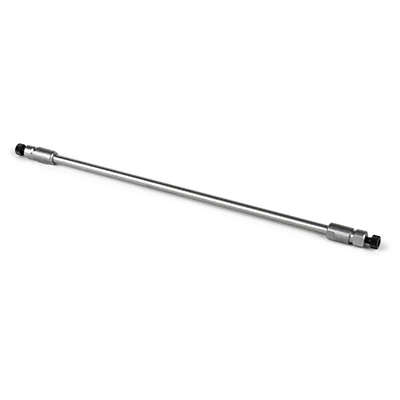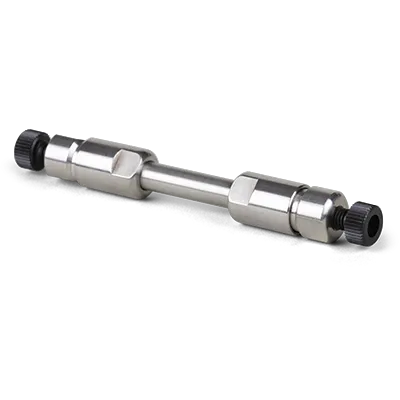


Rezex RNM-Carbohydrate Na+ Ion Exclusion HPLC Columns

  • 8% cross-linked sodium
  • For the analysis of matrices containing high concentrations of inorganic sodium (e.g. molasses)
  • Analysis of mono-, di-, and tri- saccharides
  • Easy to regenerate the original ionic strength
  • USP L58
Particle Size
8
Recommended Use
Analysis of mono-, di-,and tri- saccharides and for matrices which contain high concentration of inorganic sodium

Order

Select Attributes:

Internal Diameter (mm)

7.8

Length (mm)

50

150

300

Particle Size (µm)

8

Showing 1-3 of 3 Results
$2,224.00 USD (Ea)

Sign In

$2,379.00 USD (Ea)

Sign In

$622.00 USD (Ea)

Sign In

Overview

Cross Reference Guide

Phase


Description

Applications

Bio-Rad® Aminex®

Supelco® Supelcogel™

Waters® Sugar-Pak™

Transgenomic® CARBOSep™

Sepax® Carbomi®

RNM-Carbohydrate

(USP L58 packing)

8 %
cross-linked

SODIUM

  • Analysis of mono-, di-, and tri- saccharides
  • For matrices which contain high concentration of inorganic sodium (i.e. molasses)
HPX-87N125-0143N/AN/AN/ACarbomix Na

Retention Times for Some Carbohydrates and Sugar Alcohols

Counter Ion Analyte

RNM Na+

Adonitol (Ribitol)11.10
D-Altrose11.45
D-(-)-Arabinose12.65
D-(+)-Cellobiose 8.49
D-(+)-Digitoxose11.39
Dulcitol11.10
Meso-Erythritol11.78
D-(-)-Fructose11.76
L-(-)-Fucose12.30
D-(+)-Galactose11.47
Gentiobiose8.40
D-(+)-Glucose10.71
Inositol12.14
Isomaltose 8.76
Lactose8.78
Lactulose9.23
D-Lyxose11.98
Counter Ion Analyte

RNM Na+

D-Maltose8.75
Maltotriose7.94
Maltulose8.82
D-Mannitol 10.80
D-(+)-Mannose11.54
Melibiose8.82
D-(+)-Melezitose7.66
D-(+)-Raffinose7.76
L-(+)-Rhamnose11.00
D-(-)-Ribose14.34
Salicin17.36
D-Sorbitol 11.39
Stachyose7.30
Sucrose 8.65
Trehalose8.49
Xylitol12.16
D-(+)-Xylose11.68

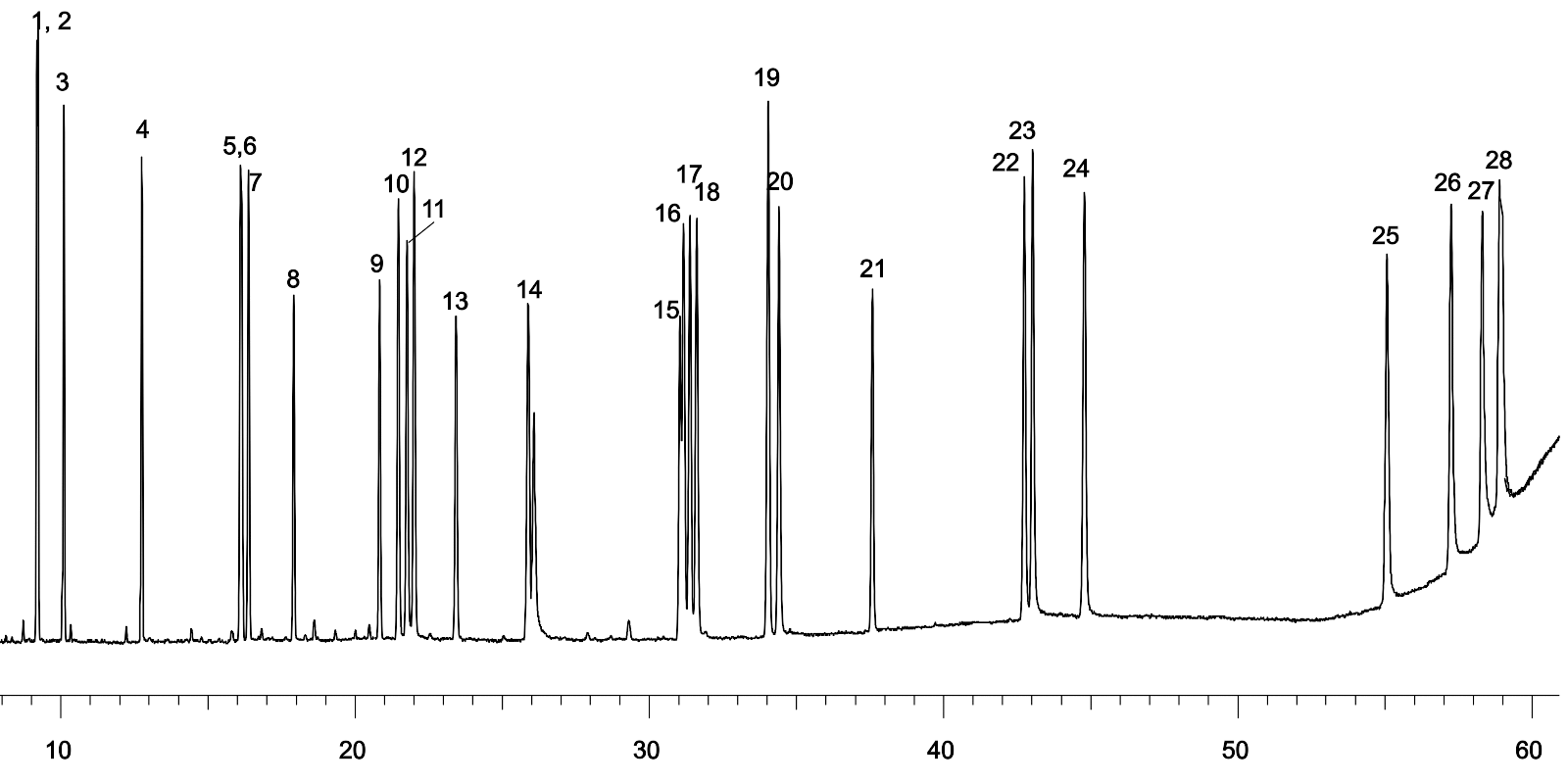
Select Applications on Rezex RNM-Carbohydrate Columns

Carbohydrates

Column:

Rezex RNM-Carbohydrate

Dimension

300 x 7.8 mm

Flow Rate:

0.6 mL/min

Temperature:

75 °C

Detection

RI

Mobile Phase:

Water

Part No.:

00H-0136-K0

Sample:

1. Stachyose
2. Cellobiose
3. Glucose
4. Fructose
5. Arabinose
6. Ribose
7. Salicin
(1 % solution of each)

Applications (partial list)

Call us for assistance in selecting the right column for your needs!

Compound

App ID No.

Arabinose

5510

D-Cellobiose

5510

Fructose

5510

Glucose

5510

Compound

App ID No.

Ribose

5510

Salicin

5510

Stachyose

5510

Specifications and Operating Recommendations

RAM Carbohydrate

Part No.

00H-0136-K0

Ionic Form

Sodium

Standard Dimensions

300 x 7.8 mm

Matrix

Sulfonated Styrene Divinyl Benzene

Cross Linking

8 %

Particle Size (μm)

8

Min. Efficiency (p/m) based on last peak

30,000

Typical Pressure (psi @ Testing Flow Rate)

170

Max. Pressure (psi @ Max Flow Rate)

1,000

Max. Flow Rate (mL/min)

1.0

Max. Temperature (°C)

85

Typical Mobile Phase

Water

pH Range

Neutral

Guard Column Part

03B-0136-K0

Cleaning, Regeneration and Storage

Organic Modifiers (Max)

5 % Methanol, IPA, EtOH

Inorganic Modifiers

5 % Sodium Salts

Avoid

Acids, Bases, Non-Sodium Salts or Metal Ions, > 30 % Acetonitrile

Cleaning Solvent

100 % Water

Flow Rate(mL/min)

0.4

Temperature (°C)

85

Duration (hrs)

12

Regeneration Solvent

0.1 M NaNO3

Flow Rate (mL/min)

0.2

Temperature (°C)

85

Duration (hrs)

4-16

Ship/Storage Solvent

Water

FAQs

DNA, RNA, miRNA, siRNA, phosphorothioates, LNA, single stranded, duplexed, and encapsulated oligonucleotides. As long as there is a phosphodiester or phosphorothioate backbone the extraction protocol should provide excellent clean-up and recovery
The mechanism for sugar separations is a mixture of size exclusion and affinity of the sugars towards the metal ion associated with the phase. The sugars form complexes with the metal ion, the strength of which dictate their order of elution from the column.
Proper care of an HPLC is critically important for lifetime of a Rezex column. Removing organic solvent from the fluid lines as well as the needle wash prevents the column from being subjected to a slug of high organic solvent that can kill a column. Similarly, metal bound Rezex columns (RCM, RPM, RAM, RSO, and RNM) are sensitive to acidic conditions and buffer salts that used for other HPLC separation. Finally, microbial contamination of mobile phase and the HPLC are a constant concern for using Ion Exclusion columns. Mobile phase should be changed frequently and the system should flushed from time to time with organic or dilute nitric acid (of course with the column removed) to reduce microbial contamination (see your HPLC manufacturers guide to use their preferred cleaning procedure).
Absolutely, we're always here to help! You can easily get in contact with our team members by clicking contact us on the menu or better yet, just head to www.phenomenex.com/chatnow and we'll help you out with method recommendations and tips.